
Published November 27, 2026
On November 27, 1912, the U.S. Army Signal Corps accepted its first flying boat from the Curtiss factory. The Army identified it as Signal Corps No. 15. What set this airplane apart from the Army’s earlier experiments with water flying was the shape and purpose of its fuselage. The central body went into the water and carried the crew. With the aircraft afloat, the pilots were sitting in the boat itself. Air University chronology
A boat shaped to become an airplane
In a floatplane, floats support the aircraft while keeping the fuselage above the water. A flying boat uses a watertight hull as the main body of the airplane. Both concepts need to support the aircraft at rest and move through the water until the wings generate enough lift for takeoff. Curtiss experimented with both approaches. The Smithsonian traces his flying boats from work on a modified float through a succession of designs with integral hulls. The more numerous Model F grew out of that experimental work. Smithsonian National Air and Space Museum
At rest, the hull carried the airplane’s weight by displacing water. During takeoff, the pilot had to accelerate through a surface that could change from smooth to choppy while the airplane moved across it. The hull had to support that transition as well as serve as part of an aircraft once clear of the water. That combination gave designers a reason to think about the airframe, its balance and the shape of the boat together. The dock and the stretch of water beyond it became part of the operating environment.
Training beside the instructor
No. 15 was shipped to San Diego in December 1912, according to the official history of the early Army air arm. It joined the Signal Corps aviation school at North Island. The history describes a Curtiss machine with two seats and dual controls, arranged so the instructor could sit beside the student. That placement allowed both people to see the same water ahead and gave the instructor a way to demonstrate what the airplane did as it gained speed. The United States Army Air Arm, 1861–1917
Side-by-side instruction gave the flying boat a role beyond showing that an airplane could leave the water. A student had to learn to handle it before the wings could do much of the work. The takeoff run started with the airplane behaving like a boat and finished with the instructor and student managing an aircraft in flight. The return required another judgment about how the hull would meet the water. A machine that could be shared by instructor and student gave the school a way to teach both ends of that process.
What the acceptance date records
Air University’s chronology calls No. 15 a Model F. The Smithsonian’s technical reference finding aid indexes photographs of S.C. No. 15 under Curtiss E-Boat. The aircraft number identifies the Army’s machine across those different labels, while the chronology supplies the acceptance date. That distinction matters in a period when Curtiss developed several flying-boat designs in close succession. Smithsonian aircraft technical reference files
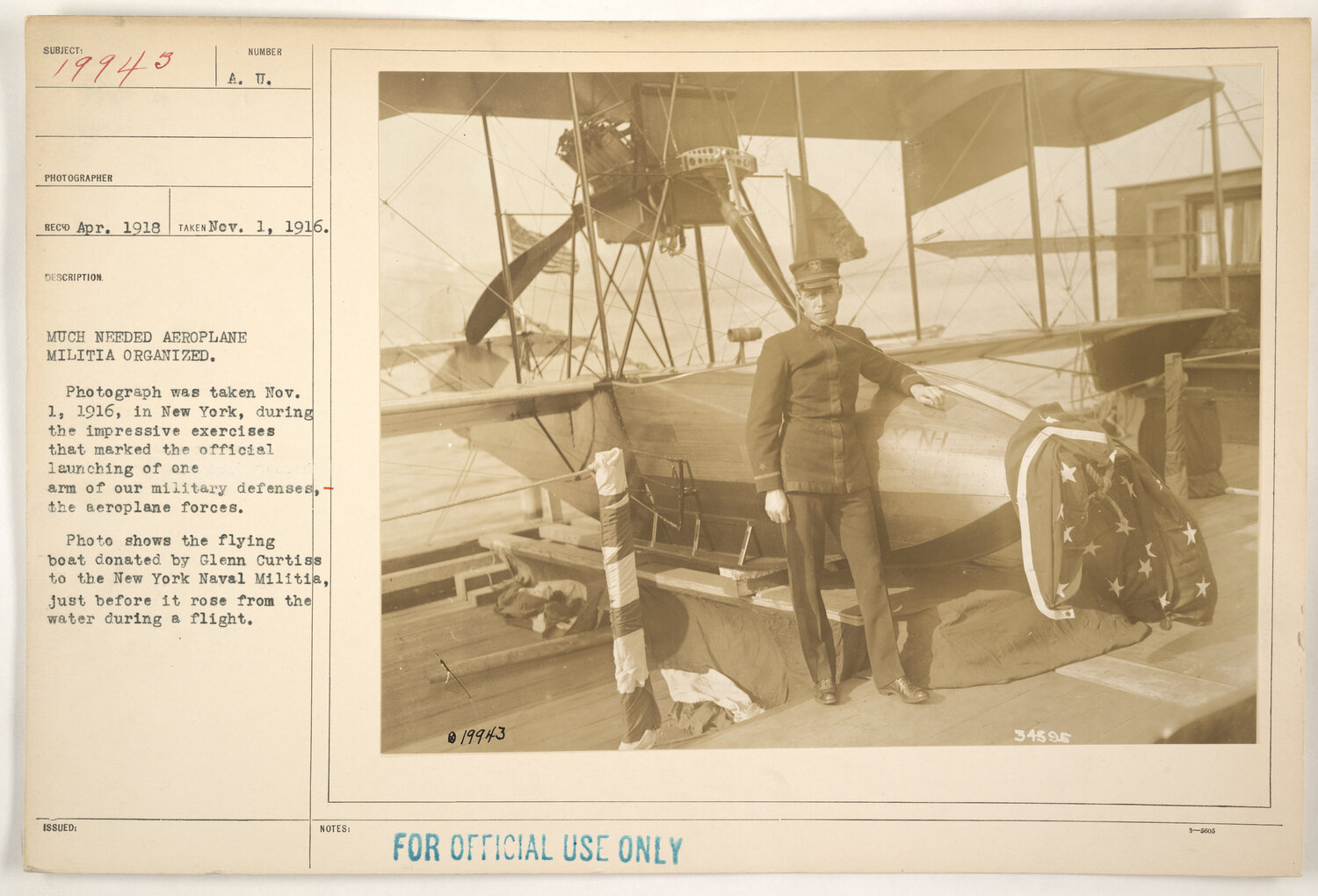
The November acceptance marks an Army decision to acquire flying-boat technology. The subsequent move to San Diego put that purchase in the hands of a school with a place to fly it and students to train. The photograph above shows a later Curtiss flying boat in New York in 1916. It illustrates the arrangement that made the type recognizable, with the crew carried low in the hull and the wings and engine mounted above.
Featured photograph — Curtiss flying boat donated to the New York Naval Militia, November 1, 1916. National Archives, 111-SC-19943, public domain. Photo record and reuse rights
Sources
Air University — Enlisted aviation chronology
U.S. Air Force historical study — The United States Army Air Arm, 1861–1917






No comment