
Published November 24, 2026
A Douglas DC-3 freighter bound for Wellington made the first scheduled departure from the new Auckland International Airport at 7 a.m. on November 24, 1965. An Air New Zealand Douglas DC-8 followed at 9:15 a.m., carrying 129 passengers to Sydney on the inaugural passenger jet service. A Qantas Boeing 707 from Sydney made the first official jet arrival that afternoon. By the end of its first day at Māngere, Auckland’s new airport had handled domestic freight and jet services across the Tasman Sea.
Those flights mark the operational anniversary of Auckland Airport. The formal opening followed on January 29, 1966, when Governor-General Sir Bernard Fergusson inaugurated the airport. Auckland Airport’s own chronology records both dates, and the National Library of New Zealand independently dates the first international flight to November 24. The distinction helps explain why photographs of the opening celebrations are dated two months after the first passengers had departed.
From Gipsy Moths to jet airliners
Flying at Māngere had started decades earlier. The Auckland Aero Club was established there in 1928, initially relying on borrowed de Havilland Gipsy Moths before receiving another aircraft from the publishers of the New Zealand Herald. In 1937, Union Airways began commercial services from Māngere on the Auckland–Wellington route. Those early flights established a civil aviation presence at the site before it became the location of a much larger project.
By the 1950s, local officials and business leaders were studying where to build an airport that could handle both domestic and international traffic. A joint airport committee set up in 1951 brought together the Auckland Chamber of Commerce and the city council. A 1955 engineering study compared possible locations around the region, including Whenuapai and sites on both sides of the city. The government confirmed Māngere that year.
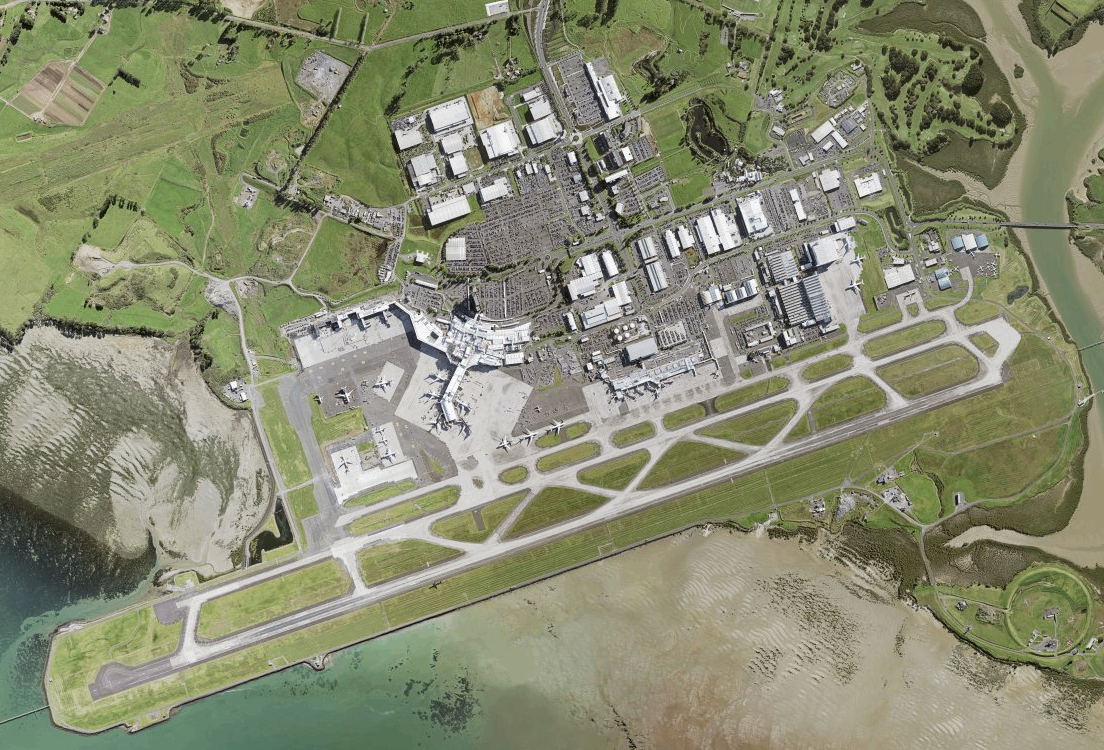
Construction began in 1960. The airport’s anniversary account puts the excavation for the main runway alone at more than five million cubic metres. The scale of that work reflects the demands of establishing a new airport on the edge of Manukau Harbour, with enough room for the aircraft already entering airline fleets and room to accommodate larger types in the years ahead.
Three aircraft tell the story of the first day
The sequence of flights captures a change in airline equipment. The National Airways Corporation’s DC-3, a piston-engined aircraft, was still useful for connecting cities within New Zealand. The DC-8 and the 707 came from a generation of jetliners that allowed carriers to offer faster international services. All three types figured in the same day of operations, and a chartered amphibian aircraft had already arrived commercially before the Qantas jet touched down.
The DC-8’s destination also mattered. Sydney was the first stop for the new airport’s inaugural passenger jet and the origin of the day’s first official jet arrival. The first schedule thus put a domestic freight link to Wellington alongside passenger traffic in both directions across the Tasman. Those details make the names and departure times in the airport’s account more than ceremonial entries. They show what the new airport was built to do from the day it went into service.
A public opening and a growing terminal
The January opening took place during a three-day air pageant. Auckland Airport reports that more than 100,000 people attended to see flying displays and aircraft on the ground. The festivities gave the public a chance to see an airport that had already been serving travellers and operators for weeks.
The original interim terminal handled both domestic and international passengers. It stayed in that role for more than a decade, until the dedicated international terminal opened in December 1977. The airport recorded more than 700,000 passenger movements in its first year. Its 50th anniversary account put the comparable figure for 2015 above 15 million, illustrating how much traffic the gateway came to handle after its first schedule.
The longer history at Māngere runs from club flying through the first Wellington service and into the jet era. November 24 marks the point at which the new airport began connecting those domestic and international operations from the same site.
Featured photograph: Auckland International Airport at Māngere in 2017. Land Information New Zealand, via Wikimedia Commons, CC BY 4.0.






No comment