
Published November 23, 2026
On November 23, 1935, Pan American Airways’ China Clipper reached Honolulu, completing the first leg of the inaugural transpacific airmail service to Manila. Captain Edwin Musick and his crew had left Alameda, California, the previous afternoon. The Hawaiʻi state aviation archive records the crew’s arrival and reception in Honolulu. The landing brought the mail across the longest stretch of open water on a route that still had four legs to go.
That geography explains why Honolulu mattered. An airplane crossing from California to Hawaiʻi had no island where it could stop midway for fuel or repairs. Once the crew reached Pearl Harbor, it could take on supplies and prepare for a series of shorter crossings. The remaining itinerary ran through Midway, Wake, and Guam before reaching Manila. Each stop made the next one possible, so a map of the route is also a map of the infrastructure Pan Am needed to establish before it could sell a regular mail service.
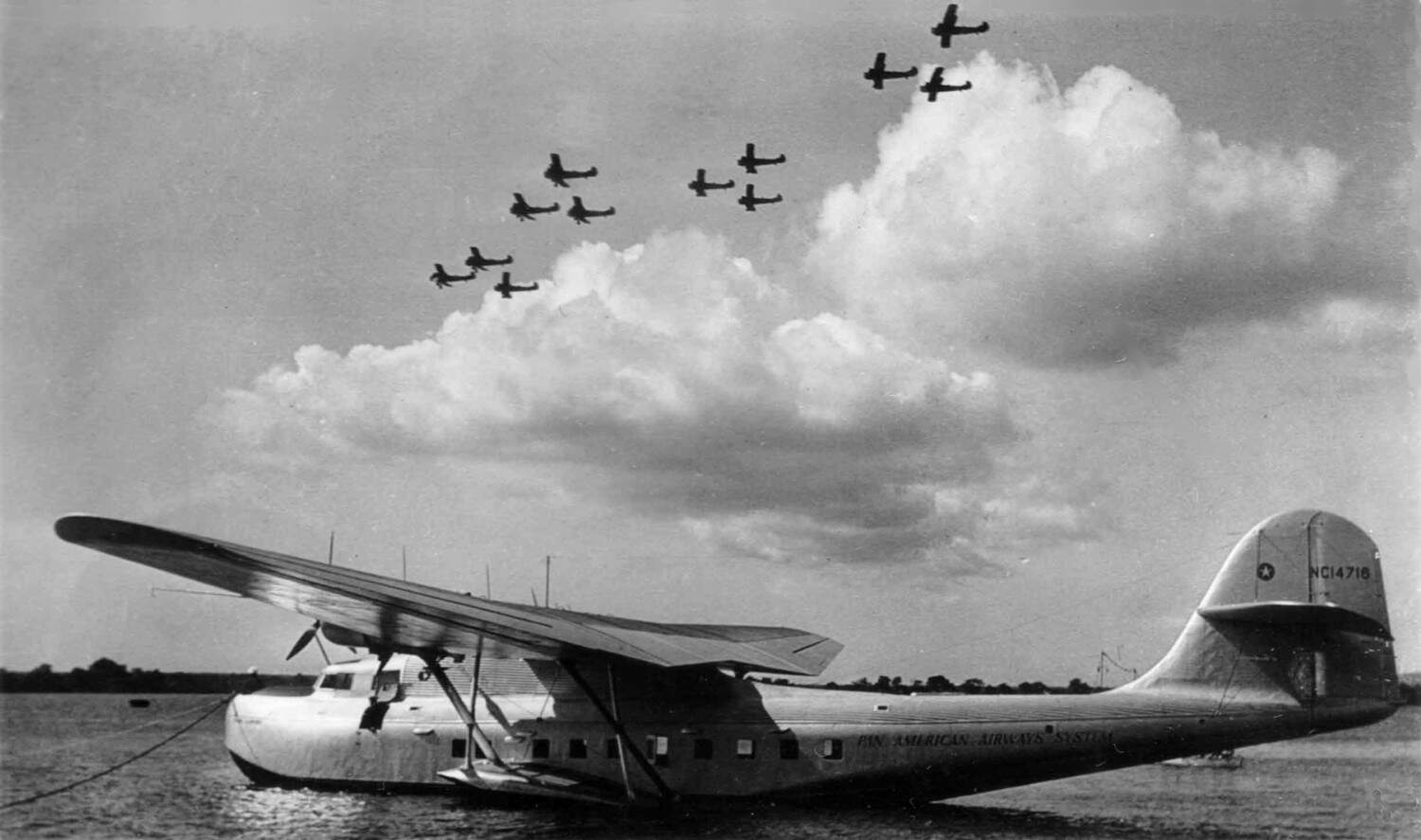
Pan Am used a Martin M-130 flying boat for the inaugural run. The aircraft carried the registration NC14716 and had a boat-shaped hull that let it take off and land on water. Harbors therefore served as terminals for a large airplane even where an equivalent land runway was unavailable. A sheltered anchorage still needed fuel, maintenance, communications, and a reliable way to move cargo between the airplane and shore. The flying boat changed where an airline could operate, while leaving plenty of work to do on the ground.
From a survey route to a mail route
The Hawaiʻi aviation history account of Pan American describes survey flights and preparations earlier in 1935. Crews had already visited Honolulu and pressed farther out across the Pacific before the November mail service began. That sequence mattered. A survey flight could establish that an airplane could reach a destination. Regular service depended on coastal and island stations being ready to receive the crew, replenish the aircraft, and send it onward again.
The cargo gave the operation a clear purpose. Mail could be sorted and carried onward at each station without requiring the comforts that an airline would later have to provide for paying travelers. For the communities along the route, the promise was a faster connection for correspondence carried across thousands of miles of ocean. For Pan Am, every completed leg was evidence that the airline could connect widely separated stations in an organized sequence.
What the Honolulu landing accomplished
The arrival on November 23 was a milestone in its own right. It gave the first scheduled transpacific airmail run a successful ocean crossing and brought the aircraft to a base from which the crew could continue. The state aviation archive records that the China Clipper prepared to leave again the next morning with cargo for the Pacific route. November 23 belongs to the California-to-Hawaiʻi crossing. November 29, when the aircraft arrived at Manila, marks completion of the full journey.
The National Postal Museum’s China Clipper account places the flight in the history of American air mail and notes the aircraft’s appearance on a stamp commemorating the route. That connection helps explain the flight’s visibility at the time. The postal system gave people a way to participate in a voyage that few could make themselves. An envelope sent over the route became evidence of where aviation could carry something ordinary, and how quickly a journey between those places might become routine.
Seen from Honolulu, the story is about the transition from an experimental crossing to a service that could keep going. The airplane’s arrival proved only one leg of the itinerary, but it was the leg that committed the crew to the broadest expanse of open water. The island stops that followed turned that crossing into a route from California to the Philippines.
Featured photograph: China Clipper at Pearl Harbor in the 1930s. National Park Service, WAPA 2505, via Wikimedia Commons. U.S. public domain. Full frame resized.
Sources
Hawaiʻi Department of Transportation aviation archive, Above the Pacific
Hawaiʻi Aviation, Pan American Airways
National Postal Museum, The China Clipper






No comment