
Published November 23, 2026
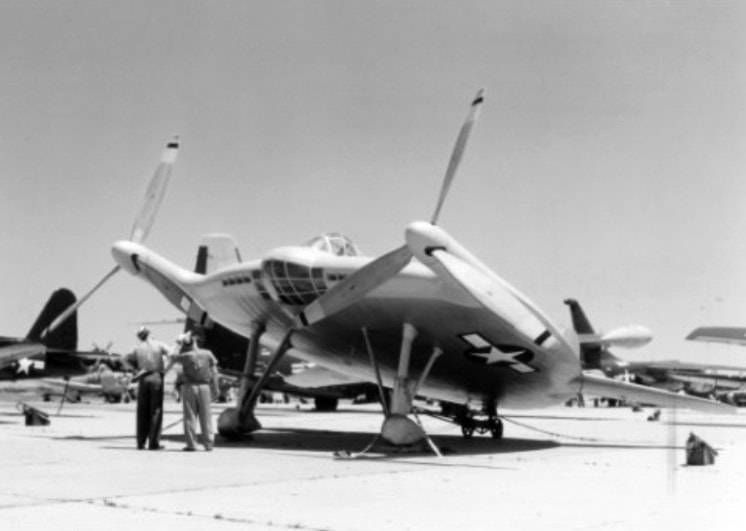
On November 23, 1942, the Vought V-173 made its first flight. The experimental aircraft had a broad, rounded body, with a propeller on each side and a cockpit set into the front of the lifting surface. The shape earned it the nickname Flying Pancake. The Navy had backed the project to find out whether an aircraft built around that unusual outline could fly slowly enough and use little enough runway to be useful aboard a carrier. The November flight began the full-scale test of that idea. Vought aircraft history
An aircraft built around a question
Charles H. Zimmerman pursued the idea in the 1930s while working at Langley Field for the National Advisory Committee for Aeronautics, NASA’s predecessor. He took it to United Aircraft in 1937 and joined its Chance Vought division that year. Vought had developed the proposal far enough to submit it to the Navy in 1939. The Navy ordered a single V-173 in May 1940. That sequence matters because the first flight came after years of design work, including time spent turning a distinctive drawing into something a pilot could actually operate.
A carrier deck made the research question practical. Runway length on land can be increased, but the deck of a ship imposes a much tighter boundary. An airplane that can remain controllable at low speed can make better use of the available space. The V-173’s shape made it possible to ask whether a very short, broad lifting surface, working with propellers placed near its edges, could do that job. The Smithsonian describes how those characteristics drew Navy interest. National Air and Space Museum aircraft record
What the first flight established
The V-173 was a proof-of-concept aircraft. Its job was to let pilots and engineers find out how the layout behaved in flight. Test pilot Boone Guyton flew it for the first time. The aircraft’s appearance was a visible sign that Vought had made a different set of choices about the relationship between the wing, fuselage and propulsion. The wider lesson from the program was that the shape could be studied in a piloted aircraft, where pilots could report on handling and engineers could compare results across flights. Frontiers of Flight Museum exhibit record
The continued flying was as important as the initial takeoff. One flight establishes that an airplane can get into the air under a particular set of conditions. A test program gives engineers repeated opportunities to explore the airplane’s behavior and see whether results hold across different speeds and configurations. Vought’s history records 199 flights and 131 hours for the V-173. For a single experimental airframe, that amounted to a sustained program of work after the November 1942 milestone.
The Flying Pancake and its successor
The Navy had separately ordered two examples of a related military design, designated XF5U-1. Vought’s chronology dates that order to September 1941, before the V-173 had flown. The first flight anniversary belongs to the V-173 proof-of-concept aircraft. The later design had a different designation and a different purpose, even though the two machines shared the rounded outline that makes them easy to associate in photographs.
Vought records that the contracts were consolidated in 1944 and canceled in 1947. The V-173 went into storage at Norfolk Naval Air Station. The airplane survived and is part of the Smithsonian’s collection. Its survival makes it possible to see the actual proportions of the prototype, including how much of the airplane’s width is devoted to the broad lifting surface. The aircraft remains a tangible record of the Navy and Vought taking an unconventional low-speed flight concept from design work into a long series of piloted tests.
Featured photograph by the U.S. Navy via Wikimedia Commons, public domain. The archival photograph shows the V-173 on the ground in the 1940s.
Sources
Vought aircraft history
Smithsonian National Air and Space Museum collection record
Frontiers of Flight Museum exhibit record
U.S. Navy photograph and rights record






No comment