
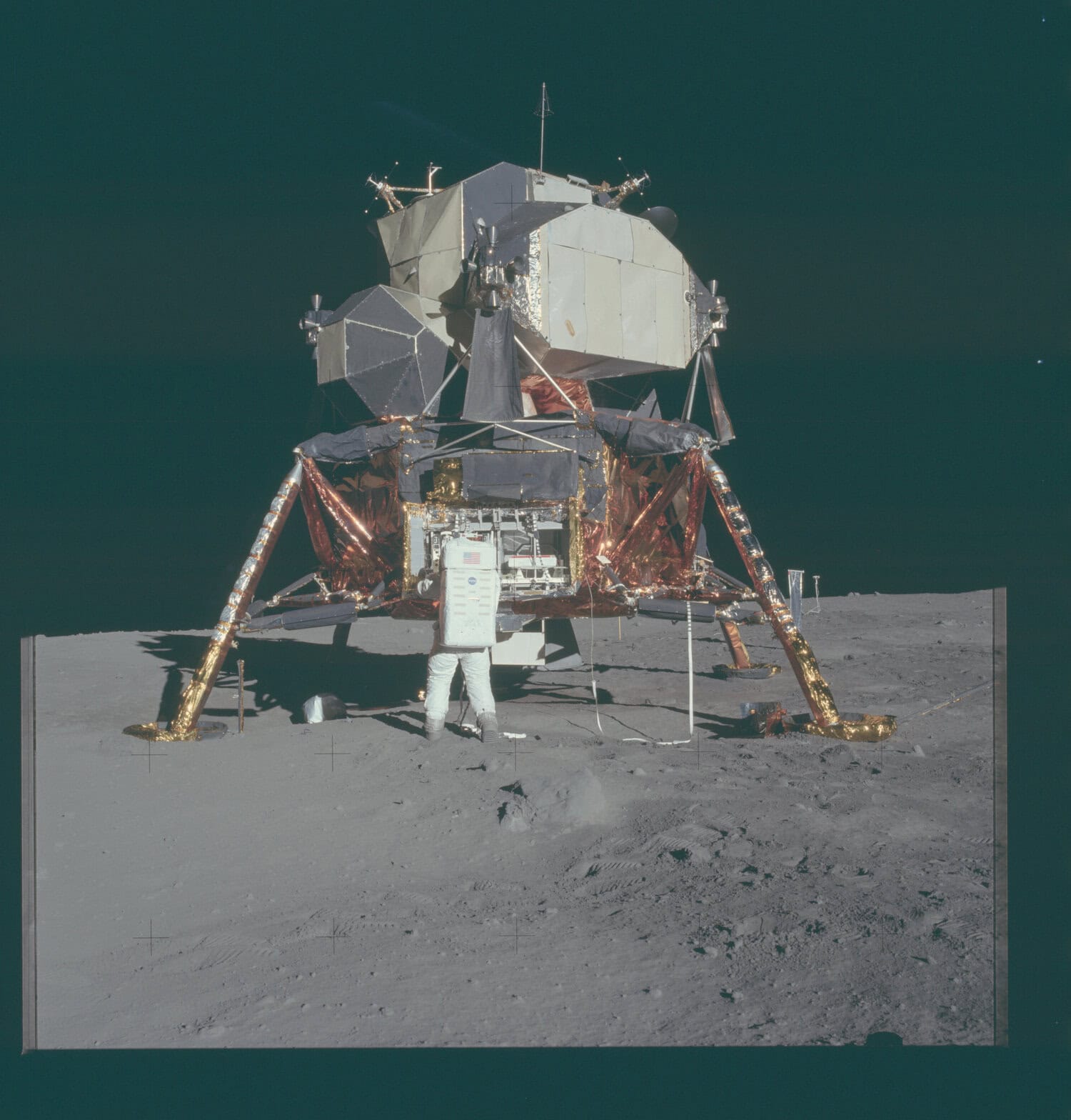
NASA is funding a study of how future Artemis missions might prepare a lunar landing site for repeated use. Slate Geotechnical Consultants and the Colorado School of Mines will compare two ways to prepare loose lunar surface material and investigate whether rovers could help maintain a pad afterward. NASA described the project in a Nov. 20 announcement covering 302 early-stage technology selections with a potential total value of $171 million.
Why repeated landings change the problem
On an unprepared site, rocket exhaust can move loose particles and excavate the surface under a lander. The material can be thrown outward, where it may pose a risk to nearby equipment. A site used repeatedly poses a different engineering problem from an isolated landing. Hardware already on the ground may have to withstand later arrivals, and operators need to know whether the surface will remain usable after each flight.
The Slate and Colorado School of Mines project asks how lunar regolith, the loose material covering the Moon’s surface, might be prepared for repeated landings. NASA’s announcement did not name the two approaches the researchers will compare. It did identify a second question beyond initial construction: whether a rover could repair and maintain the pad. That would matter at a site intended to receive spacecraft over time, where even a durable surface could need inspection or upkeep. NASA’s project description.
What NASA selected
The pad study is a Phase I Small Business Technology Transfer project. That program pairs small businesses with research institutions. NASA says its new Phase I contracts can receive up to $225,000 apiece to examine whether a proposed technology is feasible. The agency gave that ceiling for the award class. Its announcement did not specify a dollar amount for the pad study individually.
The wider announcement also includes 98 Phase II contracts. Those awards continue work from earlier projects and can be worth up to $1.3 million each. Among the examples NASA highlighted were rollable solar arrays designed for robotic handling, a robotic arm that combines a camera with contact sensors, and a battery module intended to function in extreme cold. The technologies address different needs at a possible lunar outpost. The pad proposal focuses on the surface a spacecraft would approach and depart. NASA’s selection and award summary.
From an Apollo landing site to a reusable surface
The accompanying photograph shows Apollo 11’s Eagle resting directly on the Moon on July 20, 1969. It is an archival view of a crewed lunar landing site. A future pad for repeated operations would add a layer of infrastructure to that setting, with a surface prepared for subsequent vehicles and a way to maintain it between visits. NASA archival photograph AS11-40-5927.
NASA’s announcement advances the study of that infrastructure. It does not select a lunar construction site, schedule a pad installation or report results from a completed test. The team’s immediate work is to compare the candidate approaches and examine how a rover could help maintain the surface. Those results could inform later decisions about whether and how to prepare sites for routine arrivals.
Sources
NASA — November 20 small-business funding announcement and lunar landing-pad study
NASA Johnson Space Center — Apollo 11 archival photograph AS11-40-5927







No comment