
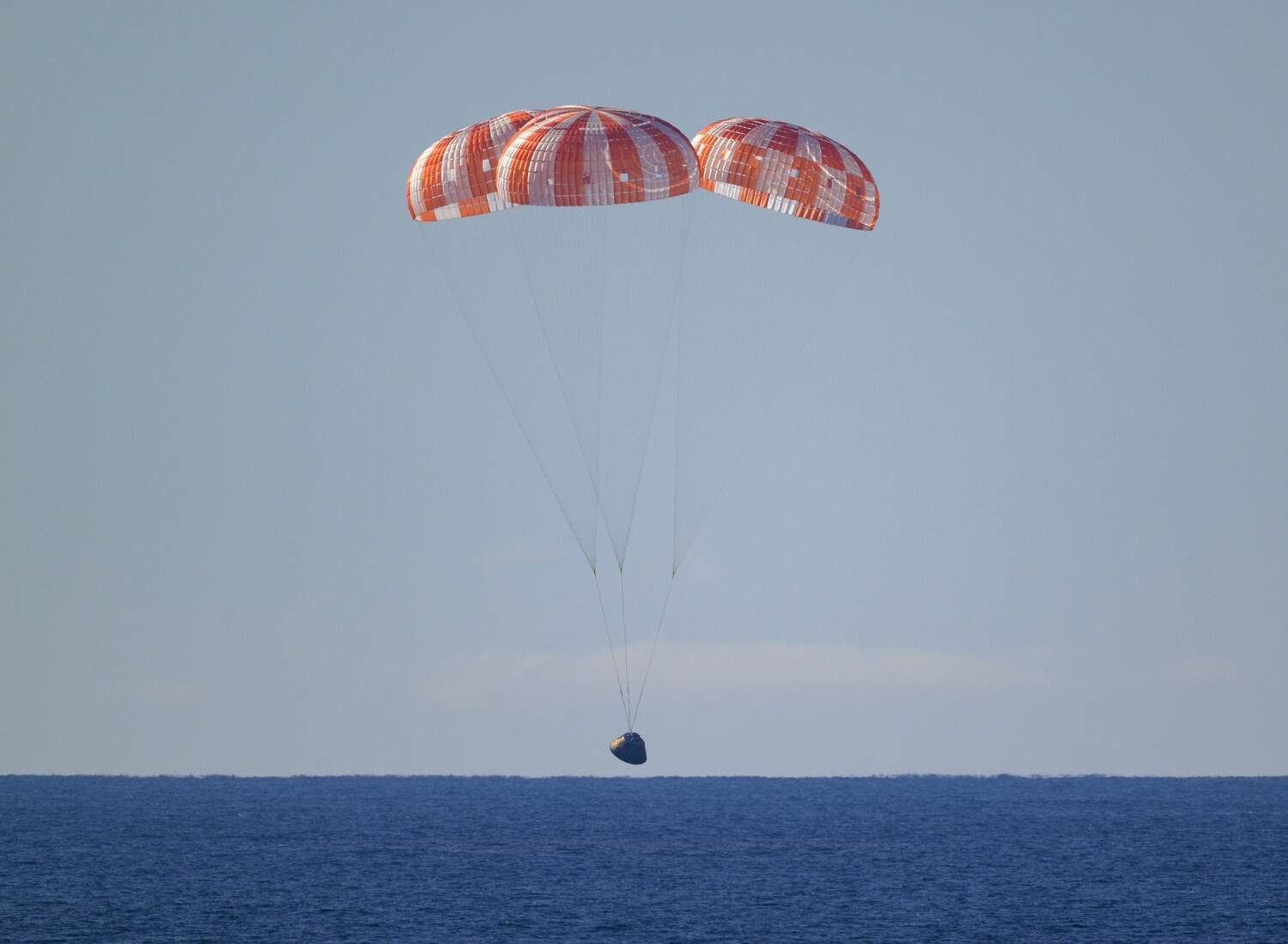
Two NASA photographers watched Orion return from the Moon from separate helicopters over the Pacific. Their assignment was to document what happened between reentry and splashdown, including the deployment of the capsule’s parachutes. In a NASA Johnson Space Center podcast published November 20, James Blair and Josh Valcarcel explained how they prepared for that assignment, coordinated with aircrews and photographed the final minutes of Artemis II on April 10, 2026.
Photographs for the engineering record
Artemis II’s return ended a nearly 10-day flight around the Moon for Reid Wiseman, Victor Glover, Christina Koch and Jeremy Hansen. The capsule landed in the Pacific off San Diego. For the photographers, the assignment began before the water landing. Valcarcel said they were looking for images of the parachutes from the earliest possible moment, including the stages when they opened from a restricted shape to their full size. Those pictures gave engineers a way to study the sequence after the flight.
The timing determines what a photograph can show. A frame of three open parachutes can illustrate the last part of the descent. Images taken earlier can preserve details about how the parachutes opened and how Orion was moving as that happened. The photographers also described a second audience for their work. The same flight produced images NASA could release to show the public what happened above the ocean and during the recovery.
Learning to work from a helicopter
Blair and Valcarcel flew from the Navy recovery ship USS John P. Murtha. Before the return, they took part in helicopter flights to practice positioning and communication. Blair said the rehearsals let them work out how to coordinate when they were traveling on different aircraft. Each photographer had to work with the aircrew in his own helicopter, while both helicopters needed views of an event that would happen once.
The assignment also called for overwater survival preparation. In the interview, the photographers described swim testing and training with a helicopter dunker, a simulator used to practice getting out of an aircraft after it enters the water. The preparation reflected the realities of the job: they were camera operators aboard aircraft flying over the ocean, and they needed to be prepared to follow the aircrew’s emergency procedures.
Taking a photograph from a moving aircraft introduced another problem. The capsule was descending while the helicopter was itself moving and turning. The camera operator had to keep Orion in view from the side of the aircraft. The rehearsals gave photographers and pilots a chance to work out how to communicate about what a camera could see from a given position.
Following Orion after it hit the water
The photographers’ work continued into recovery. NASA’s mission recap describes recovery teams securing Orion, opening the hatch and helping the astronauts out. The crew was then flown back to the Navy ship. One photograph in the recap, credited to Blair, shows the hoist into a Navy MH-60 helicopter. That image documents a different stage of the operation from Bill Ingalls’ photograph of the capsule under its parachutes, which accompanies this story.
NASA recorded the interview on August 12 and published it on November 20. The conversation adds the photographers’ account to the agency’s original imagery of the April return. Their description shows what went into preserving both the short engineering sequence above the water and the longer recovery operation that followed.
Orion descends under parachutes over the Pacific Ocean seconds before Artemis II splashed down on April 10, 2026. NASA photo by Bill Ingalls, public domain. Photograph and credit.






No comment