
Published November 20, 2026
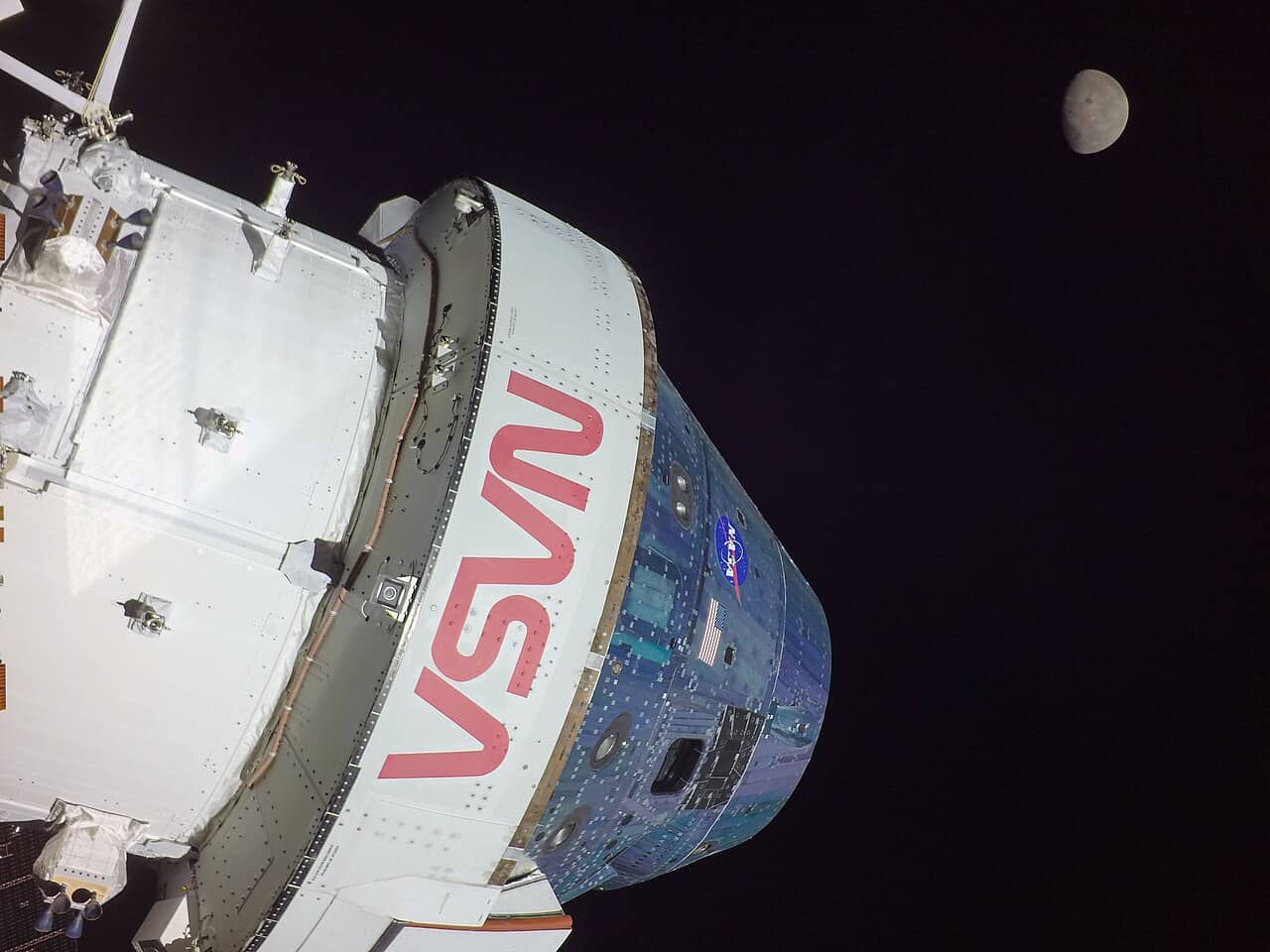
On November 20, 2022, five days into the uncrewed Artemis I mission, NASA’s Orion spacecraft reached the part of its outbound trajectory where the Moon became the dominant gravitational influence for mission planning. NASA logged the transition at 2:09 p.m. Eastern. Orion was still approaching the Moon, and the first close pass would come the next morning. A camera at the tip of one of the spacecraft’s solar arrays recorded Orion with the Moon in the distance that day.
A change in how to describe the flight
The lunar sphere of influence is a way to describe an orbital trajectory. Gravity does not switch on or off at its boundary. Earth continued to pull on Orion as the spacecraft approached the Moon, just as the Moon had been pulling on it earlier in the flight. Crossing that boundary marks where it makes sense to describe the next part of the path mainly in relation to the Moon. For Artemis I, it set the stage for a powered flyby that would change where Orion went next.
Flight controllers were refining that path throughout the outbound trip. NASA’s day-five report records a third correction that morning and describes a fourth planned overnight. These adjustments served a different purpose than the following morning’s main engine maneuver. Corrections helped bring Orion to the intended position for the encounter. The flyby burn was part of the plan to take the spacecraft beyond the Moon into a distant retrograde orbit, a large path that carries a spacecraft around the Moon in the direction opposite the Moon’s orbit around Earth.
Two ways of looking at the Moon
The featured photo came from a camera mounted on a solar array wing, giving readers a view of the spacecraft itself with its destination in the background. Separately, the flight controllers used Orion’s optical navigation camera to collect images of the Moon. NASA explained that pictures of Earth and the Moon at different distances and under different illumination would help engineers evaluate that camera as an aid for determining the spacecraft’s location. The picture that makes the flight visible to the public and the imagery collected to evaluate navigation came from different cameras and served different jobs.
Those jobs mattered on a mission designed to test a spacecraft before people flew aboard it. The teams on Earth were flying a real trajectory, taking measurements and tracking problems in flight. NASA’s report also noted that engineers were examining issues involving the star tracker and parts of the service module’s electrical system. That work went on alongside the planned maneuvers. The mission’s test value came partly from encountering conditions that engineers could observe directly once the spacecraft was beyond Earth orbit.
The next morning’s flyby
In its flight day six report, NASA confirmed the outbound flyby on November 21 and put Orion about 81 miles above the lunar surface at its closest approach. The spacecraft passed behind the Moon, where the Moon temporarily blocked the direct radio path to Earth. The flyby was one of two maneuvers NASA described as necessary to enter the planned distant retrograde orbit. Orion later left lunar orbit and returned to Earth to complete the approximately 25-day Artemis I flight test.
Looking back from four years later, the November 20 entry records a useful point between launch and the close pass. The spacecraft was still on its way toward the Moon, but the next set of choices was already concerned with flight around it. NASA’s day-five report and the photograph preserve both sides of that moment: the navigation work being done in Houston and the view from the vehicle as the Moon came closer.
Featured photograph: Orion and the Moon on November 20, 2022, captured by a solar array camera. NASA Johnson Space Center, public-domain image art001e000255. Full frame resized.
Sources
NASA flight day five report
NASA flight day six report
NASA Artemis I mission overview
NASA Johnson photo archive






No comment