
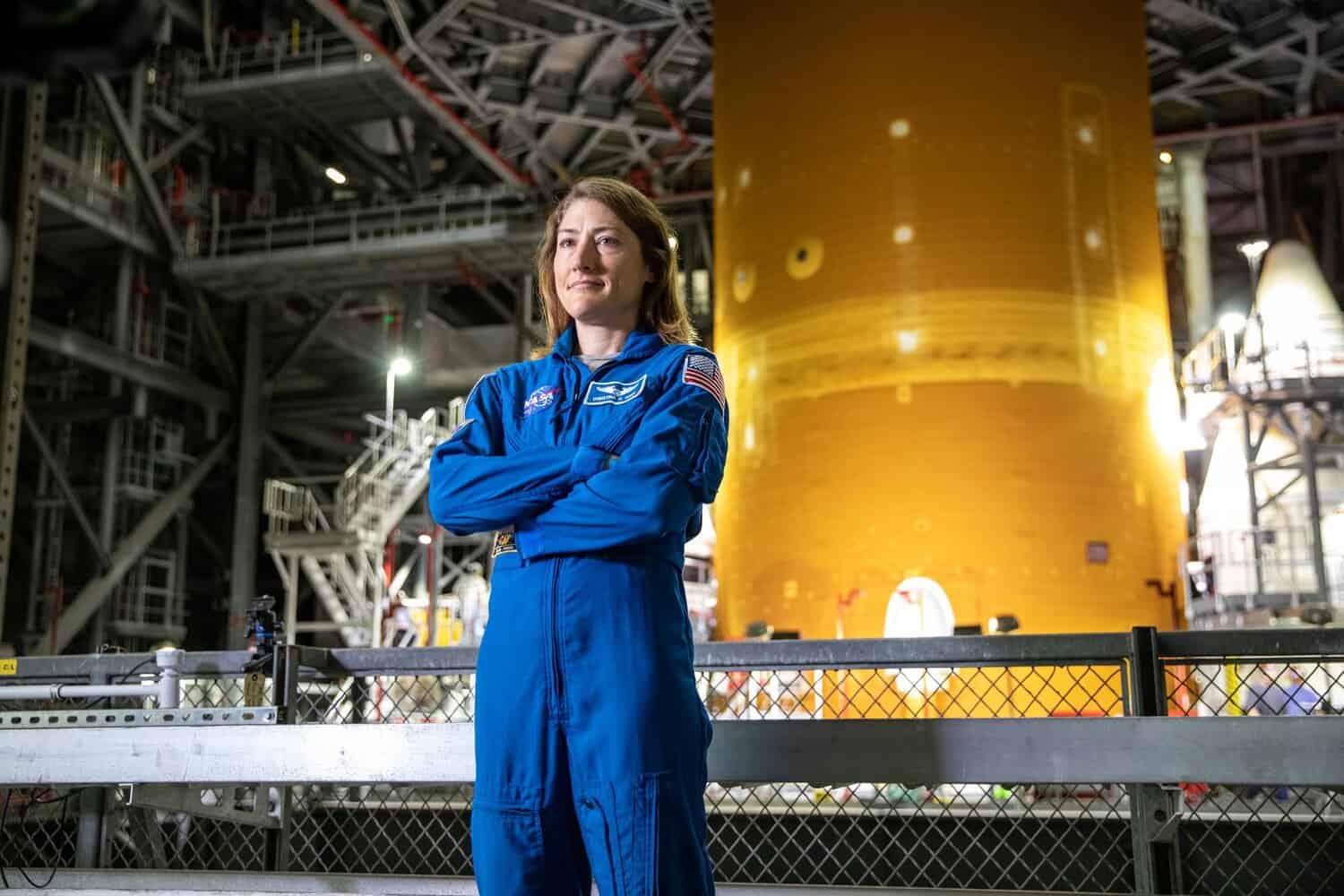
Christina Koch spent 328 consecutive days aboard the International Space Station and flew around the Moon as a mission specialist on Artemis II. This November she began a different job at NASA, helping oversee the engineering work behind its missions. The agency announced her appointment as acting deputy chief engineer on October 13, effective November 1. Its November astronaut biography confirms that she is serving in the role.
The assignment changes how Koch will contribute to human spaceflight. NASA says she has moved to management astronaut status and is no longer eligible for flight assignments. Her work now includes helping the agency assess technical readiness across programs and projects. She succeeds Katherine Van Hooser, whose NASA career included leading engineering work on propulsion through the final 21 space shuttle flights.
From instruments to field engineering
Koch began her NASA career as an electrical engineer at the Goddard Space Flight Center in Maryland, developing instruments for space science. At that stage of a mission, an engineer has to translate what scientists want to measure into hardware that can make the measurement. The instrument has to function within the spacecraft’s limits on power, mass and data, and it has to deliver information the science team can interpret. Koch’s early work put her on the hardware side of that relationship.
Before NASA selected her as an astronaut in 2013, Koch also worked in scientific field engineering in Antarctica and the Arctic. Those two environments gave her experience supporting science far from the laboratories where equipment is usually designed and tested. In remote fieldwork, the people operating an instrument also have to understand how to keep it working when personnel, parts and other resources are limited. NC State’s College of Engineering traces Koch’s path from the university to those assignments and NASA.
Nearly a year living with spacecraft systems
Koch launched aboard a Soyuz spacecraft for her first mission and worked on the International Space Station across Expeditions 59, 60 and 61. Her 328 consecutive days in orbit set the record for the longest single spaceflight by a woman, according to NASA. The duration matters for understanding her operational experience. Over a long expedition, a crew sees how equipment performs through repeated use and how maintenance, experiments and arrivals of other spacecraft fit into the same schedule.
Koch also took part in the first all-female spacewalks. Work outside the station makes the relationship between engineering and crew procedures especially clear. Tasks have to be planned around what astronauts can reach in a suit, how tools can be secured and how the crew can communicate with colleagues inside the station and on the ground. The crew’s experience gives engineers a view of the equipment under the conditions for which it was designed.
From low Earth orbit to a lunar flyby
After her station mission, Koch led the Astronaut Office’s Assigned Crew Branch and completed a technical integration rotation at Johnson Space Center, according to her NASA biography. Those assignments put her in positions where work had to be coordinated across teams before she returned to flight as a mission specialist on Artemis II in April 2026.
Artemis II took Koch from the familiar setting of a station in low Earth orbit to a flight around the Moon aboard Orion. It was the first crewed flight around the Moon in more than half a century. The two missions gave her different views of how human spaceflight hardware gets used. The station is a laboratory that successive crews maintain and operate over many months. On a lunar flyby, the spacecraft itself provides the crew’s living and working space throughout an outbound and return journey.
The work after Artemis II
NASA describes Koch’s new responsibilities in terms of technical oversight, engineering quality and mission readiness. Its announcement does not assign her to one vehicle or mission. The agency-wide scope is the important part of the appointment. Technical decisions made across separate teams can meet at the same spacecraft interface or affect the same readiness review. An engineering leadership office helps bring those issues into view before a mission commits to flight.
Van Hooser came to the office through propulsion and program engineering, including service as the first chief engineer for the Space Launch System’s Liquid Engines Element. Koch brings experience developing science instruments, supporting field research, integrating work at Johnson and operating spacecraft as a crew member. The handover brings that experience into NASA’s engineering leadership at a point when it can inform future missions from the ground.
Featured photograph: NASA/Glenn Benson. Taken July 14, 2021, at Kennedy Space Center. Original caption and credit. Used under NASA’s editorial media guidelines.
Sources
NASA appointment announcement and photograph
NASA astronaut biography, November 2026
NC State College of Engineering coverage






No comment