
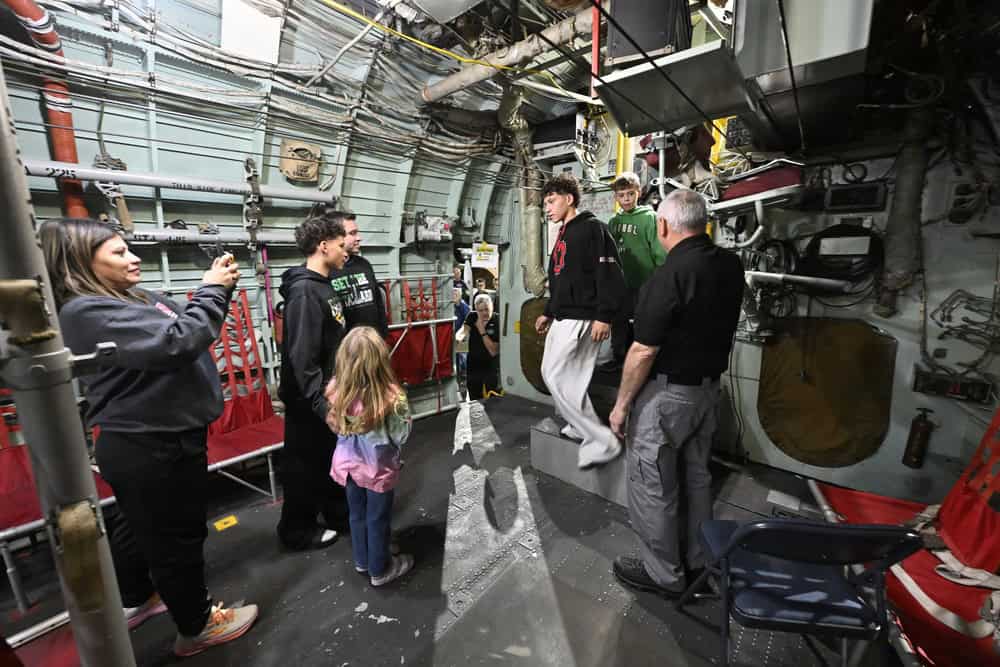
More than 4,000 people visited the National Museum of the U.S. Air Force in Dayton, Ohio, for Open Aircraft Day on November 14, 2026. The Air Force’s account of the event highlighted three aircraft that visitors could explore: the Fairchild C-123K Provider known as Patches, a Sikorsky CH-3E helicopter and a Lockheed EC-121D Warning Star.
The aircraft gave visitors three different ways to look at Air Force history. The Provider moved people and cargo. The CH-3E was part of a helicopter family that took on rescue work. The Warning Star carried radar and the crews who operated it. Each aircraft’s job depended as much on the space behind the cockpit as on the people at the controls.
A transport with a name earned in service
The C-123K was the cargo aircraft of the group. Its broad fuselage and rear loading ramp make its purpose easy to see from the gallery floor. A ramp lets crews move loads directly into the cargo compartment, while the usable space inside determines what can be carried and how the load is arranged. A walk through that compartment offers a sense of the working environment that an exterior view can only suggest.
The museum’s C-123K is known as Patches. MiGFlug’s coverage of Open Aircraft Day identifies the aircraft by name and describes its Vietnam service. A single preserved airframe makes that history tangible. Visitors can connect a particular aircraft, with its own service record, to the larger story of Air Force transport operations.
A helicopter built around access
The Sikorsky CH-3E offered a different view of the same basic question: how do crews reach people and places that conventional aircraft cannot serve? A helicopter can approach and depart without the runway a fixed-wing transport needs. That makes cabin access and the arrangement of equipment central to how the crew works. In rescue operations, the cabin is where crew members receive and care for people brought aboard.
Put next to the Provider, the helicopter shows how designers approached different kinds of access. The Provider’s ramp and cargo space are suited to moving loads between landing sites. The CH-3E’s ability to hover and operate from confined locations changes where a crew can go and how it can bring people aboard.
A radar station in the air
The Lockheed EC-121D Warning Star showed visitors a third use for a large cabin. The aircraft’s external radomes mark its role as an airborne radar platform. Inside, space that could have carried passengers or freight instead housed equipment and the people assigned to operate it. Flying the aircraft was one job. Watching radar displays, interpreting returns and communicating what crews saw were others.
Putting radar in the air extends the view beyond what a ground station can see at low elevations, where Earth’s curvature limits line of sight. The Warning Star makes it possible to see how much space that capability once required and why airborne early warning was a crew mission in its own right.
What an open aircraft adds to a museum visit
From behind a gallery barrier, visitors can compare wings, engines, rotors and radomes. An open aircraft adds another set of comparisons: how high the floor sits, where people entered and how much room crews had to work. At Dayton, the three aircraft made those differences concrete. One carried cargo, one could reach locations without a runway, and one put a radar crew in the sky.
Featured photograph: Ken LaRock, U.S. Air Force. Public domain. DVIDS image 10100987.
Sources
U.S. Air Force / DVIDS, Open Aircraft Day brings thousands to NMUSAF
MiGFlug, coverage of the National Museum of the U.S. Air Force’s Open Aircraft Day





No comment