
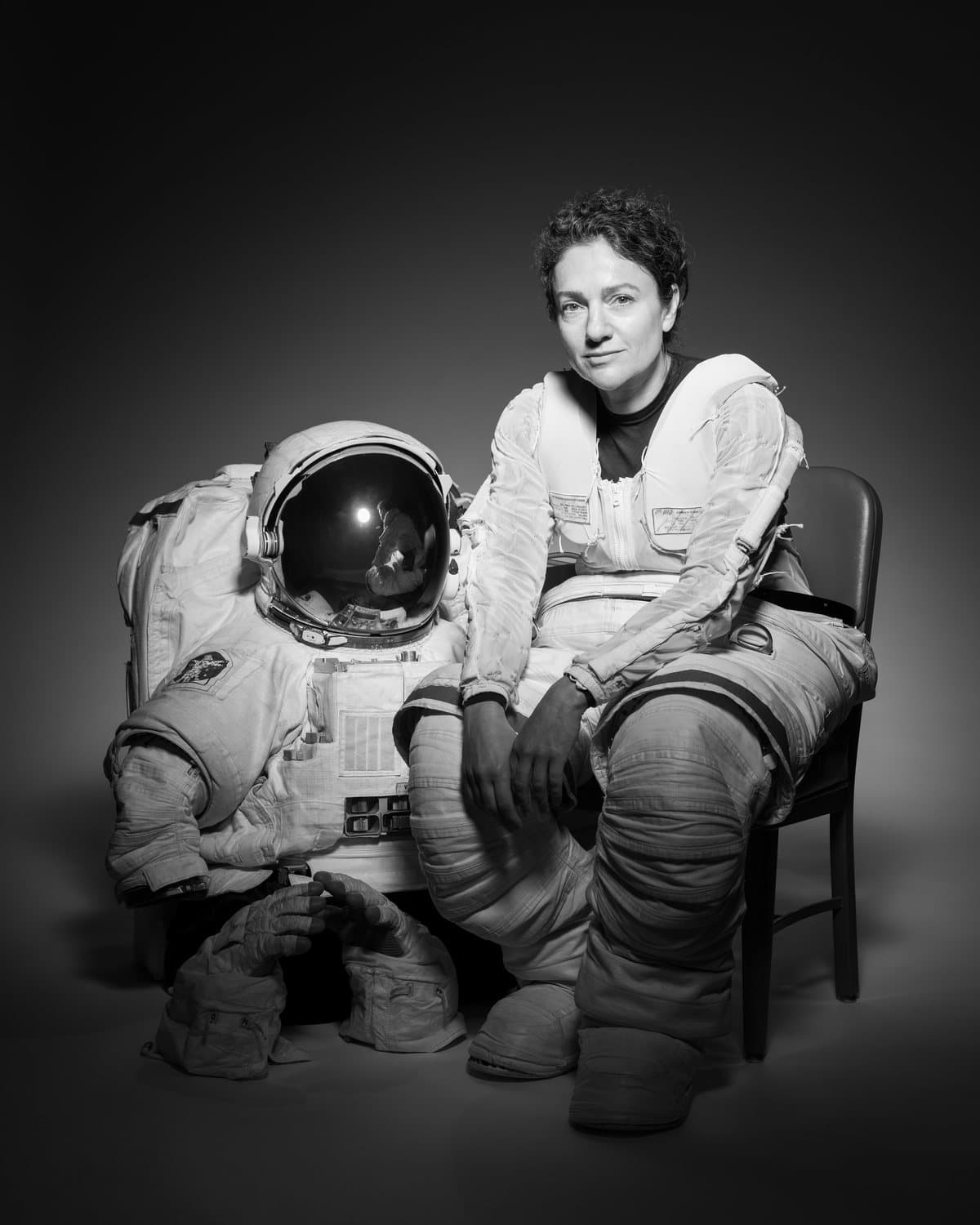
NASA astronaut Jessica Meir will join fellow Expedition 74 crew members at Space Center Houston on Tuesday evening, Nov. 17, for a public debrief about life and research aboard the International Space Station. The event is a chance to hear how a long-duration mission translated into daily work in orbit, with Meir bringing the perspective of a scientist who has now completed two station expeditions and commanded a crewed spacecraft mission.
The program is scheduled for 6 p.m. Central in Space Center Theater, with doors opening at 5:45 p.m. The center says the event is free but requires advance registration, and that seating is limited. The listed crew includes Meir, NASA astronaut Jack Hathaway, European Space Agency astronaut Sophie Adenot, and three Expedition 74 crewmates from NASA and Roscosmos. The event listing identifies Meir as commander of SpaceX Crew-12. Space Center Houston’s event notice provides the current attendance and entry details.
A commander returning to Houston
Meir’s appearance comes after a 237-day flight aboard the station. She, Hathaway, Adenot and Roscosmos cosmonaut Andrey Fedyaev launched from Florida on Feb. 13, 2026, aboard SpaceX’s Dragon spacecraft Freedom. They reached the orbiting laboratory the following day and joined the ongoing Expedition 74/75 crew rotation. The four returned to Earth on Oct. 8, when Freedom splashed down in the Pacific Ocean off California. NASA reported a landing time of 8:34 a.m. Pacific and said the crew traveled more than 100 million miles and completed more than 3,792 Earth orbits during the flight. NASA’s splashdown release records the mission’s return and measured totals; the Associated Press also reported the crew’s Pacific landing after more than seven months in orbit.
The Nov. 17 appearance is not the landing itself: it is a public look back at the expedition after the crew’s return. Space Center Houston describes it as a debrief and welcome-home ceremony, with crew members reflecting on their time aboard the station and recognizing NASA Johnson Space Center employees and partners. For the astronaut-of-the-day profile, that distinction matters: Meir’s defining recent achievement is the completed flight and its scientific work, while the Houston event offers a timely opportunity to hear the crew’s account directly.
From extreme-environment biology to human spaceflight
Meir’s path to the astronaut corps began in biological research. Before NASA selected her in 2013, she studied how animals function in extreme environments, a background that included work on diving physiology and high-altitude adaptation. Her academic training spans biology, space studies and marine biology: NASA lists a bachelor’s degree from Brown University, a master’s from the International Space University and a doctorate from Scripps Institution of Oceanography at the University of California, San Diego. The combination is more than a résumé detail. It connects the questions she studied on Earth—how organisms respond to demanding conditions—with the physiological and operational challenges that accompany extended human presence in space.
Meir also worked from 2000 to 2003 at the Human Research Facility at Johnson Space Center, supporting physiology research for the space shuttle and station programs. NASA’s official astronaut biography traces that research work, her education and flight history. She later served as a flight engineer on Expeditions 61 and 62, her first spaceflight, launched in September 2019. During that mission she and NASA astronaut Christina Koch conducted the first all-female spacewalks, a milestone that became part of a larger campaign of station maintenance and assembly rather than a stand-alone spectacle.
Seven spacewalks across two missions
On Crew-12, Meir served as spacecraft commander and participated in four spacewalks, bringing her career total to seven. NASA says that total ranks third among women astronauts in the agency’s career spacewalk count, behind former NASA astronauts Peggy Whitson and Suni Williams. The work outside the station demands months of preparation in spacesuits and underwater training facilities, along with coordinated procedures between the crew and flight controllers. Each excursion supports a specific maintenance, installation or research objective; the count is a useful measure of experience, but the work’s purpose is the equipment and systems the station relies on.
Her leadership role also extended to the Dragon spacecraft’s operation as the crew traveled between Earth and the station. Crew-12’s four-member international complement paired Meir and Hathaway with Adenot of ESA and Fedyaev of Roscosmos. The mission was the second for Meir and Fedyaev and the first for Hathaway and Adenot, NASA reported. For Meir, returning to the station as commander meant applying experience from Expedition 61/62 to a new crew and a new sequence of research, station operations and vehicle procedures.
Research with applications beyond the station
The crew’s science program ranged across human health, materials and fundamental physics. NASA’s mission recap describes investigations into stem-cell production for potential cell-based therapies, on-demand generation of intravenous fluids, nutrition, blood-flow changes in microgravity and how pneumonia-causing bacteria may affect the heart over time. The experiments do not produce instant medical treatments; they help researchers understand how biological systems behave in orbit and whether processes or technologies can be improved for use on Earth or on future exploration missions.
Several examples show how that work is conducted. In the station’s Cold Atom Lab, Meir worked with equipment used to cool, trap and study atoms. Microgravity allows ultracold atoms to remain observable for longer periods than they can in many ground experiments, supporting measurements relevant to quantum science and technologies. Another investigation examined colloidal materials—tiny particles suspended in liquid—and how they assemble in the absence of ordinary sedimentation. Such studies can inform materials used in pharmaceuticals, plant growth or manufacturing, although each application requires further research after the orbital experiment.
The crew also supported work on crystallizing cancer-targeting treatments, stem-cell production and tissue engineering. NASA’s Crew-12 science recap describes these as part of a broad portfolio of station investigations. The station’s value is partly its repeatability: researchers can send equipment, run procedures, return samples and compare results across missions. Astronauts serve as operators and experimental participants, while ground teams design protocols and analyze the resulting data.
Why Crew-12’s record is part of a larger transition
A 237-day expedition is a long assignment, but the International Space Station’s continuous operations depend on regular crew rotations rather than a single team remaining aboard. Crew-12’s departure was followed by new residents, keeping the laboratory staffed while overlapping teams transfer responsibilities. NASA’s mission reports frame the station as both a research platform and a place to test systems and procedures relevant to future exploration. The Crew-12 work therefore sits within a program of sustained operations, not simply a one-off endurance flight.
The mission also illustrates the international structure of station operations. NASA astronauts flew with an ESA astronaut and a Roscosmos cosmonaut; the research and maintenance plan used equipment and expertise from multiple partners. This cooperative arrangement affects daily life as well as mission planning: crew schedules, experiments, station systems and emergency readiness must fit a shared orbital workplace. Meir’s role as commander was exercised in that multinational context, with responsibility for the spacecraft and an assigned place in the station’s ongoing chain of command.
A public debrief, not a new launch announcement
For Houston-area visitors, Tuesday’s event is an opportunity to hear about a mission that has already concluded. Space Center Houston lists the event as free with registration, while warning that theater capacity is limited. Attendees should check the center’s event page for current entry conditions. NASA’s original Nov. 10 announcement likewise describes an evening program at the visitor center, where the Expedition 74 crew will share highlights following their return.
Meir’s profile ties together scientific training, operational experience and a new command assignment. Her first mission included station science and the first all-female spacewalks; her second added four more excursions and leadership of Crew-12’s flight to and from the station. The work discussed in Houston tonight will make the most sense against that longer arc: research in orbit is performed by trained crews within a complex international system, then evaluated by scientists on Earth. Meir’s own career bridges those roles, from studying physiology to helping operate a laboratory that circles the planet every 90 minutes.
Sources
- Space Center Houston: Expedition 74 Crew Debrief & Welcome Home Ceremony
- NASA: Expedition 74 public event announcement
- NASA: Jessica U. Meir astronaut biography
- NASA: Crew-12 splashdown and mission totals
- NASA: Crew-12 research recap
- NASA/Josh Valcarcel: Jessica Meir portrait and image credit
- NASA Images and Media Usage Guidelines
- Associated Press: Crew-12 returns to Earth






No comment