
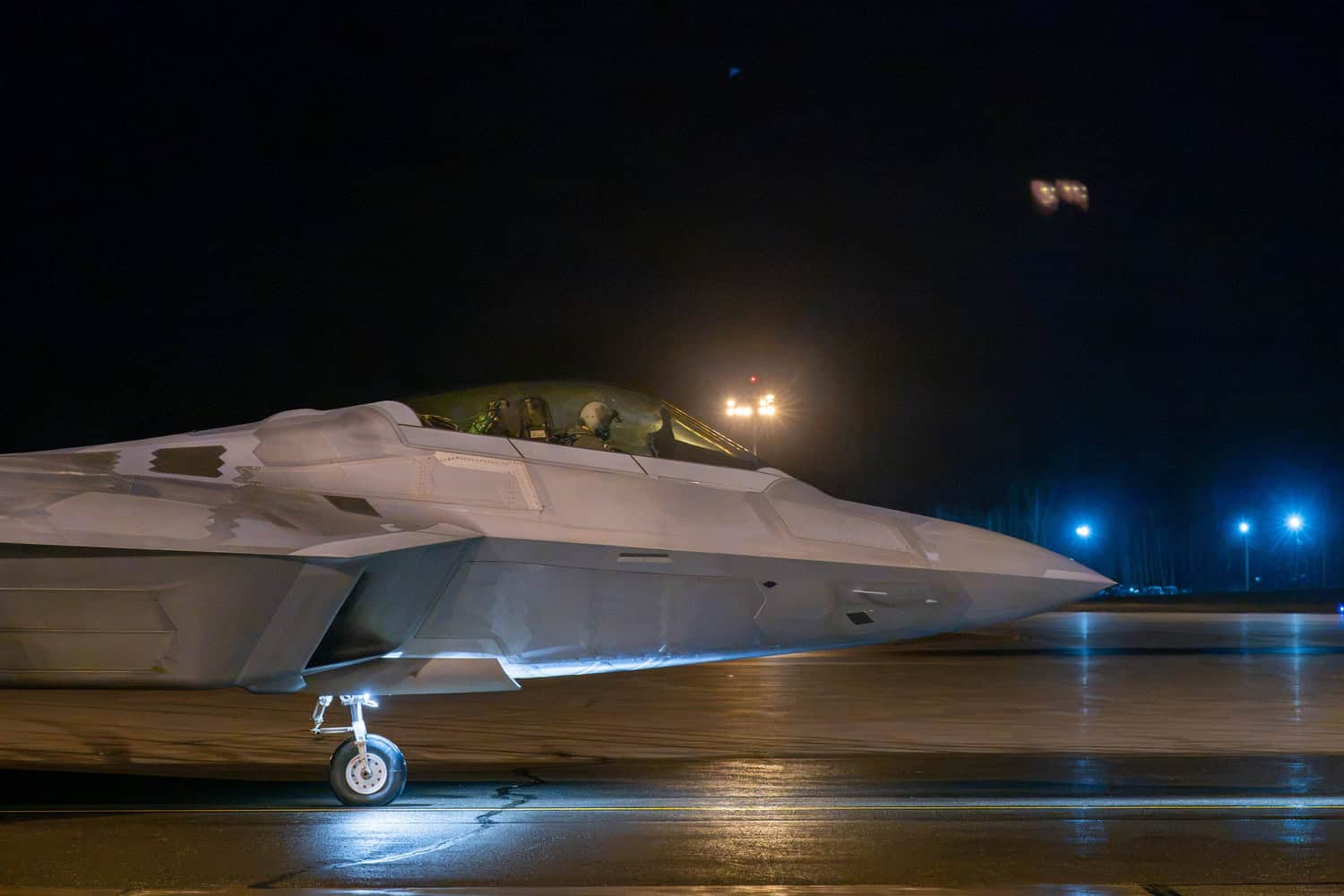
A new U.S. Air Force photo series from Joint Base Elmendorf-Richardson, Alaska, shows F-22 Raptors and their crews preparing for night operations. The images, released Nov. 16, document a 90th Fighter Squadron aircraft taxiing for takeoff and airmen completing preflight procedures on Nov. 9. The photographs offer a current look at the work that supports the base’s air-defense and readiness mission, while the public record does not identify the specific purpose of that sortie.
The distinction matters. The images are evidence of aircraft and crew activity at JBER, but they do not say that the aircraft were responding to a real-world alert, intercepting another aircraft, or taking part in a named exercise. The Air Force caption describes the F-22 as supporting JBER’s readiness and resilience to deter aggression and ensure homeland defense. That broader mission is consistent with the 90th Fighter Squadron’s public descriptions of its work in Alaska.
What the new photographs show
In the photo set, Airman 1st Class Hunter Watson photographed a pilot from the 90th Fighter Squadron and a dedicated crew chief discussing preflight procedures beside an F-22. Other frames show an aircraft taxiing for takeoff at Joint Base Elmendorf-Richardson. The pictures were taken Nov. 9 and posted to the Defense Visual Information Distribution Service on Nov. 16. Their captions identify the aircraft with the 90th Fighter Squadron and the maintenance team with the 90th Aircraft Maintenance Unit.
That sequence points to the ordinary but essential steps behind a fighter sortie: the pilot and maintainers review the aircraft, confirm it is ready, and move it from the parking area toward the runway. The photographs do not disclose aircraft configuration, mission tasking, weapons, route, or flight duration. They also do not establish that the images were made during a live alert. SkyLord reviewed the caption and accompanying official material; no additional operational details were stated in the release.
The image set is a recent public record of F-22 activity in Alaska, rather than an announcement of a new aircraft capability. In that sense, its value is documentary: it shows how a high-end combat aircraft and its ground crew appear in a real operating environment, and it places the aircraft in the unit and location that support the northern defense mission.
Why Alaska matters to the Raptor mission
JBER’s location gives its fighter units a role in a geographically large region where aircraft can approach North American airspace from across the Arctic and North Pacific. The 90th Fighter Squadron, known as the “Dicemen,” operates F-22s from the base. A JBER account of the squadron’s work describes its support for the Alaskan NORAD Region’s combat-alert mission, including the ability to launch fighters to identify and intercept aircraft entering the Alaska Air Defense Identification Zone or other potential airborne threats. That account dates to 2020, so it explains the unit’s established mission rather than the purpose of the Nov. 9 flight.
Alaska’s air-defense mission is not limited to one fighter type. In a March 2026 release, the North American Aerospace Defense Command said it detected and tracked two Russian Tu-142 military aircraft operating in the Alaskan Air Defense Identification Zone. NORAD said U.S. and Canadian aircraft, including two F-22s, were sent to positively identify, monitor, and intercept the aircraft. The command also explained that an ADIZ is international airspace where aircraft are expected to identify themselves, and that operating there does not by itself mean an aircraft has entered sovereign U.S. or Canadian airspace.
A separate JBER photo record from May 2026 shows a 3rd Wing F-22 taking off during a practice alert response at U.S. Coast Guard Air Station Kodiak. The base said the wing maintains response options across the Alaskan theater to detect, deter, and defeat potential threats and protect North American airspace. That practice-response image is a different event from the November night-operation photographs, but together the records show how training, alert readiness, and aircraft maintenance connect to the region’s air-defense posture.
Designed for air dominance, with a demanding support system
The Air Force describes the F-22 as an air-dominance, multirole fighter. Its public fact sheet highlights stealth, integrated avionics, maneuverability, and supercruise—the ability to sustain supersonic flight without using afterburner. The aircraft can perform air-to-air and air-to-ground missions. Those characteristics make the Raptor a tool for gaining control of the air and protecting other forces, but its capabilities depend on a much larger system of pilots, maintainers, planners, communications, fuel, and base support.
Night operations make that support visible. Before an aircraft can leave the ramp, crews have to complete inspections and servicing, pilots have to coordinate with maintainers, and the aircraft has to be cleared for its planned flight. The Nov. 9 images show a small portion of that process rather than the full operation. They do not provide details about night-vision equipment, mission systems, or tactics, and this report does not infer those details from the photographs.
The Air Force fact sheet notes that the F-22 combines stealth, supercruise, maneuverability, and integrated avionics. Those features are relevant to the aircraft’s designed mission, but they should not be confused with what a photograph alone can prove. The publicly released images establish the aircraft’s unit, location, date, and visible activity. Further claims about the sortie would require additional official information.
Readiness is a continuing process
For a fighter squadron, readiness is not a single event. It is maintained through recurring training, aircraft upkeep, crew coordination, and the ability to respond when tasked. A current photo release can show that process in motion, but it cannot reveal deployment status, readiness rates, or the details of a particular operational plan. The Nov. 9 series is therefore best read as a narrow but useful snapshot of the 90th Fighter Squadron and its support team preparing an F-22 for night activity at JBER.
The Raptor remains one element of a layered defense network that includes radar, command-and-control personnel, tankers, airborne surveillance aircraft, and other fighters. NORAD’s March account illustrates that mix: F-22s operated alongside tankers, an E-3 airborne warning aircraft, and Canadian fighters during the identification and monitoring mission. The F-22’s part is important, but the mission depends on coordinated forces and decisions well beyond the aircraft itself.
For now, the new JBER images document a routine that underpins the F-22’s larger role. A pilot and crew chief confer beside the aircraft; a Raptor moves toward the runway; the squadron continues operating from Alaska. The photos do not announce a new milestone, and they do not show an emergency response. They do provide a timely, rights-cleared view of the people and aircraft behind a mission that is often described only in terms of advanced technology or distant intercepts.
Sources
- DVIDS: F-22 Raptor Aircraft Night Flight, photo 10098241 — image and caption, Nov. 9, 2026; posted Nov. 16; marked public domain. Credit: U.S. Air Force photo by Airman 1st Class Hunter Watson.
- U.S. Air Force: F-22 Raptor fact sheet — mission and aircraft characteristics.
- Joint Base Elmendorf-Richardson: “Dicemen” take comms behind the scenes — the 90th Fighter Squadron’s Alaska NORAD Region combat-alert role.
- NORAD: Russian aircraft operating in the Alaskan Air Defense Identification Zone, March 4, 2026 — reported identification and monitoring mission involving F-22s.
- JBER: 3rd Wing F-22 practice alert response at Kodiak, May 13, 2026 — separate practice event and photo caption.






No comment