
Edwards Air Force Base used a three-day immersion tour this month to show civic leaders how its flight-test mission works, moving from the history of the 412th Test Wing to current aircraft programs and test infrastructure. Fifteen leaders from around the country visited Nov. 3–5 with Lt. Gen. Linda Hurry, Air Force Materiel Command commander, according to the 412th Test Wing’s Nov. 12 report. The schedule included a walk across Rogers Dry Lake, briefings on aircraft and systems, and stops with personnel involved in research and testing. (412th Test Wing / DVIDS)
The tour’s subject was Edwards’ role as a test center: the work of evaluating aircraft, technologies and changes before they move into broader service. The public account does not say the visitors participated in a test or observed a flight. Instead, it describes briefings and demonstrations intended to give community representatives a closer look at the installation’s mission and its history.
From the lakebed to the test wing
Rogers Dry Lake is part of the base’s distinctive test environment. The visitors walked the lakebed and saw the compass rose, a 4,000-foot-wide magnetic-free directional marker used for aircraft navigation testing, the report said. That physical landmark links the base’s open terrain with the precision work of flight research: test crews need reliable references for observing and evaluating aircraft behavior.
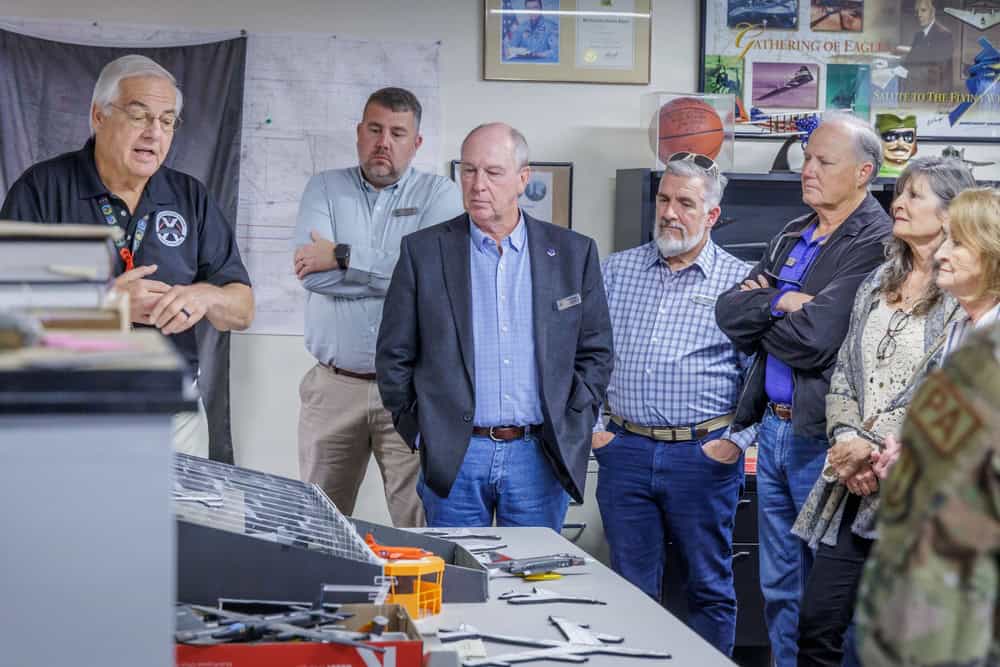
George Welsh, director of the Flight Test Museum, briefed the group on the history of the 412th Test Wing. Col. Tom Tauer, the wing’s commander, spoke with visitors near the compass rose, while other briefings connected the site’s past with current programs. The visit included a briefing by Lt. Col. Timothy Grace, commander of the 419th Flight Test Squadron, on B-52 Stratofortress modernization.
The image accompanying this report shows Welsh speaking with visitors during the Nov. 3 tour. It is an archival record of the event, not a photograph of an aircraft test. The U.S. Air Force credited the photograph to James West; DVIDS marks photo 10091295 public domain. (DVIDS photo record)
Briefings on autonomy, training and modernization
The tour also featured the X-62 VISTA, an experimental aircraft used for flight-testing autonomy. Rachel Kinard, director of research at the Air Force Test Pilot School, briefed the visitors on the aircraft, according to the report. The X-62 combines a modified F-16 airframe with an experimental control system used to test autonomous flight capabilities. The tour account describes it as a platform for autonomy research; it does not claim that an autonomous system has replaced a human pilot in operational service.
Visitors also looked inside a T-7 Red Hawk cockpit with Maj. Robert Ritchie of the 416th Flight Test Squadron. The T-7 is a new trainer being evaluated for pilot training. A cockpit demonstration helps illustrate that flight testing encompasses human-machine interfaces and training as well as performance in the air.
The B-52 modernization briefing presented another side of the work: keeping a long-serving aircraft relevant through planned upgrades. The report identifies the subject of the briefing but does not provide program milestones or technical details from the discussion. The visit therefore offered context about the breadth of test activity without announcing a new B-52 modification or a change to its schedule.
Why bring civic leaders to a test base?
The Air Force account says the visit was designed to build partnerships and give local and national civic leaders firsthand insight into Edwards’ flight-test mission. Such tours can make the work of a large installation more tangible to the communities and institutions connected to it. They also allow officials to see how aircraft, test personnel, research organizations and range infrastructure fit together.
Edwards’ setting is part of that story. The lakebed, marked test areas, flight-test organizations and museum preserve different parts of the installation’s function. A history briefing explains why the base matters; a look at the X-62, T-7 and B-52 programs shows how testing continues across experimental autonomy, pilot training and modernization.
The report does not list the civic leaders by name, identify their home communities or describe specific policy commitments made during the tour. It also does not say that the visit produced a new contract, test milestone or operational decision. The verified news is the immersion itself and the range of work presented to the visitors.
For Edwards, explaining test operations is an extension of the mission: the public can see that aircraft capability is not established by design alone. It must be evaluated through structured flight testing, trained crews, reliable instrumentation and carefully managed ranges. The Nov. 3–5 visit brought those elements into view through a mix of history, infrastructure and current programs.






No comment