
The European-Japanese BepiColombo mission entered orbit around Mercury on Nov. 21, 2026, completing an eight-year journey to the innermost planet. Nature reported the European Space Agency’s confirmation of the arrival. The maneuver captured two science spacecraft that are still joined together. The next major step will send them into separate orbits, where they can study Mercury and its surroundings at the same time.
Two spacecraft arrive together
BepiColombo pairs ESA’s Mercury Planetary Orbiter with Japan Aerospace Exploration Agency’s Mercury Magnetospheric Orbiter, known as Mio. The two rode to Mercury on a common stack. The Mercury Transfer Module, which supplied propulsion and power for much of the journey, separated on Sept. 3, 2026. ESA’s orbiter took responsibility for the remaining arrival maneuvers with Mio still attached.
The ESA arrival timeline puts the November maneuver first in a series of orbital changes. ESA plans to separate the two orbiters on Dec. 9–10. The spacecraft will then follow different paths around Mercury. ESA’s mission updates place the start of the science phase in April 2027.
Why Mercury took eight years to reach
BepiColombo launched on Oct. 20, 2018. Mercury is relatively close to Earth by interplanetary standards, but a spacecraft headed inward must shed enough orbital energy to match Mercury’s motion around the Sun. BepiColombo used solar-electric propulsion and a sequence of planetary flybys to adjust its trajectory. The flybys also gave the mission opportunities to collect observations before orbit insertion.
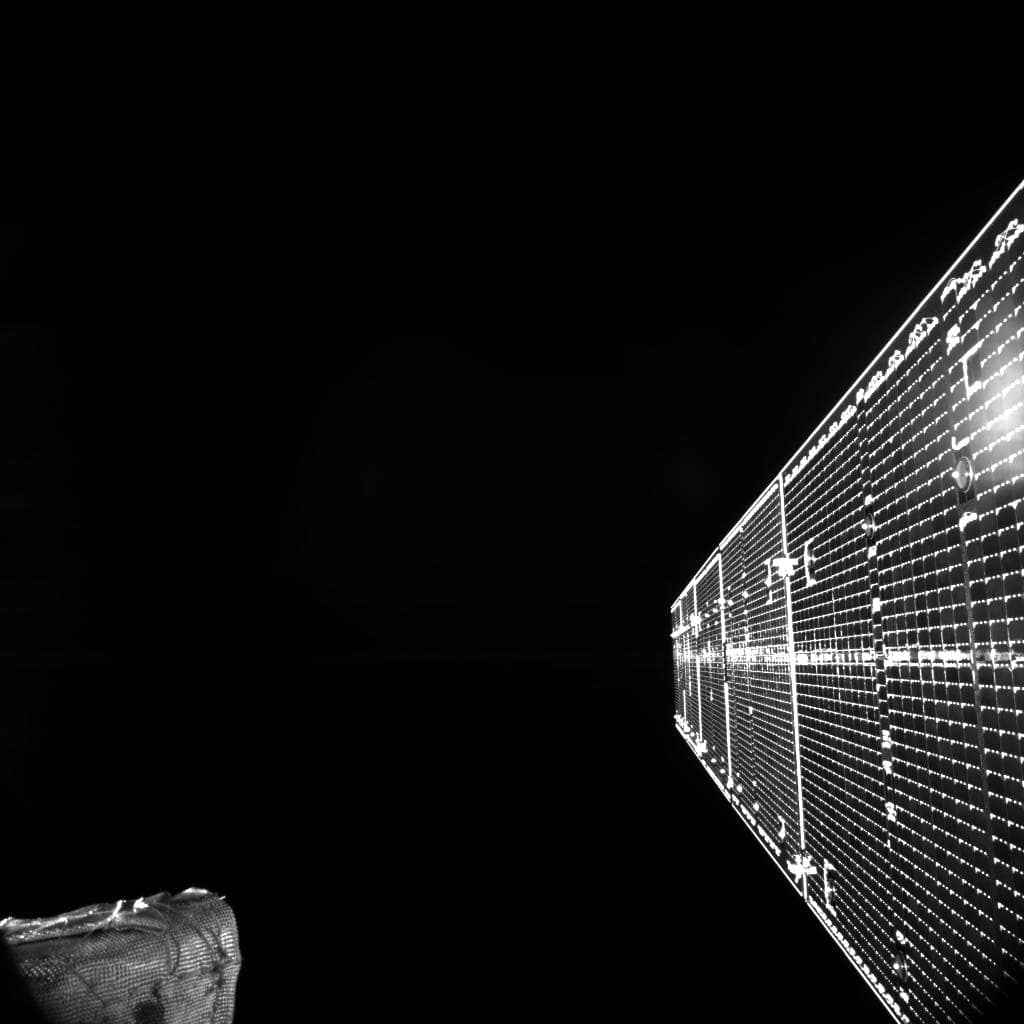
During the cruise, monitoring cameras on the transfer module photographed parts of the spacecraft and its surroundings. The photograph accompanying this article comes from the first of those in-flight images. It shows a solar array shortly after deployment in October 2018, at the beginning of the journey.
What scientists gain from flying two orbiters
ESA’s spacecraft is designed to study the planet itself, including its surface, composition and structure. Mio will examine the environment around Mercury, including the interaction between its magnetic field and the solar wind. Mercury’s proximity to the Sun makes those interactions particularly important to understanding what happens around the planet.
A measurement at one spacecraft can change because the surrounding environment is evolving or because the spacecraft has moved into a different region. Two sets of observations will give scientists a way to compare what is happening at different locations at the same time. This is the first mission designed to put two spacecraft in orbit around Mercury simultaneously, according to ESA.
Featured photograph: ESA/BepiColombo/MTM, licensed under CC BY-SA 3.0 IGO. The photograph is shown in its original frame.
Sources
ESA mission updates
ESA arrival timeline
Nature’s report on the arrival
ESA photograph and license





No comment