
Published November 27, 2026
On November 27, 1944, the first Boeing XF8B-1 took to the air. Boeing’s company chronology records the flight as the debut of its Model 400, a long-range aircraft built for the U.S. Navy. It was the first of just three prototypes. The aircraft never went into production, but the flight opened a test program that showed what Boeing could build around a large piston engine for carrier service.
An unusual assignment for Boeing
Boeing was building bombers in large numbers when the XF8B-1 flew. Earlier that same month, its C-97 transport prototype had flown for the first time, taking the company’s experience with large aircraft in another direction. The Model 400 brought Boeing back to a different kind of design. The company’s chronology identifies the three aircraft as the first fighters it had built since 1934. Ten years separated those projects, years in which the size and ambitions of wartime aircraft had changed considerably.
The company was asked to build an aircraft with a long reach and the ability to operate from a ship. Size could help meet the first requirement by making room for fuel and a powerful engine. The second requirement put a limit on how much space the aircraft could occupy when it was parked. The XF8B-1’s outer wing panels could fold so it would take up less room aboard a carrier. The result was a large single-seat airplane with a way to reduce its span on the deck.
Two propellers on one engine
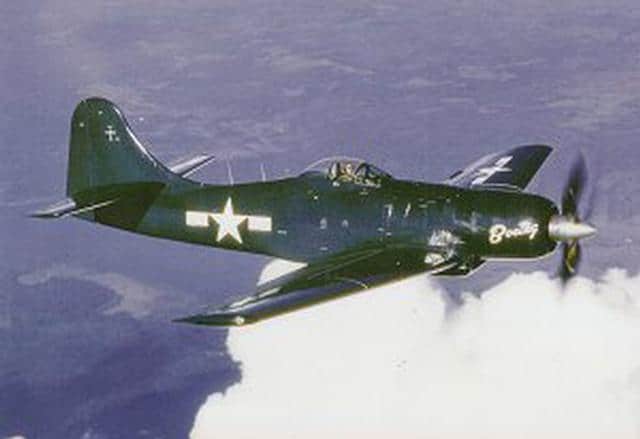
The aircraft’s nose held a Pratt & Whitney Wasp Major, a radial engine with 28 cylinders. The engine drove two propellers arranged one behind the other. They turned in opposite directions. In an ordinary single-propeller installation, turning the propeller tends to twist the airframe in the opposite direction. Using a pair turning against one another reduces that effect. The two propellers were among the most visible signs that the Model 400 was built around a different set of demands from a smaller fighter. Vintage Aviation News recounts the first flight and the prototype’s distinctive layout.
The arrangement also put more machinery at the front of an airplane meant to spend time at sea. A prototype program gave designers and test crews a chance to see how the powerplant and airframe worked together under real flight conditions. The first flight was the point where Boeing began obtaining that evidence in the air. Whether the Navy would find the aircraft worth building in numbers would take much longer to decide.
A prototype at the close of the piston era
Boeing built three XF8B-1s. Their test program crossed the end of World War II and continued into a period when jet aircraft were increasingly important to decisions about future fighters. The aircraft that flew in November 1944 had been conceived for wartime requirements. By the time the three prototypes had been built, the services could judge it against a very different set of prospective aircraft and missions. The Model 400 stayed a prototype, leaving its first flight as the beginning of a short chapter in Boeing’s history.
The Navy photograph accompanying this feature shows an XF8B-1 airborne. It is an archival view of the aircraft type. The date of the first flight comes from Boeing’s written chronology. Together, the image and the dated record preserve the moment when a design that had existed on paper and on the factory floor became an aircraft its pilots could evaluate in flight.
Featured photograph — Archival U.S. Navy photo, public domain. Wikimedia Commons archive and rights record.
Sources
Boeing company chronology
Vintage Aviation News, XF8B first flight history
U.S. Navy photograph via Wikimedia Commons






No comment