
Published November 23, 2026
On May 18, 1953, Jacqueline Cochran became the first woman to fly faster than the speed of sound. The flight was a milestone in the transition from piston aircraft to jets, and it came well into a career already distinguished by air racing and military ferry operations. The National Air and Space Museum records that by the end of her life she had accumulated more speed, altitude, and distance records than any other pilot. Those three kinds of records are worth distinguishing. A time through a measured course, a maximum altitude, and a long flight with a limited fuel supply test different aspects of an aircraft and its pilot.
Learning to compete over a course
Cochran learned to fly in the early 1930s and competed in an era when races gave civil aviation a large public audience. In 1938 she won the Bendix Trophy race, a long-distance contest in which finishing time mattered more than a momentary burst of speed. The National Museum of the United States Army traces her progress from earning her license to flying competitively and eventually taking on wartime aviation work. The racing part of her career matters because it shows the kind of judgment needed when performance is measured over an entire journey. A pilot must make decisions about weather, route, fuel, and aircraft condition before anyone can compare the time at the finish.
Record flying put similar demands on planning but let a crew isolate one question at a time. A speed attempt could use a measured course. A climb to a record altitude depended on keeping enough performance available as the air thinned. The pilot still had to bring the airplane home after the measurement that would make the headlines. Cochran’s record across different kinds of flying is more revealing than any one number because it shows how often she returned to take on a different problem.
The ferry work behind the records
During World War II, Cochran helped organize opportunities for women to fly military aircraft in noncombat roles. She led the Women’s Airforce Service Pilots program after the consolidation of two earlier groups. Ferry flying was one of the jobs women performed. It meant moving aircraft from the places where they were built or stored to the places where the military needed them. Pilots also carried out duties such as towing targets for training. The work required judgment and the ability to adapt to different aircraft, even though there was no finish line and no trophy at the end of an ordinary trip.
Taking the same competitive approach into jets
When Cochran crossed the sound barrier in 1953, the airplane was a Canadair Sabre. It belonged to a different generation from the aircraft she had raced before the war. One reason the transition drew attention was that the speed of sound is a threshold tied to local atmospheric conditions. A pilot flying at Mach 1 at one altitude is not necessarily moving at the same speed over the ground as a pilot flying at Mach 1 somewhere else. The milestone describes what the airflow around the aircraft was doing, and the aircraft had to be controllable on both sides of that threshold.
Cochran kept pursuing jet records after the Sabre flight. The Army museum’s biography notes her later altitude record in a Northrop T-38 Talon. The Talon was a different airplane and the climb posed a different challenge from a supersonic speed attempt. The continuity was Cochran’s willingness to put her flying to a measurable test. Seen together, the Bendix race, wartime ferry work, and jet records show a pilot whose experience spans several ways of judging performance, from getting the aircraft to its destination to finding out what it could do at the edge of its operating range.
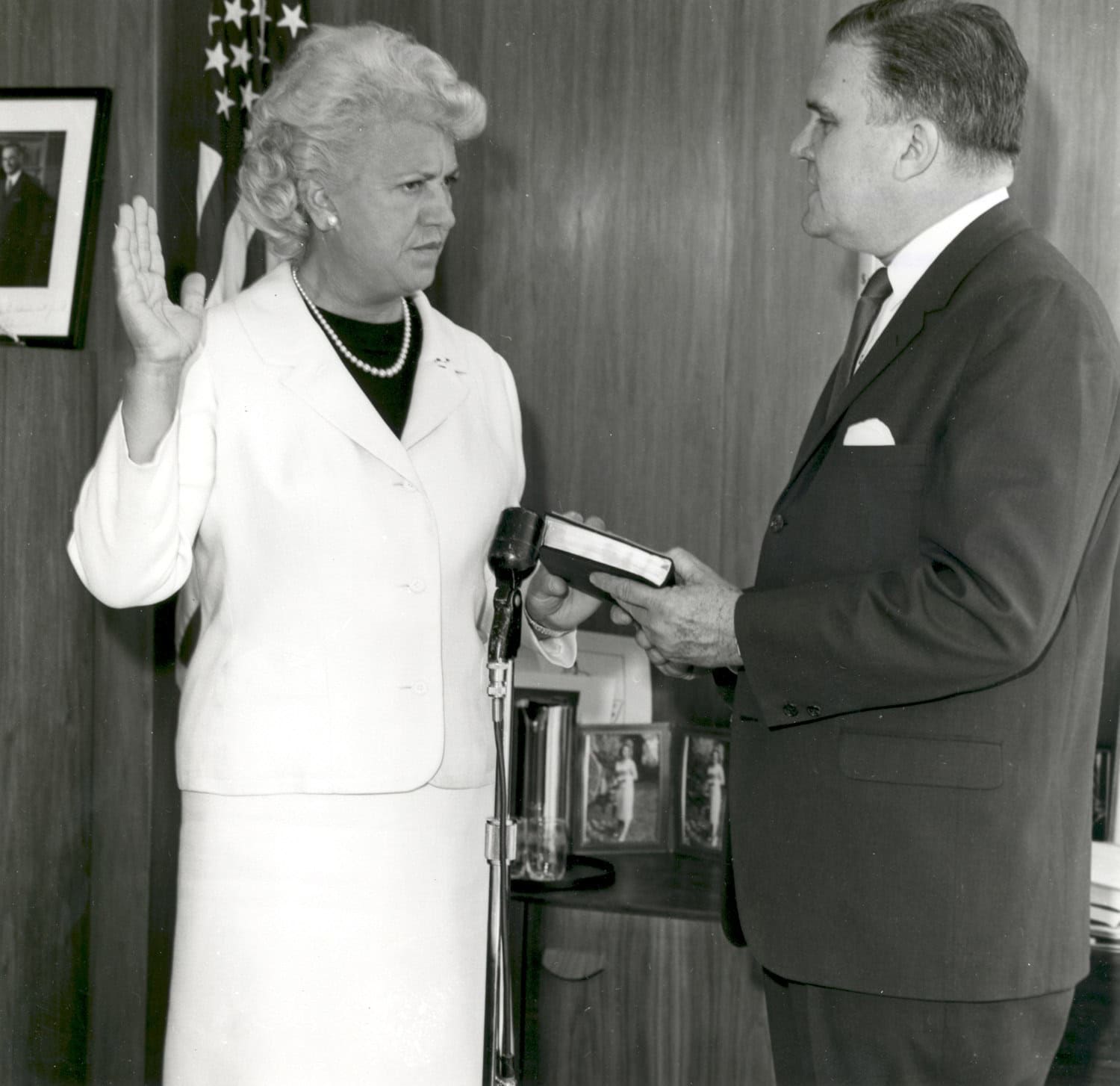
Featured photograph: Jacqueline Cochran sworn in as a NASA consultant by Administrator James Webb in 1961. NASA photograph via Wikimedia Commons, U.S. public domain. Full frame resized.
Sources
National Museum of the United States Army, Jacqueline Cochran biography
Smithsonian National Air and Space Museum, Meet Jacqueline Cochran


No comment