
Published November 22, 2026
Army aviation students at Fort Rucker, Alabama, recently got a virtual-reality look at how crewed aircraft could work alongside autonomous aircraft, robots and connected battlefield systems. The November 20 demonstration was an educational exercise in future concepts; the Army said it did not signal a procurement, fielding or endorsement decision.
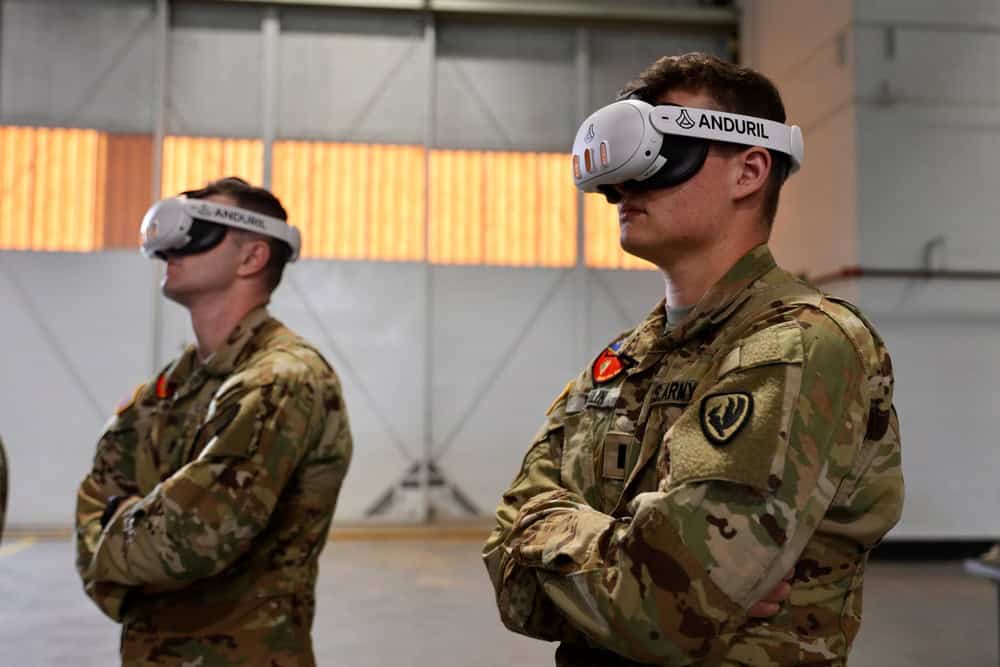
The event at the Army Aviation Center of Excellence brought the subject into the classroom for students preparing to fly the AH-64 Apache. First Lt. Colby Clark and 1st Lt. Patrick Mullin, both in the Apache academics phase of training, used virtual-reality headsets to explore how aircraft and uncrewed systems might share information and support a formation. Anduril Industries supported the demonstration. The Army’s account is available through Army.mil and the original DVIDS release.
A classroom demonstration, not a fielding announcement
The distinction matters. The Army release describes an opportunity for students to examine possibilities and discuss operational concepts. It does not identify a selected aircraft, a funded program, a testing schedule or a plan to equip a unit with a particular autonomous system. The concepts shown should therefore be understood as examples for discussion, not as equipment entering Army service.
That framing also helps explain why the demonstration took place at a training center. Future aviators will encounter an aviation environment where aircraft may be part of a larger network of sensors, communications links and uncrewed platforms. Familiarity with the questions raised by those systems can help students think about how they would operate with them, even while designs and policies remain under development.
Glenn Rizzi, an Anduril program manager for maneuver dominance and retired Army aviator, introduced students to the virtual experience. The presentation included examples of unmanned aircraft systems and an optionally piloted helicopter concept. Students considered how uncrewed aircraft might support crewed formations through reconnaissance, sensing, communications relay or other mission-support functions. Those were potential roles discussed in the demonstration, not capabilities the Army announced as approved for operational use.
What the students examined
The first part of the experience focused on how an aviation formation might use a mix of crewed and uncrewed aircraft. A system that can gather information or relay communications could, in principle, extend what a crewed aircraft can observe or help maintain connectivity across a dispersed group. The release did not specify a platform, operating range, autonomy level or technical performance figures, so the demonstration should not be read as a test result.
Students also saw a hybrid-electric tiltrotor concept. The Army account presented it as an example of industry technology that could inform future conversations about autonomy. It did not say that the Army had selected the concept, evaluated it for a requirement or decided to acquire it. Keeping that boundary clear separates a classroom introduction from a program announcement.
The second part of the demonstration used a simulated three-dimensional battlefield environment. Students viewed how aircraft, unmanned aerial systems, ground robots, artillery, rockets and communications networks could exchange information across a formation. The scenario provided a way to discuss how a commander might coordinate multiple systems and keep information moving among people and equipment.
For students in Apache academics, the display connected future-facing concepts to the aircraft training they were already undertaking. The Army release described the exercise as a practical look at systems that could influence future aviation roles. The students could explore the layout and interactions in a simulation without treating it as a live mission, flight test or operational evaluation.
Why human-machine teaming raises practical questions
Adding autonomous aircraft to an aviation formation would involve more than building an aircraft that can fly without a pilot onboard. Crews and commanders would need to understand what a system can do, how it receives instructions, what information it returns and how a person can intervene when conditions change. The Fort Rucker event raised those kinds of integration questions through a visual, interactive scenario.
Communications are central to that discussion. A crewed aircraft might depend on an uncrewed system to observe an area or relay information, but the value of that support would depend on reliable links and useful data. The Army presentation did not offer technical answers or claim that those issues had been solved. It gave students an opportunity to consider how networks and aircraft could fit together, and what would need further testing.
Command and control is another open question. A formation that includes several types of aircraft, robots and ground units could present a heavy workload for crews. Students discussed ways systems might support reconnaissance, sensing or communications, but any future operational use would require decisions about who directs each system, how tasks are assigned, and how the crew maintains a clear picture of the mission.
Training and doctrine would also have to develop alongside the technology. The Army account notes that future use would require experimentation, testing, airworthiness assessment, doctrine work and integration with command-and-control processes. Those steps are part of the distinction between seeing a concept in a simulation and making it safe, reliable and useful for real Army aviation operations.
A wider Army focus on autonomous systems
The demonstration took place amid a broader Army effort to organize work on autonomy. An October 1 memorandum from Acting Army Secretary Adam Telle directed the creation of the U.S. Army Futures and Autonomous Systems Command and called for autonomous capabilities to be considered across at least six Army formations, including aviation. The memo also set a goal of prioritizing collaborative teaming between crewed and uncrewed platforms by fiscal year 2028. The directive is available in the Army’s announcement of the new command.
That larger policy context explains why Army aviation students were introduced to human-machine teaming, but it does not turn the Fort Rucker event into a procurement decision. The Army’s own release says no procurement, fielding or endorsement resulted from the demonstration. The next steps for any specific capability would depend on requirements, testing, airworthiness decisions, resourcing and formal acquisition choices.
For now, the value of the event is educational. Students were able to see how a future formation might combine aircraft, uncrewed systems and shared information, then consider where human decisions remain essential. That exposure can help future aviators ask better questions as the Army studies how autonomy could fit into aviation, while leaving room for testing and policy to determine which ideas are practical.
What comes next
The Army has not announced a follow-on test, a selected optionally piloted helicopter or a schedule to equip Apache units with autonomous aircraft. The Fort Rucker demonstration should be viewed as an early exploration of concepts, with additional experimentation and evaluation required before any of them could become operational capability.
That leaves the central question open: how can an Army aviation formation use autonomous systems to extend awareness or support crews without adding complexity that makes the mission harder to manage? The virtual-reality session did not resolve that question. It gave future aviators a chance to examine it before they face the task in an operational setting.

No comment