
Published November 20, 2026
Historical event date: November 20, 1998
The first piece of the International Space Station left Earth on November 20, 1998. A Proton rocket carried the Zarya module from the Baikonur Cosmodrome in Kazakhstan. About nine minutes into the flight, the module was in orbit and began deploying its solar panels and antennas. The NASA account of the station’s construction traces the project’s start to that launch. Everything that would later make the station familiar, from its laboratory modules to its large solar arrays, would arrive on other flights.
What Zarya had to do on its own
Zarya was built in Moscow by the Khrunichev State Research and Production Space Center under contract to NASA. The module’s formal name was the Functional Cargo Block. NASA describes it as the infant station’s temporary control module. It had to be able to function by itself in orbit while the next piece was still on Earth. That made it a spacecraft in its own right as well as the first element of a much larger structure.
The deployment of the solar panels and antennas illustrated the immediate priorities after separation. The solar panels provided a means of generating electrical power, and the antennas made communications possible. Once the module was operating in orbit, the assembly program could move to a different engineering problem. The next component had to catch up with Zarya and attach to it, even though the two units had never been brought together on the ground.
Endeavour brings Unity
Space Shuttle Endeavour carried the U.S.-built Unity node and two pressurized mating adapters on STS-88. NASA identifies Unity as the second station module and the first U.S. component. A node is a connection point, and its job becomes clearer as other modules are added. It gives their crews a way to move between pressurized spaces and provides connections for the systems that those spaces share. NASA’s Unity module overview describes the hardware and its role in the finished station.
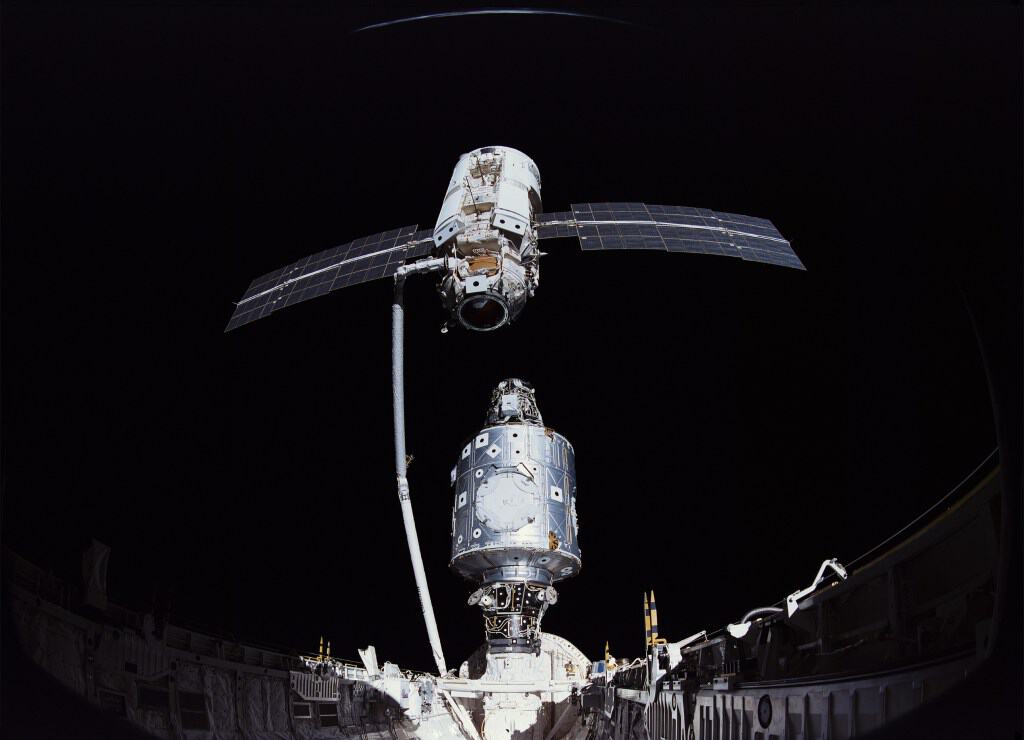
On December 6, the shuttle closed in on Zarya. Endeavour’s crew used the shuttle’s robotic arm to capture the module and bring it into position to mate with Unity. Teams had built the units in different countries. Their first physical fit took place in orbit. The crew then spent several days putting in the connections that let the modules work together. NASA’s anniversary photo feature shows them above Earth after their December 13 release from the shuttle.
From two modules to a permanent outpost
The two pieces gave later crews a place to attach more hardware. NASA records that the arrival of Russia’s Zvezda service module in July 2000 enabled long-term habitation. Expedition 1 arrived that November, with William Shepard, Sergei Krikalev and Yuri Gidzenko. Other assembly flights brought more electrical power, the U.S. Destiny laboratory and Canada’s Canadarm2 robotic arm. The project eventually drew on multiple kinds of launch vehicles, along with spacewalks and extensive robotics work, to connect major components that had never been assembled together on Earth.
Seen from Endeavour in December 1998, the station consisted of two modules and their adapters. The photograph captures the point when a first launch had become an assembly project. It also shows why November 20 is the starting date. Zarya was the piece the next flight could meet, and Unity gave subsequent flights a way to add to what was already there. As the station acquired living quarters, laboratories and new places to dock, the first joined modules remained part of the path crews could travel through.
Sources
NASA Johnson Space Center — ISS20th: High-Flying Construction
NASA — 25 Years Ago: The First Pieces of the International Space Station. The joined Zarya and Unity modules above Earth after release from Endeavour on December 13, 1998. NASA, STS-88, image S99-03776. Editorial use under NASA media guidelines. NASA media guidelines.

No comment