
Published November 24, 2026
On November 25, 2022, NASA’s uncrewed Orion spacecraft entered a distant retrograde orbit around the Moon. At 4:52 p.m. Eastern, flight controllers at Johnson Space Center commanded the spacecraft’s orbital maneuvering system engine to fire for 88 seconds. The burn was brief, but it changed the nature of the flight. Orion had reached the vicinity of the Moon and passed close to it earlier in the mission. Now the spacecraft was settled into the orbit NASA had planned for the next portion of Artemis I. NASA’s flight-day report recorded the maneuver shortly after it happened.
A wide path around the Moon
The name of the orbit describes its shape and direction. In this case, “distant” meant the spacecraft would range roughly 40,000 miles above the Moon. “Retrograde” referred to the direction of the orbit around the Moon, opposite the direction in which the Moon travels around Earth. The resulting path looked very different from the low lunar orbits flown by Apollo crews. It gave Orion room to travel far beyond the Moon as seen from Earth while remaining on a planned path through the lunar region.
The flight had already taken Orion through a key earlier maneuver. A close lunar pass on November 21 helped set up the approach to the distant orbit. That flyby and the November 25 insertion served different purposes. The first used a close encounter with the Moon to shape the outbound trajectory. The second put Orion on the path it would follow for the next several days. Together they show how a lunar mission links short engine firings with longer stretches of coasting, with each event setting the conditions for the next.
What NASA could learn there
Artemis I was a flight test of the systems NASA intended to use on later crewed Artemis missions. Sending Orion beyond the Moon let mission controllers observe the spacecraft over a longer stretch of deep-space flight. That mattered because the character of a test changes once the vehicle leaves Earth orbit. The capsule still needs to exchange information with Earth, manage its power and maintain the orientation required for its instruments and systems while it follows a trajectory thousands of miles from the nearest landing site.
The distant orbit was also a useful place to spend time. NASA’s November 25 update said the orbit would require relatively little fuel to remain in. Instead of repeatedly changing course, the mission team could use the time to monitor the spacecraft and gather flight data before setting up the return. An insertion burn lasting less than a minute and a half thus opened a phase of the mission measured in days.
The view back toward Earth
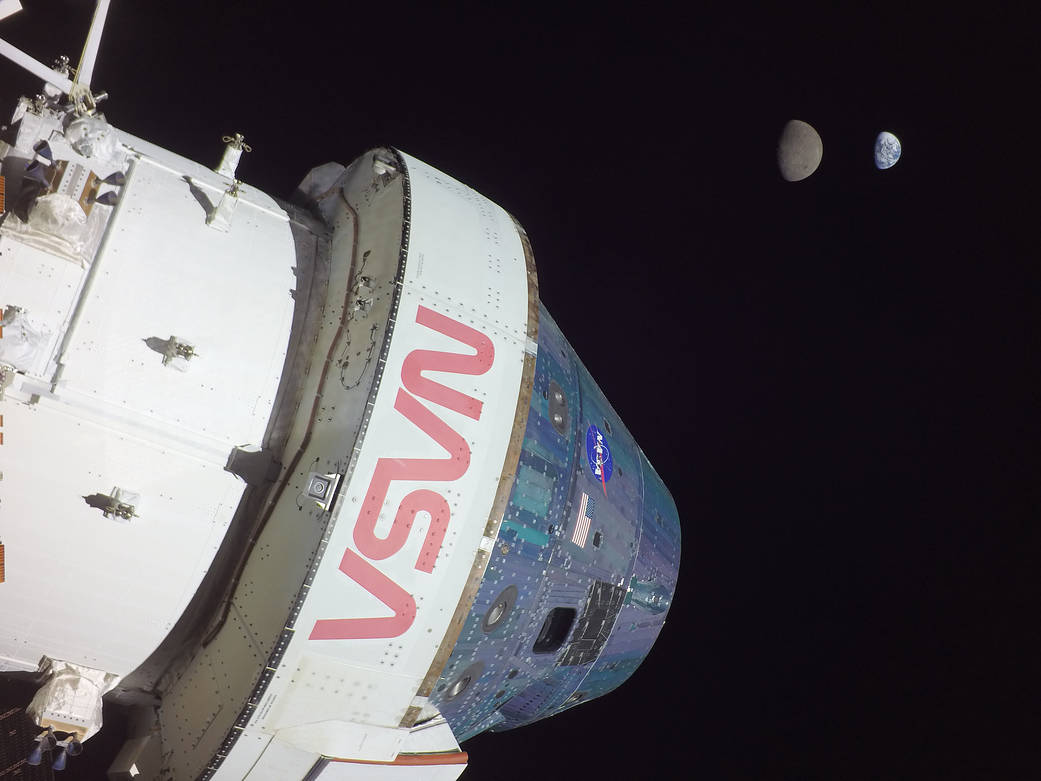
On November 28, three days after insertion, Orion reached its greatest distance from Earth on Artemis I. NASA put that distance at 268,563 miles. The photograph accompanying this article comes from that later point in the mission. A camera mounted on a solar array captured Earth and the Moon from the spacecraft’s perspective. The image records what the geometry of that wide orbit looked like from Orion, with both worlds visible in the same frame.
The orbit was a waypoint for a flight designed to come home. Orion had to leave the distant path, use another lunar flyby to help set up its return, and ultimately reach Earth for recovery. The November 25 burn sits at the center of that sequence. It demonstrated that a spacecraft designed for crewed missions could reach a planned deep-space orbit during an uncrewed test and spend time there before turning back toward Earth.
Featured photograph: Earth and the Moon seen from Orion on November 28, 2022. NASA solar-array camera photograph, public domain.
Sources
NASA’s November 25 Artemis I flight-day report
NASA image archive and November 28 distance record



No comment