
Published November 24, 2026
At 6:44 p.m. Eastern on November 24, 1991, space shuttle Atlantis lifted off from Pad 39A at Kennedy Space Center. It carried six people, a Defense Support Program satellite with its own upper stage, and a collection of experiments that would occupy the crew after the main payload was out of the cargo bay. NASA’s mission record identifies the flight as STS-44.
A launch after dark
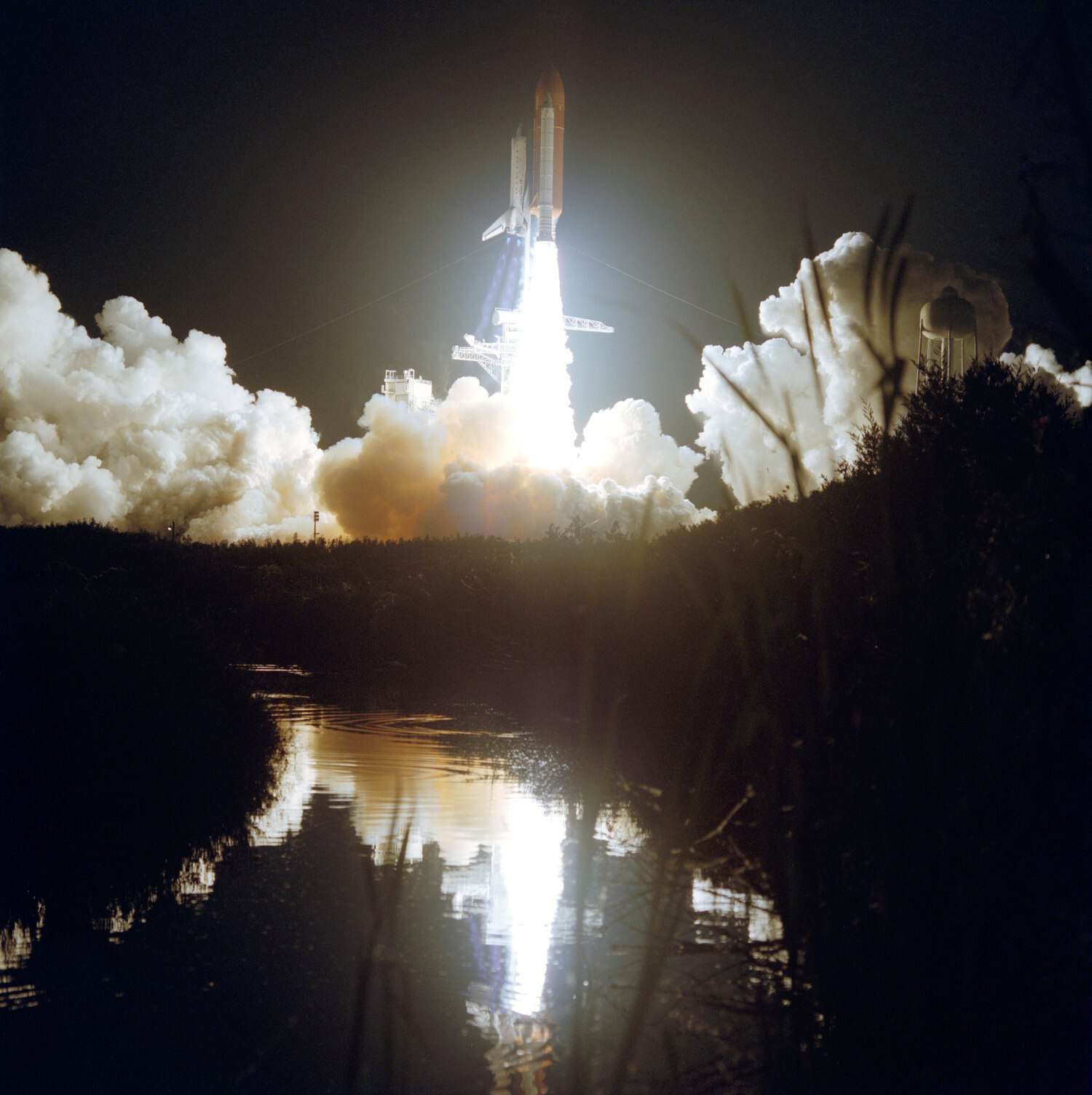
A remote camera recorded the shuttle climbing above the pad. The photograph shows a bright exhaust cloud spreading below Atlantis as the vehicle rises against the dark sky. The light makes the scale of the exhaust more apparent than the outline of the orbiter. NASA’s archive identifies the picture as STS044-S-095, taken on the evening of launch. NASA launch photograph.
Frederick D. Gregory commanded the flight, with Tom Henricks as pilot. F. Story Musgrave, James S. Voss and Mario Runco Jr. served as mission specialists, and Thomas J. Hennen was the payload specialist. The launch was the beginning of a nearly seven-day mission. The satellite deployment came on the first flight day, leaving the crew time in orbit for work in the cabin and experiments elsewhere aboard the shuttle. NASA crew and mission summary.
From the cargo bay to orbit
The unclassified primary payload paired a Defense Support Program satellite with an Inertial Upper Stage. Atlantis carried the pair into Earth orbit, where they could be released together. The upper stage provided the propulsion needed for the satellite’s onward journey. For a reader looking at the launch photograph, that distinction explains why the launch was only the first step in getting the payload where it needed to go. The shuttle served as the crewed carrier for the first part of the trip. NASA’s Space Shuttle retrospective.
On a shuttle flight, a large payload naturally dominates the account of liftoff. Once it was deployed, though, the rest of the mission still had a full program. The NASA retrospective lists a contamination monitor, instruments for studying aspects of the space environment, and the Extended Duration Orbiter Medical Project. These investigations used time and space aboard an orbiter already carrying a crew and working in orbit.
The work inside Atlantis
NASA’s STS-44 gallery shows another side of the mission. One photograph catches Voss working below the middeck floor. In another, Henricks tests his visual acuity. The pictures take the story from a distant view of the launch to the scale of the cabin, where astronauts could collect observations and perform tasks in the conditions of an actual spaceflight.
The medical project comprised several investigations supporting the Extended Duration Orbiter program. That made the astronauts part of the research as well as the people carrying it out. A visual test, for example, gives investigators a way to collect observations on how a person performs in orbit. The mission also carried radiation monitors and equipment to observe contamination around the vehicle. The variety of instruments illustrates how engineers and researchers could use the same flight to study both the people aboard and the environment around them. NASA retrospective and payload list.
A California landing
Atlantis landed at Edwards Air Force Base, California, on December 1. NASA records a flight of six days, 22 hours and 50 minutes and 110 orbits. The mission began with a night launch in Florida and ended on a runway across the continent. In between, the orbiter delivered its primary payload and gave six crew members nearly a week to carry out work that could only be done in flight. NASA flight and landing record.
Featured photo: NASA, STS044-S-095, public-domain U.S. government imagery.






No comment