
Published November 23, 2026
On November 23, 1959, the Boeing 720 made its first flight. Boeing had already put the 707 into service, and the new airplane brought much of that design to a different set of routes. The company describes the 720 as a modified 707 intended for short- and medium-range service and for operation from shorter runways. That combination opened a different market for Boeing’s four-engine jet family. Boeing chronology
A jet for a different route
Airlines choose aircraft for the routes they expect to fly repeatedly. A long trip can justify carrying more fuel and using a large airport with a long runway. On a shorter route, an airline may put greater value on serving an airport closer to its passengers or offering more departures with fewer seats per flight. Those choices are connected. An aircraft that can use a particular runway may still be a poor fit if it offers too many seats for the route, while an aircraft with the right capacity is of little use if it cannot operate from the airport.
Boeing’s answer was to adapt an airframe it already knew. The 720 had a shorter fuselage and a lighter structure than the 707 versions from which it was developed. Boeing also changed the wing’s leading-edge geometry. The wing change is a useful detail because photographs of the aircraft can make it look like a 707 with a few rows of seats removed. For the engineers working on it, weight, airflow and runway performance were part of the same design problem. First-flight and design account
The first aircraft carried the registration N7201U. That detail identifies the airplane involved in the November 23 milestone, which is easy to confuse with the many later photographs of the type in airline and research service. The date marks the beginning of the aircraft’s flight-test history. An airline’s first passenger departure on the type was a separate milestone. Aircraft identification and first-flight date
What the shorter runway requirement changed
Takeoff and landing performance help determine which airports an airline can use and how much it can carry on a given day. Temperature, airport elevation and runway conditions also affect those calculations. For a manufacturer adapting an existing jet, shortening the cabin was one way to reduce weight, but it did not by itself settle how the aircraft would behave in the air or on the runway. The 720 is an example of how a familiar airliner shape can conceal meaningful differences in the design work underneath.
There was also a practical reason to start with a related airplane. Boeing’s existing jet program gave the company an airframe and a body of engineering experience from which to work. Designing for a new part of the airline market could then focus on which parts of that aircraft could be retained and which characteristics had to change. For passengers, those decisions ultimately mattered in ordinary terms, including which airports could support jet service and which city pairs an airline could serve with its available fleet.
A Boeing 720 in NASA’s archive
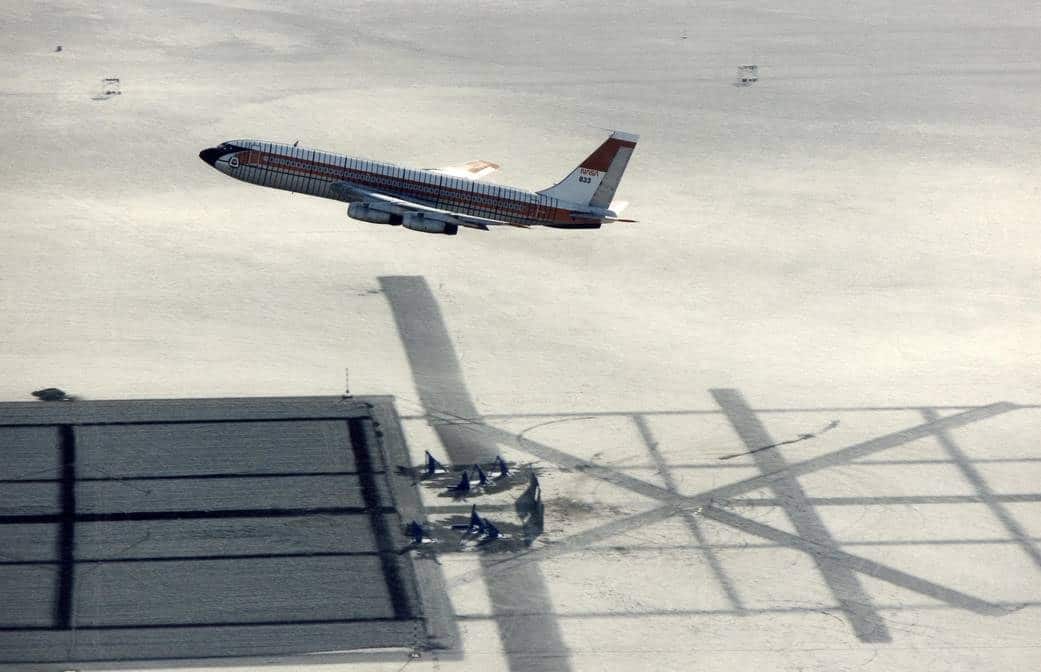
The featured photograph shows a Boeing 720 in a later chapter of the type’s career. NASA identifies it as a practice run ahead of the joint NASA and FAA Controlled Impact Demonstration in 1984. The agencies used the aircraft for a full-scale aviation safety experiment. Its flight path in the photograph belongs to that research program, more than two decades after the type’s first flight. NASA photo record and experiment background
The two dates tell different parts of the story. The 1959 flight marked Boeing’s effort to make a jet family useful on a wider range of airline routes. The 1984 photograph documents what a retired example could contribute to safety research. The same type that was designed around airline operating requirements later gave researchers a full-size transport aircraft for a controlled experiment.
Featured photo: A Boeing 720 flies a practice pass before the 1984 Controlled Impact Demonstration. NASA archive image EC84-3167-A, public domain. Photo source and credit.
Sources
Boeing historical chronology · This Day in Aviation first-flight record · NASA image archive and Controlled Impact Demonstration





No comment