
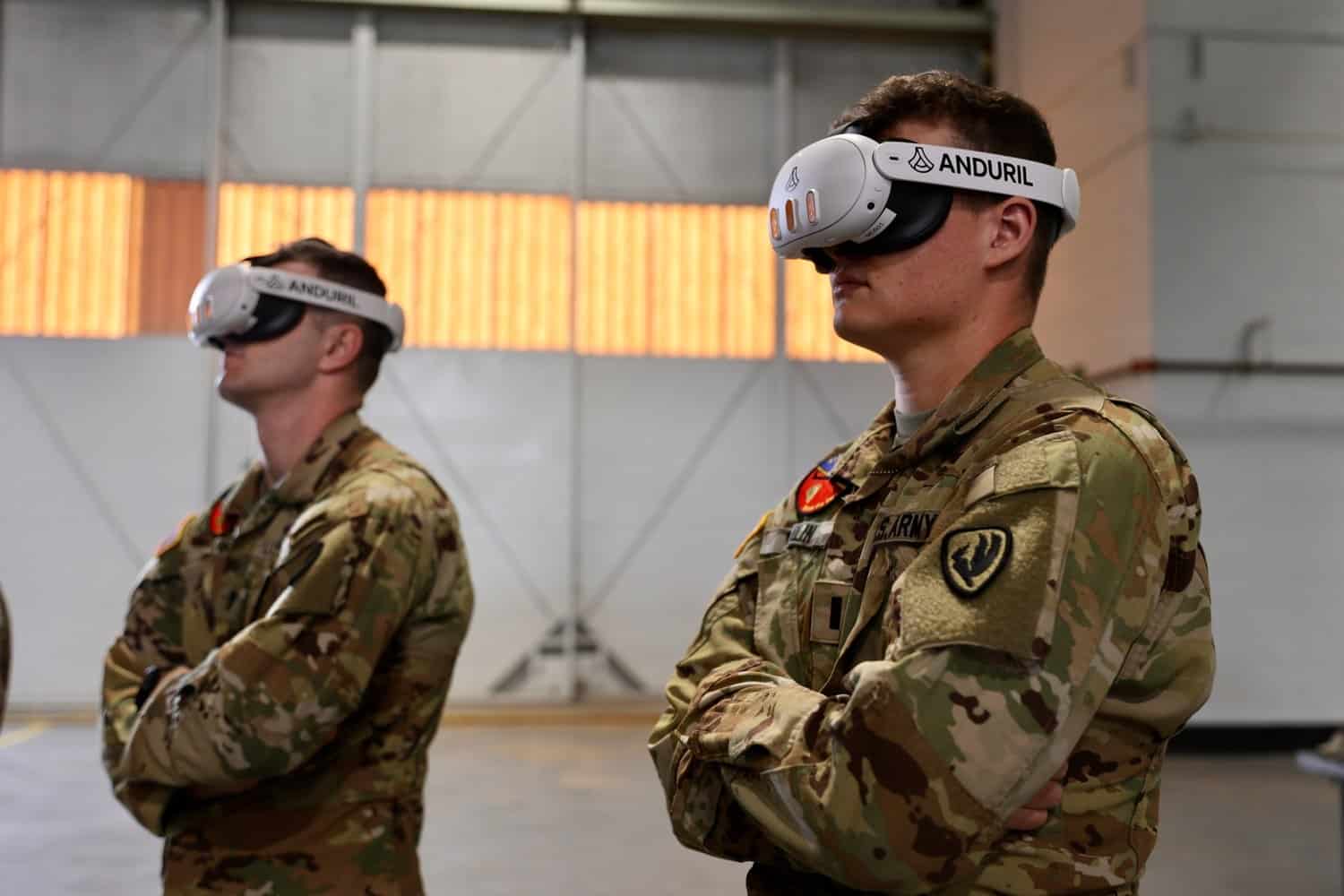
Army aviation students at Fort Rucker, Alabama, put on virtual reality headsets on November 20 to explore how crews might work alongside autonomous aircraft. The Army Aviation Center of Excellence said the demonstration was designed to prompt discussion about emerging technology and the responsibilities aviators might have if it enters service.
Two of the participants, First Lt. Colby Clark and First Lt. Patrick Mullin, were in the academic phase of AH-64 Apache flight training. They were learning to operate a specific crewed aircraft when the demonstration asked them to consider a broader question: how might the people in that aircraft work with other systems that have varying degrees of autonomy?
An introduction during flight training
Maj. Gen. Phillip C. Baker, commanding general of the Army Aviation Center of Excellence and Fort Rucker, requested the event. Anduril Industries supported the demonstration, and Glenn Rizzi, a company program manager and retired Army aviator, introduced the students to the virtual experience.
The Army release described two parts to the session. The first presented examples of emerging aviation technology, including an optionally piloted helicopter concept and a hybrid-electric tiltrotor concept. The second used a three-dimensional display to give students a view of how multiple platforms might relate to one another. The Army characterized the demonstration as an educational event and said it carried no procurement, fielding or endorsement decision.
Questions the demonstration raised
A new aircraft introduces questions that aviators already know how to ask. Who is responsible for it? What information does the crew have? How does its use change the crew’s workload? Autonomous systems add another layer to those questions, because the people using them need to understand the limits of the technology as well as what it can do. Mullin told the Army that the discussion also raised questions about control and responsible use.
The session gave students a way to consider concepts before they encounter them in an operational unit. It also put aircraft technology in the context of the people expected to use it. A student can discuss how a display represents several aircraft at once and what that picture leaves out. Those are useful distinctions when a demonstration is meant to familiarize an audience with a concept.
The Army listed experimentation, testing, airworthiness assessment and development of doctrine among the steps that would be needed before future use. Those steps are separate from introducing students to the ideas. The November session took place in the training environment, where the students could view the concepts and ask questions about them while they continued their Apache coursework.
Featured photograph: U.S. Army photo by Leslie Herlick, public domain via DVIDS.
Sources
Army Aviation Center of Excellence release
DVIDS featured photograph and rights statement






No comment