
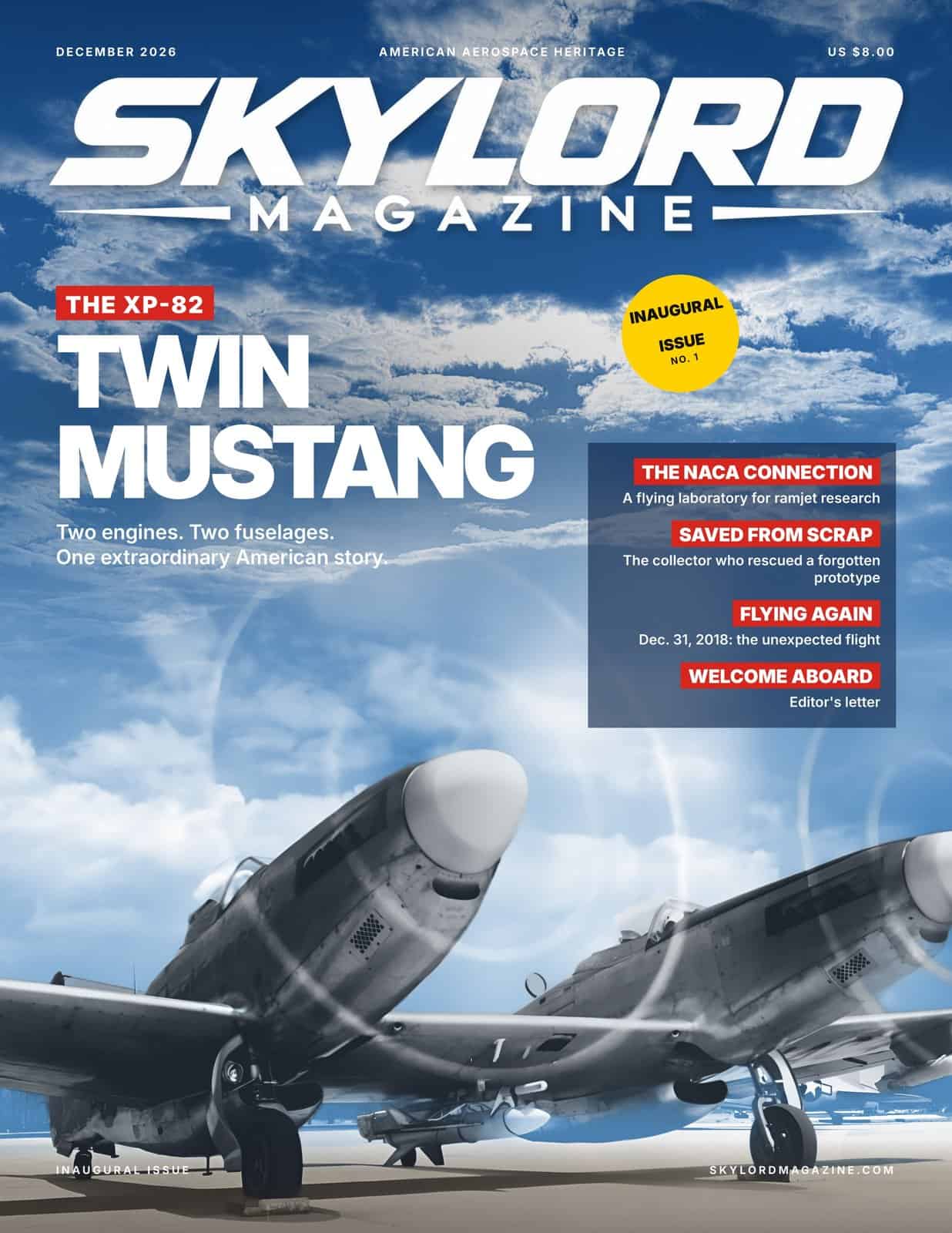
From Pacific Escort to Flying Laboratory: The Second Life of XP-82 Serial 44-83887
Few airplanes have lived as many lives as North American XP-82 serial number 44-83887. Built as a long-range escort fighter at the end of World War II, it went on to carry experimental ramjet missiles for the agency that came before NASA, nearly ended up as scrap after an icy landing, spent decades in pieces on an Ohio farm, and then flew again almost seventy years later.
A Fighter Built for the Pacific’s Distances
By the closing years of the war, bombers such as the Boeing B-29 Superfortress could fly farther than the fighters sent to protect them. The P-51 Mustang had closed that gap over Europe, but the Pacific was another matter. The distances between island bases and targets meant escort pilots could face many hours alone in the cockpit.
North American Aviation’s answer looked, at first glance, like two P-51s joined by a wing. In reality the XP-82 Twin Mustang was a purpose-built design: two lengthened fuselages, two engines, two cockpits and a specially designed center wing. Two crew members could share the load on long missions, and the aircraft had the range to go with it. Its two Rolls-Royce Merlin-derived engines supplied the power.
Serial 44-83887 was one of the two original prototypes. They began flying in 1945, but the war was nearly over by then, and the type never saw the conflict it was designed for.
Joining NACA’s Propulsion Research
In October 1947, the National Advisory Committee for Aeronautics (NACA) acquired the prototype for its Cleveland laboratory. That lab, the Aircraft Engine Research Laboratory, later became the NACA Lewis Flight Propulsion Laboratory and is now NASA’s Glenn Research Center. It specialized in propulsion: how aircraft and missiles might fly far faster than propeller-driven airplanes.
Wind tunnels could answer only some of those questions, so NACA needed an airplane that could carry test hardware aloft. The Twin Mustang had the range, the altitude capability, the payload capacity, room for external test installations and a two-person crew, which made it a strong candidate.
The XP-82 never flew for NASA itself, because its research career ended before NASA was formed in 1958 and absorbed NACA. But the people, methods and facilities behind its work became part of the foundation NASA was built on.
Ramjets Beneath the Wing
A ramjet has no rotating compressor. Instead, the vehicle’s forward motion rams air into the inlet. That design has advantages at high speed, but a ramjet can’t produce useful thrust from a standstill. It has to be brought up to speed first.
NACA’s solution was to carry the engines up on another aircraft. Experimental ramjet missiles roughly 16 feet long hung beneath the XP-82’s right wing. According to NASA’s historical account, research pilots took the aircraft to about 30,000 feet and Mach 0.5 before starting the test sequence. The missile then accelerated away while instruments radioed pressure and temperature data to researchers on the ground, and it ended its flight in the ocean.
A NASA photograph dated April 22, 1949, shows the XP-82 preparing for takeoff with one of these missiles under its right wing.
The Pilots: Joseph A. Walker and William Swan
NASA’s account highlights two pilots. Joseph A. Walker joined NACA in March 1945 and later flew the North American X-15 rocket plane, which he took above the altitude the U.S. military recognizes as the boundary of space. He flew the X-15 24 times, reached 4,104 mph (Mach 5.92) on June 27, 1962, and reached 354,300 feet on August 22, 1963. William Swan, whose name also appears as Swann in some photo captions, also flew in NACA’s ramjet program. A 1945 NACA photograph of Cleveland research pilots shows both men.
“Within less than two decades, American research aviation moved from wartime fighter technology to piloted rocket aircraft operating at the edge of space.” (SkyLord Magazine, December 2026)
December 14, 1949: Ice, Mud and a Grounded Prototype
On December 14, 1949, the XP-82 was returning to Cleveland Municipal Airport when it hit ice on landing, skidded sideways and left the runway. Unusually warm weather earlier that week had softened the ground, and the landing gear sank into the mud. The center wing, landing gear, radiators and propeller were damaged. The pilots weren’t hurt, but NACA decided the prototype wasn’t worth repairing. Its engines and propellers were removed, and a different Twin Mustang, F-82E serial 44-65168, took over the research work. That replacement is a separate aircraft with its own history.
Saved by a Collector, Rebuilt by a Restorer
The damaged airframe was sold to Walter Soplata, an Ohio collector who kept retired military aircraft on his property in Newbury. NASA’s account says he cut the airplane apart to move it there. Over the decades it deteriorated. Parts were separated or sold, and the military borrowed the right fuselage for destructive testing. Still, the airframe and its serial number survived.
In 1997, veteran restorer Tom Reilly found the remains on Soplata’s property. Restoration began in earnest in 2008, after the aircraft was acquired, and Reilly’s team did the work in Douglas, Georgia. They searched the United States and other countries for parts, including material from other F-82s and from a crash site in Alaska. Where nothing could be found, they built new components from scratch. EAA and NASA put the effort at about 207,000 labor hours over more than a decade.
Back in the Air
On December 31, 2018, test pilot Ray Fowler was running a high-speed taxi test that was supposed to include only a brief hop. EAA reported that the two engines made a combined 3,720 horsepower. Once the airplane was airborne, Fowler decided that trying to land and stop in the runway left was riskier than flying on, so he stayed up for about five minutes. It was the first time 44-83887 had flown since 1949. The first planned post-restoration flight followed on January 28, 2019, and the Twin Mustang appeared at EAA AirVenture Oshkosh that summer. NASA’s account identifies the restored aircraft as displayed at the Valiant Air Command Warbird Museum in Titusville, Florida, near Kennedy Space Center.
Read the full story, with archival photographs, in the December 2026 issue of SkyLord Magazine, available to members.


No comment