
Most trips to Mars start with a launch and a straight shot out of town. NASA’s ESCAPADE mission is doing it differently. A year after two small spacecraft lifted off from Cape Canaveral, they are heading back toward Earth this week, and they are doing it on purpose.
On Saturday, Nov. 7, and Monday, Nov. 9, each of the twin ESCAPADE spacecraft will swing close past our planet and fire its engine at the same time, using Earth’s gravity plus its own thrust to slingshot itself toward Mars. In a Nov. 2 update, NASA said the mission “will perform a maneuver that no agency spacecraft has flown before — and do it twice.”
What happens this weekend
ESCAPADE stands for Escape and Plasma Acceleration and Dynamics Explorers. According to NASA, the first spacecraft will make its flyby and engine burn around 5 a.m. EST on Nov. 7, and the second will follow around 6 a.m. EST on Nov. 9. At closest approach, each one performs what NASA calls a “trans-Mars injection burn,” firing its engine for about 9 minutes.
That burn adds more than 1,000 miles per hour to each spacecraft, taking it from about 6.3 miles per second to about 6.7 miles per second, or roughly Mach 30 to Mach 31. NASA puts that in terms anyone can picture: at that speed, the spacecraft could fly from Washington, D.C., to San Francisco in less than 7 minutes.
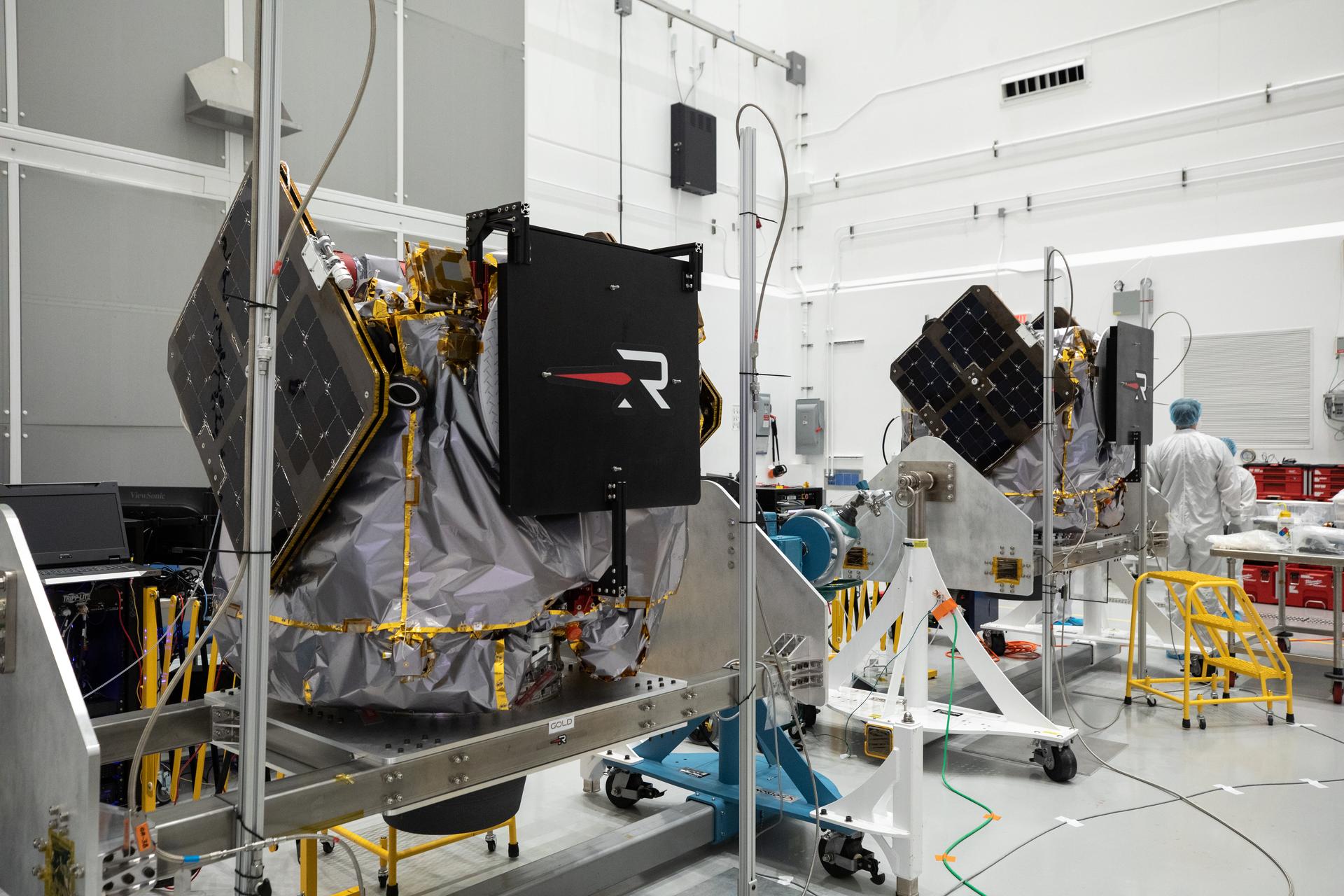
NASA says the burns begin at 4:51 a.m. EST on Nov. 7 and 5:51 a.m. EST on Nov. 9, while each spacecraft is over southern Australia. At closest approach, the spacecraft, each about the size of a standard refrigerator, will be between 600 and 1,100 miles above the surface.
Why take the long way
Pilots know that timing is everything, and so do mission planners. NASA explains that earlier Mars missions launched when Earth and Mars were aligned, which only happens every 26 months, to shorten the trip and save fuel. ESCAPADE launched in November 2025, when the two planets were on opposite sides of the Sun.
Instead of waiting on the ground, the twins went to space and waited there. NASA says they flew a kidney-bean-shaped loop around the Earth-Sun Lagrange point 2, a spot about a million miles from Earth on the side opposite the Sun, then headed back toward home so they could use Earth’s gravity once the planets lined up again. That alignment is now.
Some spacecraft have used Earth flybys to reach other destinations, but NASA says no Mars-bound spacecraft has successfully executed a powered flyby, also known as an Oberth maneuver.
The detour has already paid off. NASA reports that the route let ESCAPADE collect “bonus” science while flying through a distant part of Earth’s magnetotail, the region of Earth’s magnetic environment stretched out by the solar wind. No spacecraft had directly explored that part of the magnetotail before, and the mission’s scientists plan to share those findings soon.
A Florida launch
ESCAPADE has strong Space Coast roots. The twin spacecraft, built by Rocket Lab, were unboxed and processed at the Astrotech Space Operations Facility near Kennedy Space Center in August 2024, as the NASA photo above shows. They launched aboard Blue Origin’s New Glenn rocket at 3:55 p.m. EST on Nov. 13, 2025, from Launch Complex 36 at Cape Canaveral Space Force Station.
The mission is managed by the Space Sciences Laboratory at the University of California, Berkeley. NASA lists Rocket Lab, NASA’s Goddard Space Flight Center, Embry-Riddle Aeronautical University, Advanced Space LLC and Blue Origin as key partners.
What the twins will do at Mars
After the flybys, NASA says the spacecraft face a 10-month cruise, arriving at Mars on Sept. 7 and Sept. 9, 2027. Along the way they will make small course corrections, called trajectory correction maneuvers, to make sure they arrive at the right place and time.
At Mars, ESCAPADE is set to become the first multi-spacecraft mission to fly in formation around the planet. Its job is to study how the solar wind, a stream of material from the Sun moving at about a million miles per hour, interacts with the Martian environment and drives the loss of the planet’s atmosphere. NASA’s mission page says that work could help explain how Mars lost its once-thick atmosphere, one that may have supported liquid water. The twin satellites will measure Mars’ upper atmosphere and magnetic environment at altitudes between 100 and 6,200 miles.
Can you see them?
Maybe, with help. NASA says the spacecraft will be faint, and a telescope will most likely be needed to spot them as dim points moving against the stars. Observers in the western U.S. have the best chance in the hours before each burn: the first spacecraft should be brightest between midnight and 1 a.m. PST in the early morning of Nov. 7, and the second between 1 and 2 a.m. PST on Nov. 9. NASA’s Scientific Visualization Studio has posted sky maps for different locations, and NASA’s Jet Propulsion Laboratory Horizons System can provide coordinates.
The Skylord take
There is something every aviator can appreciate here. ESCAPADE’s team couldn’t change the calendar, so they changed the route, parked two spacecraft a million miles out, and came back for the right window. Several days after the burns, NASA says, the team will know how well the spacecraft are aimed for Mars. We will be watching.
Have an aviation or space story Skylord Magazine should cover, or someone we should interview? Send us your tips.
Sources
- NASA Science, “NASA’s Twin ESCAPADE Spacecraft to Slingshot Past Earth on Way to Mars,” Nov. 2, 2026: https://science.nasa.gov/blogs/escapade/2026/11/02/nasas-twin-escapade-spacecraft-to-slingshot-past-earth-on-way-to-mars/
- NASA Science, ESCAPADE mission page: https://science.nasa.gov/mission/escapade/
- NASA Image and Video Library, “ESCAPADE Unboxed at Astrotech” (KSC-20240822-PH-KLS01_0003), photo by NASA/Kim Shiflett: https://images.nasa.gov/details/KSC-20240822-PH-KLS01_0003
- NASA Image and Video Library, “NASA’s ESCAPADE Launch on Blue Origin’s NG-2” (KSC-20251113-PH-BLU01_0001), launch details: https://images.nasa.gov/details/KSC-20251113-PH-BLU01_0001
- NASA Scientific Visualization Studio, ESCAPADE sky maps: https://svs.gsfc.nasa.gov/15114/
- NASA Images and Media Usage Guidelines: https://www.nasa.gov/nasa-brand-center/images-and-media/


No comment