
Published November 26, 2026
On August 22, 1963, NASA research pilot Joseph A. Walker flew the X-15 to 354,300 feet. It was his final flight in the rocket plane and the highest altitude reached by the program. Walker had spent years flying research aircraft before the X-15 arrived at Edwards Air Force Base. His work ranged from studying ice on aircraft to testing machines that carried their pilots into parts of the atmosphere conventional airplanes could never reach. NASA’s biography records the altitude, the flight date and his earlier work.
From icing research to Edwards
Walker joined the National Advisory Committee for Aeronautics in 1945 at its Aircraft Engine Research Laboratory in Cleveland. He worked as both a physicist and a research pilot, with much of his early effort devoted to icing. The work put him on both sides of flight research. The laboratory needed an explanation for what ice did to an aircraft. The people conducting a flight needed to know how the airplane behaved as those conditions developed.
In 1951 he transferred to the High Speed Flight Research Station at Edwards. The experimental aircraft he flew there included the D-558 series and several of the early X-planes. The assignments gave him experience moving between aircraft designed to answer different questions. A flight might investigate an aerodynamic characteristic, expose a problem that needed further tests, or establish whether a proposed maneuver made sense for the next flight.
What the X-15 could investigate
The X-15 was carried aloft under a B-52 and released before its rocket-powered portion began. After powered flight, it returned to a landing without a conventional engine to carry it around for another approach. This placed several kinds of flying into a single trip. The pilot began by working within a planned sequence with the carrier aircraft and ground team. At the other end, the airplane had to arrive at the dry lakebed with enough energy to complete the landing. NASA’s program history follows the development of that flight profile and describes how its research flights explored aerodynamic and thermal behavior.
Walker made NASA’s first X-15 flight on March 25, 1960, and flew the type 24 times. In June 1962 he reached Mach 5.92, according to his NASA biography. His August 1963 flight took the aircraft to its highest altitude. The speed and altitude figures describe different achievements. The X-15 could follow a profile chosen to build speed or climb steeply to investigate conditions higher above Earth. Each sort of flight put a different demand on the aircraft and its pilot.
Why the altitude flight matters
At the top of a climb like Walker’s, the atmosphere was thin enough that ordinary aerodynamic controls had little air to work with. The X-15 program gave engineers a way to study the transition between that environment and denser air, where the aircraft again flew and landed on its wings. A flight brought back measurements on more than the peak altitude. The climb, the change in control environment and the return all belonged to the same research sequence.
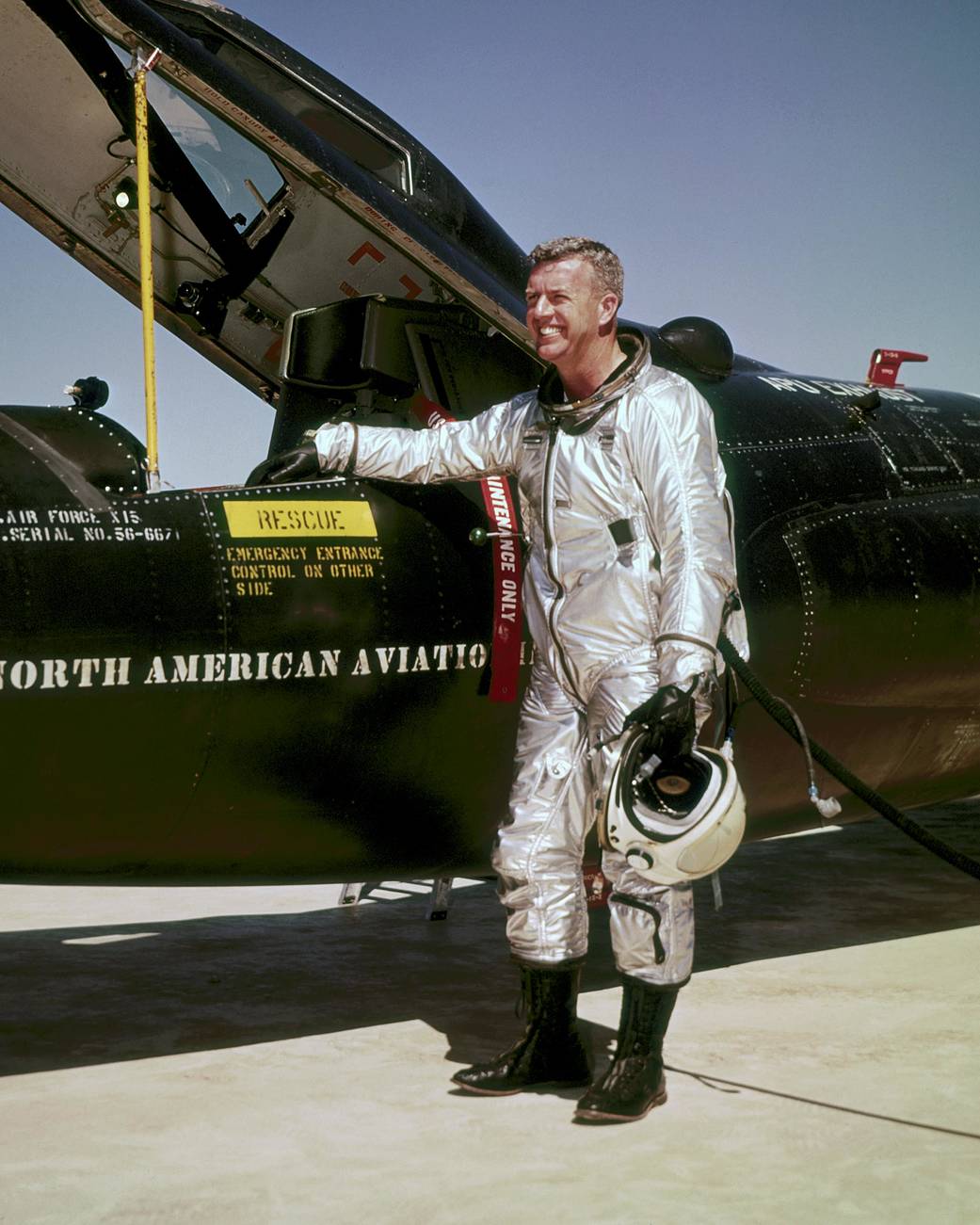
The featured photograph places Walker beside the aircraft. Its scale makes the research program easier to picture. A small cockpit sat within an aircraft built to carry a pilot, a rocket engine and the equipment needed to gather data. What Walker and the project team learned depended on repeat flights and the ability to compare what happened on one run with what had happened before. His altitude record remains memorable, and his 24 flights show how much work it took to get there.
Sources
NASA biography of Joseph A. Walker
NASA history of the X-15 program
NASA archive photograph EC68-1937
Featured photograph from NASA, EC68-1937, public domain.






No comment