
EnduroSat has booked two dedicated flights on Blue Origin’s New Glenn rocket to carry satellites it builds for customers. Both missions are planned to depart from Cape Canaveral, Florida, with the first scheduled for 2029. Blue Origin and EnduroSat announced the agreement on November 25. The companies did not identify a date for the second flight or publish a payload manifest for either mission.
What EnduroSat reserved
EnduroSat designs and builds spacecraft and can operate them after launch. Under the new agreement, it has bought two flights reserved for its customers. The arrangement allows satellites ordered by different customers to fly on the same New Glenn while EnduroSat coordinates the spacecraft side of the mission. The companies say they expect the flights to serve both new and existing customers.
The distinction matters for a company selling a satellite mission as a package. A customer still has to decide what its spacecraft should do and where it needs to operate. A dedicated launch gives EnduroSat a flight around which it can organize those requirements. The company can work backward from the launch plan to schedule spacecraft integration and testing, and it can bring those schedules together as the group of spacecraft for a flight takes shape.
A reserved rocket also leaves questions about how the missions will be assembled. Satellites can differ in shape, mass and deployment needs. When several fit under one fairing, engineers must plan how the spacecraft will be mounted, carried and released after the rocket reaches the required conditions. The November announcement establishes that there are two flights to plan around. It leaves the payload count, individual destinations and deployment sequences for later disclosure.
The rocket and its capacity
The contract names the New Glenn 7×2 configuration. Blue Origin says it can carry 45 metric tons to low Earth orbit or 13 metric tons to geostationary transfer orbit and uses a fairing seven meters in diameter. Both figures are advertised vehicle capabilities. They describe what the rocket is designed to carry to two different kinds of destinations. The announcement did not identify either destination as the planned orbit for the EnduroSat flights.
The fairing matters for customers because satellites take up space as well as weight. A group of spacecraft must fit around the equipment that holds them in place and later releases them. A wider fairing can give the integration team more options in choosing how to arrange the hardware. The eventual layout still depends on the spacecraft selected for each launch.
Blue Origin says the capacity can accommodate EnduroSat’s Frame S and Frame L satellite platforms as well as its larger Frame Max. A platform, or bus, provides the infrastructure that supports a customer’s instruments or other mission hardware. EnduroSat’s offering therefore spans spacecraft of different sizes. The releases describe which platforms could fit on the rocket. Neither company announced which of those platforms will actually fly on the first mission.
From a satellite order to an orbital mission
The launch agreement adds a step to a business that already covers spacecraft design, construction and operations. In practice, a satellite project moves through a series of transitions. The hardware has to meet the customer’s mission requirements, remain within the launch constraints and be ready for a handover to the team that will operate it after deployment. A change in launch timing can move those transitions. A change to the spacecraft can affect the integration work and the timing as well.
For a constellation customer, deploying more than one spacecraft together can matter because the satellites are intended to operate as a group. A company might need multiple spacecraft before it can begin a planned service or before a particular region receives the intended coverage. A dedicated flight can give a satellite manufacturer a way to coordinate several deliveries around one launch. It still needs to match what its customers want to the capabilities and schedule of the rocket.
EnduroSat and Blue Origin cited recent orders from TrustPoint for a navigation and timing constellation and from Vantor for an Earth-imaging fleet as examples of EnduroSat’s expansion. The companies did not name spacecraft from either program as payloads for these New Glenn missions. Via Satellite separately reported the two-flight agreement and the 2029 target for the first launch.
What to watch as 2029 approaches
The next details will show how the companies intend to use the space they have reserved. A named manifest would establish which customers and spacecraft are grouped together. A destination orbit would help explain that grouping. A second launch target would give a clearer view of how the agreement fits into the customers’ plans for getting their spacecraft into service. For now, the confirmed development is the reservation of two dedicated New Glenn flights for satellites built by EnduroSat.
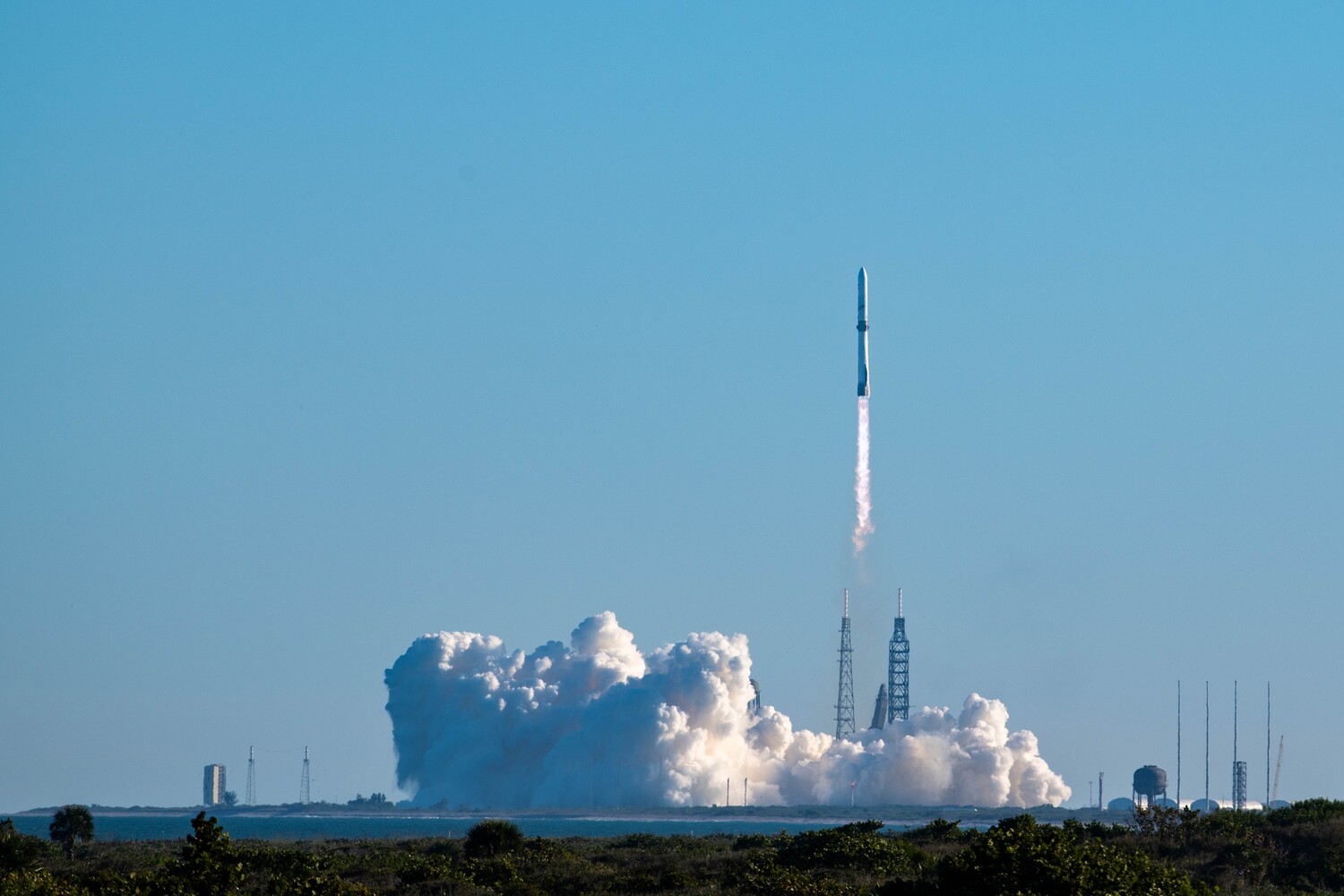
The featured photograph shows an earlier New Glenn departure from Space Launch Complex 36 on November 13, 2025. It documents the launcher and the Cape Canaveral setting described in the announcement. The first flight under the new agreement is scheduled for 2029.
Sources
Blue Origin’s November 25 announcement
EnduroSat’s November 25 announcement
Via Satellite coverage
U.S. Space Force archive photograph and rights record
Featured file photograph by Staff Sgt. Samuel Becker, U.S. Space Force, public domain.




No comment