
Published November 26, 2026
On November 26, 1947, the National Advisory Committee for Aeronautics put an 11-inch hypersonic wind tunnel into operation at Langley. The facility gave engineers a way to study airflow at speeds beyond Mach 5 while keeping a model and its instruments on the ground. NASA’s historical account of Langley records the date. Its technical history of wind tunnels explains how an installation built to guide the design of a larger tunnel became an important research facility in its own right.
Why an eleven-inch tunnel mattered
The name conveys the modest scale of the installation. A wind tunnel creates a controlled stream of air past a model. Researchers can vary the shape they put into the flow and compare the results under known test conditions. For a laboratory entering a new speed range, the equipment that produces the flow is itself part of the experiment. The team has to establish that the air in the test section behaves as intended before it can draw conclusions from the model placed there.
The small Langley tunnel made that work possible before the institution committed to larger equipment. The early project was called the 11-Inch Pilot Hypersonic Tunnel because it was meant to help establish how a larger installation should be designed. Its usefulness outlasted that assignment. NASA’s history records that the word Pilot was dropped from its name and that the tunnel was later moved from Langley’s East Area to a newer building in the West Area.
A window into the test section
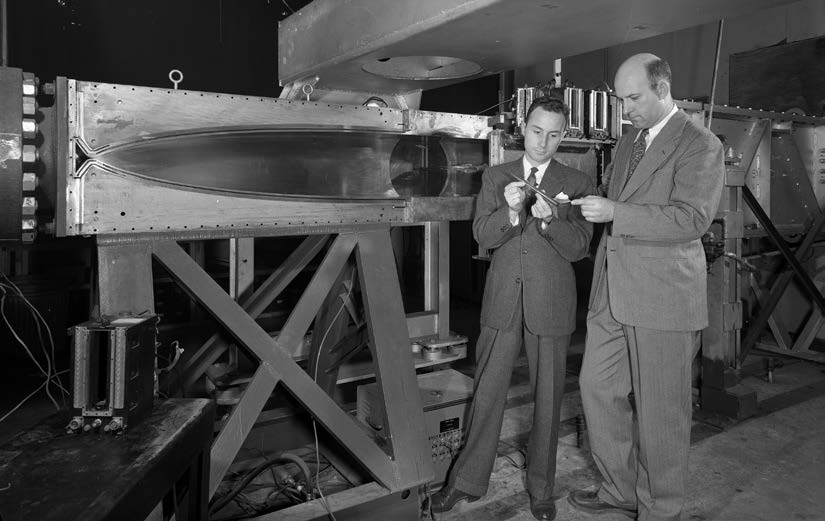
The archive photographs show why the tunnel was more than an empty passage for a stream of air. It had a shaped nozzle to accelerate the flow into a test section, then a diffuser downstream. The nozzle’s geometry had to be made accurately. The technical history includes a photograph of a test nozzle with a scale below it and another image showing the hardware between the nozzle throat and the test area. These photographs make visible the amount of apparatus needed to create a useful flow around a comparatively small model.
The test section also had optical windows for schlieren photography. This technique makes changes in air density visible by recording how the flow bends light. A researcher can see features such as shock waves around the model and compare where those features appear during different tests. The windows and the tunnel together made it possible to inspect airflow that would otherwise be invisible in an ordinary photograph.
From pilot installation to research program
The featured photograph dates from 1950, several years after the first run. It shows John V. Becker and Charles H. McLellan beside the apparatus. NASA credits both men with helping to get the tunnel designed and built. The date of the photograph matters because it shows the research equipment in use after the initial milestone, during the period when Langley was finding additional reasons to keep working with it.
NASA reports that experiments at the facility led to more than 230 technical reports. That volume helps explain why the anniversary matters. A pilot facility is usually judged by what it teaches the designers of the next installation. The Langley tunnel also produced a body of research of its own. Its first successful operation gave investigators a place to develop methods, test designs and repeat experiments in a speed range that placed new demands on their equipment.
The November 1947 milestone was a ground test. Its contribution to flight came through what researchers could learn about fast-moving air before committing a design to an expensive flight experiment. The small tunnel gave them time to change a model, refine their measurements and repeat the test while keeping the conditions under laboratory control.
Sources
NASA historical account of Langley Research Center
NASA wind tunnel history and archival photograph
Featured photograph from NASA/NACA Langley, LRC-1950-B701_P-63887, public domain.

No comment