
Published November 26, 2026
Richard “Ricky” Arnold II was born in Cheverly, Maryland, on November 26, 1963. He became a science teacher and later a NASA astronaut, flying on the space shuttle Discovery and returning to orbit for a longer stay aboard the International Space Station. The NASA astronaut fact book records the birthday. His NASA biography traces a career that took him from classrooms on Earth to work outside a spacecraft and lessons delivered from inside one.
A path through science and teaching
Arnold studied at Frostburg State University and completed teacher certification before earning a master’s degree in marine, estuarine and environmental science at the University of Maryland. He worked in the marine sciences and taught overseas, including in Morocco, Saudi Arabia and Indonesia. NASA selected him as an astronaut candidate in May 2004. By then he had worked both with scientific evidence and with students who were learning how to make sense of it.
The two jobs call on different skills. Scientific work asks a researcher to describe what is observable and to account for the conditions of an experiment. Teaching asks that person to make those conditions clear to someone encountering a problem for the first time. Both skills became part of Arnold’s work in orbit, where the equipment and the place he worked offered examples that were difficult to reproduce in a school.
Building the station on Discovery
Arnold’s first spaceflight was STS-119 in March 2009. Discovery carried a truss segment and the final pair of solar array wings to the International Space Station. The arrays were part of the station’s electrical supply. Getting them to orbit was only the beginning. The hardware had to become part of an occupied spacecraft that was already supporting its crew and experiments.
Arnold performed two spacewalks during that mission. Their place in the flight helps explain why an astronaut with a teaching background went through the same demanding technical preparation expected of any mission specialist. Shuttle crews spent much of an assembly flight coordinating work across separate workspaces, including the shuttle, the station and the exterior of both. Each job depended on a common understanding of what had already been completed and what the next crew member was about to do.
A classroom connection from orbit
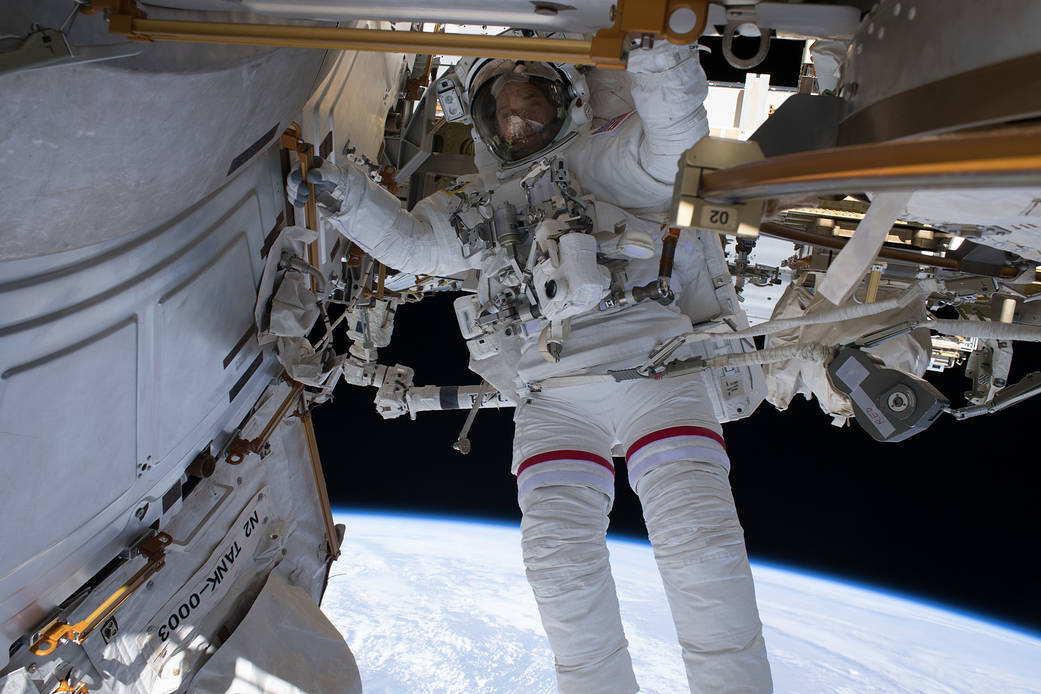
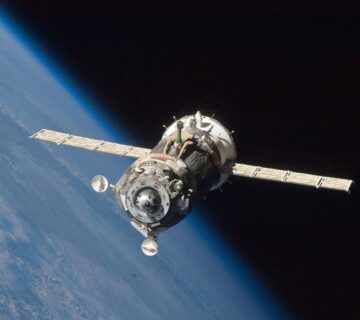
Arnold returned to space in 2018 aboard a Soyuz and worked as a flight engineer during Expeditions 55 and 56. The assignment lasted about six and a half months. He made three more spacewalks, including the June 14 outing with Drew Feustel shown in the featured NASA photograph. The pair installed cameras on the exterior of the station. NASA’s photo record identifies Arnold and dates the outing.
Students saw another part of Arnold’s work during NASA’s Year of Education on Station. The agency arranged live question-and-answer sessions that gave students a chance to speak to crew members. One NASA release announced an educational downlink with Arnold for students at New York City’s Spruce Street School. The format let them put their own questions to someone who had spent months living and working in orbit.
That connection gives Arnold’s birthday a place in the history of human spaceflight. His work spans two phases of the station’s life. On Discovery he helped assemble it. On Soyuz he traveled there as a resident crew member, responsible for maintaining the orbiting laboratory and able to use it as a place to teach. The classroom experience that preceded his selection remained visible in the kind of work he did after the station became his temporary home.
Sources
NASA Astronaut Fact Book, 2004 astronaut candidate class
NASA biography of Richard R. Arnold II
NASA education downlink release
NASA spacewalk photograph and caption
Featured photograph from NASA, ISS056-E-012158, public domain.

No comment