
Published November 26, 2026
On November 26, 1951, Gloster’s first Javelin prototype, WD804, took to the air. The Royal Air Force needed an aircraft that could intercept bombers at high altitude in weather and darkness, and Gloster’s answer was a twin-engine jet with a broad triangular wing and a tailplane perched high on the fin. The first flight began a program that would turn that distinctive prototype into a type flown by RAF squadrons for more than a decade. The RAF Museum’s collection record identifies both the prototype and the date.
An interceptor for poor visibility
The shape is the first thing a visitor notices on a surviving Javelin. The wing occupies much of the length of the fuselage, broadening toward the rear, while the horizontal tail is raised above the engines. Those features made the aircraft instantly recognizable on a crowded flight line. Inside the aircraft, the most important design choices were less visible. Gloster provided two seats and made radar part of the aircraft’s equipment so that the crew could search in conditions where a target would be difficult to see.
The division of labor was an important part of that proposition. Flying the aircraft and interpreting radar information were separate jobs. The pilot could concentrate on handling and positioning the jet while the second crew member worked with the radar. A photograph of the aircraft alone shows the geometry of the airframe. Its two-seat arrangement helps explain how the RAF intended to use that airframe.
From prototype to squadron
WD804 was the first of five prototypes. The RAF Museum records trials that examined wing sections and changes to the nose and canopy. Each of those areas had a different bearing on the finished aircraft. The wing was central to flight behavior, the nose housed equipment, and the canopy shaped what the crew could see. The work took several years. The first production FAW.1 flew on July 22, 1954, and No. 46 Squadron received Javelins in February 1956.
The designation FAW stood for Fighter All Weather. Different marks continued to refine how the design met that requirement. The museum traces changes to radar and tail design in earlier variants and notes that later versions gained more powerful Sapphire engines. This evolution is visible in museum collections today. The RAF Museum preserves FAW.1 XA564, while a later FAW.9, XH897, is preserved at Duxford. The Aviation Gazetteer’s Duxford entry identifies the latter aircraft and documents its shape from several angles.
A photograph from the service years
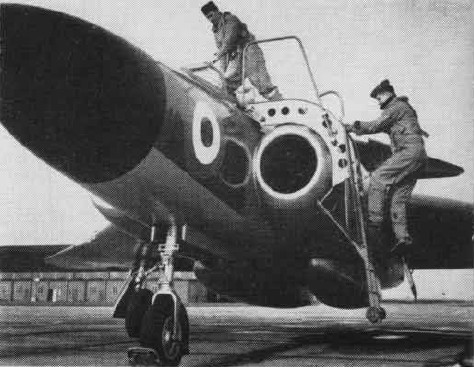
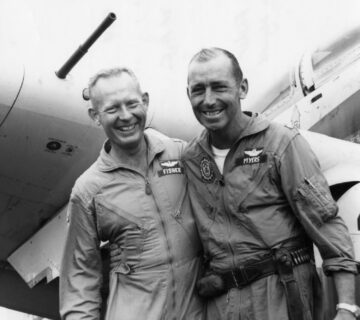
The featured photograph shows a No. 64 Squadron Javelin at RAF Duxford in 1959, eight years after the maiden flight. It survives through the U.S. Navy’s Naval Aviation News archive. The archive record on Wikimedia Commons connects the photograph to two U.S. Marine Corps captains who served with the RAF squadron as radar operators. Their assignment gives the image a human connection to a job that is hard to see from the outside of the airplane.
The Javelin remained in RAF service into the late 1960s. According to the RAF Museum, the last aircraft left service with No. 60 Squadron at RAF Tengah in April 1968. The distance between that final posting and the November 1951 trial illustrates what a maiden flight begins. The engineers had proved that the prototype could fly. Squadrons would later have to train crews, maintain the aircraft and use its radar in routine service. The preserved aircraft and the Duxford photograph give a view of both ends of that process.
Sources
RAF Museum collection record
Aviation Gazetteer technical profile
U.S. Navy photograph and public-domain record
Featured photograph from U.S. Navy Naval Aviation News, public domain.




No comment