
Published November 25, 2026
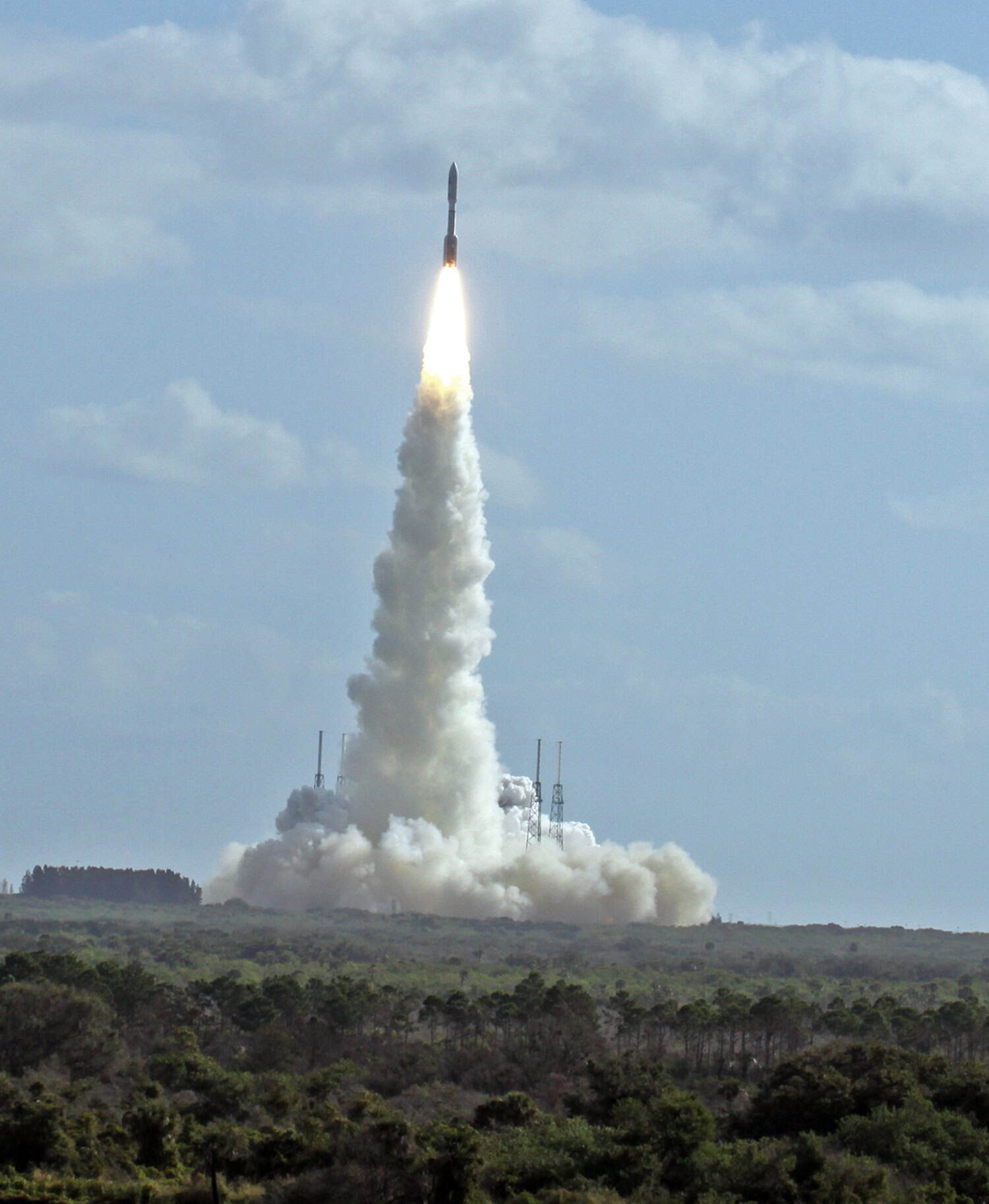
On November 26, 2011, an Atlas V rose from Space Launch Complex 41 at Cape Canaveral Air Force Station carrying NASA’s Curiosity rover. The launch began an interplanetary trip for the largest rover NASA had yet sent to Mars. Curiosity would land inside Gale Crater in August 2012 and investigate whether that part of Mars had ever offered conditions suitable for microbial life. NASA’s mission overview traces the expedition from that Florida launch to fieldwork on Mars.
Why NASA sent a laboratory
The mission’s formal name, Mars Science Laboratory, says a great deal about its purpose. Curiosity could drive to a rock, examine it up close, drill into it, and deliver powdered material to instruments inside its body. Those instruments could examine the minerals and chemistry preserved in a sample. That combination let the science team connect laboratory results to the place where the sample was collected, including the rock’s position relative to other layers.
Gale Crater offered a chance to study changes in the Martian environment over time. Near its center rises Mount Sharp, a mountain built up in layers. If the rover could reach and examine parts of that sedimentary record, scientists could compare materials formed under different conditions. They could ask how water had shaped the landscape and how the local environment had changed as newer layers accumulated.
The mission’s first major finding came before Curiosity began climbing the mountain. At Yellowknife Bay, the rover examined rocks that had formed in the presence of water. NASA concluded that the ancient environment could have supported microbial life. The evidence addressed habitability, a question scientists can investigate by studying the chemistry and physical setting preserved in rocks.
From the launch pad to Gale Crater
The launch recording captures the moment the project became a flight mission. For the people who would eventually drive Curiosity, the months between launch and landing were a different kind of work. The rover traveled enclosed in the hardware that would protect it during entry into the Martian atmosphere. During cruise, the flight team could track the spacecraft and adjust its course toward the intended arrival point.
The final approach required several distinct ways of slowing down. The spacecraft used the atmosphere to shed speed, a parachute to slow further, and a powered descent stage for the final approach. The descent stage lowered Curiosity to the surface on cables. Once the rover was on its wheels, the stage separated and flew clear. This was the first use of the sky crane technique on Mars, an approach NASA later used to land Perseverance.
That landing method mattered to the science because it put a heavy rover directly onto its wheels within Gale Crater. A payload that can work only where it lands has a limited view of the local geology. A mobile laboratory can compare an outcrop with the next one, return to a question raised by earlier observations, and make decisions about how to spend time and instrument resources as the team learns more about the terrain.
What the anniversary marks
This anniversary marks the start of the flight that made those comparisons possible. The photograph from Cape Canaveral shows the rocket clearing the launch complex, with the plume lighting the area below it. The mission’s scientific payoff would come through much quieter work after landing, when geologists and engineers used images, instrument readings and samples to decide where Curiosity should go and what it should examine.
That work continues to give the launch its significance. Mars can be studied from orbit at the scale of a crater or a mountain. Curiosity brought the investigation down to the scale of individual grains, layers and drill samples, while keeping each observation tied to the larger landscape. That ability to connect measurements across scales is what NASA sent to Mars on November 26, 2011.
Sources
NASA Mars Science Laboratory mission overview
NASA Curiosity launch recording
NASA launch photograph and credit
Featured photograph by NASA/Ken Thornsley, public domain.


No comment