
Published November 21, 2026
On November 21, 1972, NASA research pilot John Manke flew the M2-F3 lifting body to Mach 1.3 and about 65,000 feet on a mission to evaluate flight controls. The aircraft began its 23rd flight beneath the wing of a B-52 carrier aircraft. After release, Manke tested a system that helped translate pilot commands into aircraft response, one part of NASA’s effort to understand how a wingless vehicle could be controlled on its way back to a runway. NASA’s 1972 chronology records the date and results.
A body shaped to generate lift
The M2-F3 belonged to a family of experimental aircraft known as lifting bodies. Its shape generated aerodynamic lift across the body, giving it a way to fly without conventional wings. NASA used the program to investigate a practical question for returning spacecraft. Could a vehicle with an unconventional shape be controlled well enough to fly an approach and land on a runway? The agency’s program history describes how engineers pursued that idea through a series of piloted vehicles.
The aircraft was rebuilt from the earlier M2-F2. The rebuild added a third vertical fin between the two outer fins to improve lateral control. NASA pilot Bill Dana made the first M2-F3 glide flight in June 1970. NASA reported better lateral stability and control in the modified aircraft. That gave the team a platform for later research into how the vehicle responded to pilot inputs under different flight conditions.
What Manke tested on flight 23
On the November flight, the main objective was to evaluate the command augmentation system. The team also sought stability and control data at Mach 1.1, 0.8 and 0.7 and checked the pitch-reaction augmentation system. Those test points gave the team a way to examine the aircraft’s behavior at supersonic and subsonic speeds within one flight. NASA’s chronology reports that the crew completed all the objectives.
The program’s interest in augmentation grew from the difference between making an aircraft stable through its shape and shaping its response through controls. The extra fin changed the vehicle’s aerodynamics. The flight-control experiments let researchers study how the vehicle responded when a pilot gave it a command. NASA also evaluated a side-mounted control stick and installed reaction jets to gather data about their effectiveness for vehicle control. Those tests explored ideas relevant to aircraft and spacecraft with different requirements from a conventional airplane.
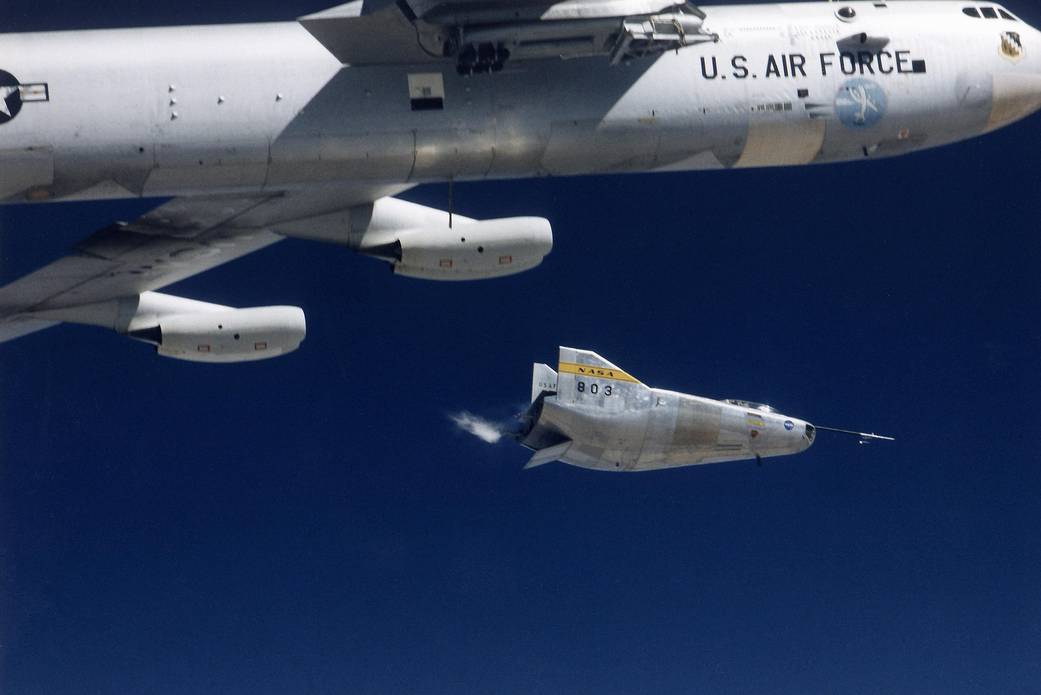
What the photograph shows
The NASA archival photograph shows the B-52 releasing an M2-F3 during the test program. The image documents the launch method. NASA’s chronology provides the date of Manke’s 23rd flight and the results recorded for that mission. Together the records show how the carrier aircraft and the lifting body contributed to a single test. The B-52 took the research vehicle aloft, and the M2-F3 provided the aircraft response the team wanted to measure.
Sources
NASA, Astronautics and Aeronautics, 1972 — November 21 flight objectives and results
NASA — Lifting Bodies program history
NASA — featured archival photograph EC71-2774. Editorial use under NASA media guidelines.

No comment