
Published November 25, 2026
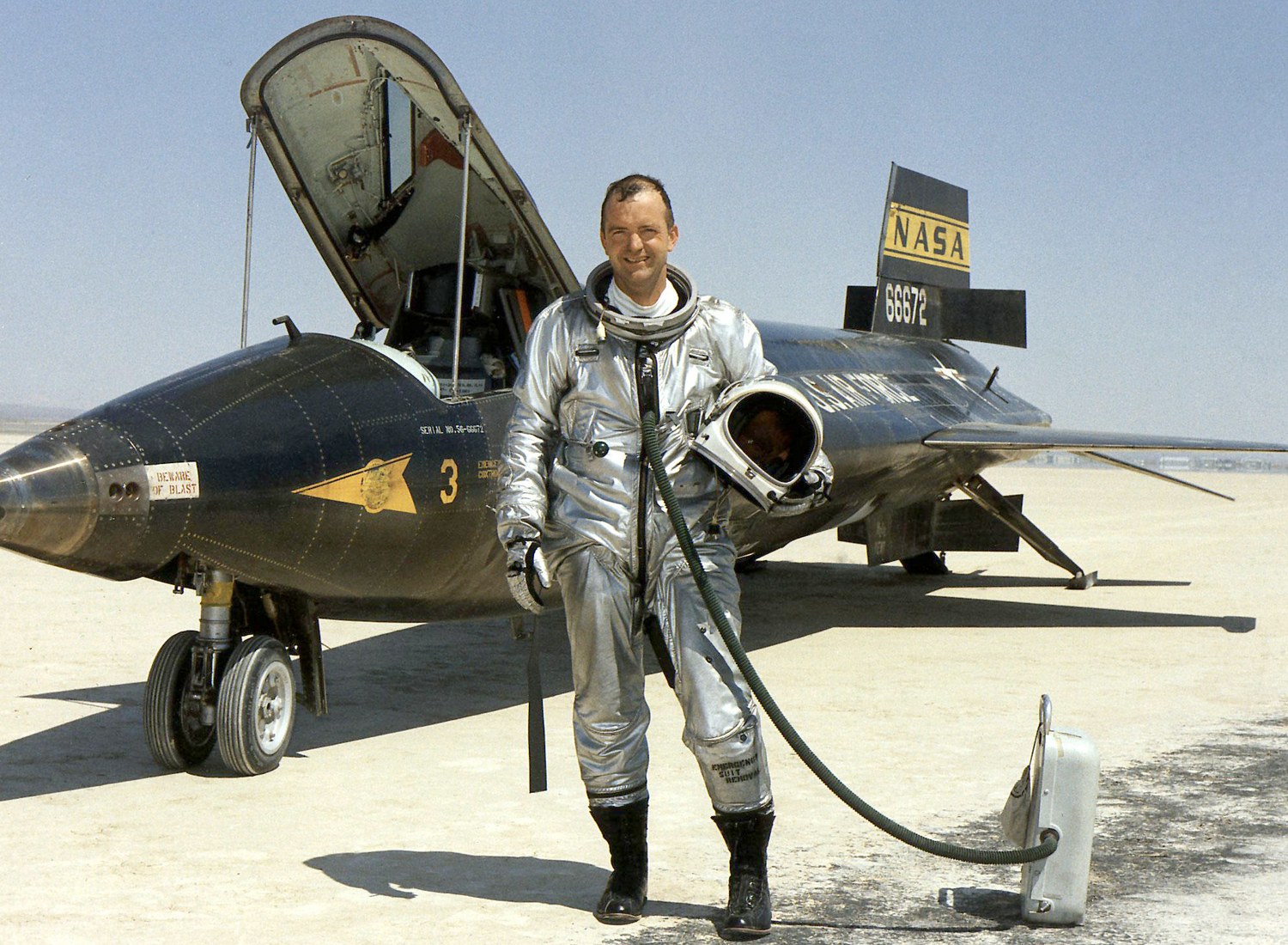
On October 24, 1968, NASA research pilot William “Bill” Dana climbed into an X-15 under the wing of a modified B-52. It was his 16th sortie in the rocket plane. At about 45,000 feet the carrier leveled out and Dana completed his launch checks. Minutes later the X-15 was climbing above the California desert at more than five times the speed of sound. It returned to Earth as a glider and slid to a stop on the hard clay of Rogers Dry Lake. The flight was the program’s 199th and, as events turned out, its last. NASA’s account of Flight 199 follows Dana from preparations to touchdown.
An engineer in the cockpit
Dana came to flight research through both military aviation and engineering. He graduated from the U.S. Military Academy in 1952, spent four years flying for the Air Force and earned a master’s degree in aeronautical engineering from the University of Southern California. He joined NASA on October 1, 1958, the day the agency began operating. His career at the Flight Research Center, now Armstrong Flight Research Center, lasted almost four decades. NASA’s biography records that his X-15 flights took him as high as 307,000 feet and as fast as 3,897 mph, with civilian astronaut wings awarded in 2005.
On a research flight, a pilot had to fly the planned profile closely enough for the instruments to capture the conditions engineers wanted to study. The demands changed quickly in the X-15. The flight started beneath a carrier aircraft, continued with a rocket-powered climb and ended on a glide. Once the engine stopped, Dana had to manage the altitude and speed he had left for the approach. The flight’s peak speed came early and its peak altitude came later, so each demanded a different set of cockpit tasks.
What Dana flew on Flight 199
Just under 84 seconds after release, Dana reached Mach 5.38 at 148,000 feet. The X-15 continued climbing after the engine shut down. At 235,000 feet, Dana deployed an instrument intended to observe a launch from the California coast. It lost power within seconds and retracted. A separate sky-brightness experiment also failed. Other instruments aboard the aircraft continued to record aerodynamic data automatically as the plane reached 255,000 feet and started back down. That mix of results is part of the flight’s record. Several experiments depended on the same flight profile and each had its own outcome. NASA’s flight account documents which instruments worked and which failed.
As Dana crossed Death Valley, the workload began to ease. At 75,000 feet he was still traveling at Mach 3.2, and he could see the dry lake where he would land. Chase aircraft joined the descent near Edwards Air Force Base. Dana brought the X-15 around and down the steep approach. The two F-104 chase planes followed him low over the lakebed and climbed away as the X-15 slid across the clay. By the end of that short flight he had taken the same aircraft from a captive ride on a B-52 through powered hypersonic flight and back to the ground under its own glide.
The flight that closed the program
A 200th flight was planned. Technical problems and weather kept it from taking place. Engineers processed the data from Flight 199 while preparations for another sortie were still underway. The work from the program ultimately produced more than 760 technical reports, covering subjects that included high-speed aerodynamics and materials. The aircraft Dana flew on the final sortie had also made the program’s first flight and is now in the Smithsonian’s National Air and Space Museum. NASA’s program history puts that final mission in the context of the preceding decade of flight tests.
Dana continued flying research aircraft after the X-15. He worked on lifting bodies and later on projects that studied digital flight controls and the behavior of aircraft at high angles of attack. He became the center’s chief pilot and eventually its chief engineer before retiring in 1998. Those appointments extended the work he had started as an engineer in a cockpit. On October 24, 1968, his contribution was one flight with a precise profile, a set of instruments to operate and a dry lake to reach. It became the final entry in a program whose measurements continued to inform aircraft and spacecraft research.
Featured photo: Bill Dana with the X-15 on October 24, 1967, a year before the program’s final flight. NASA photo EC67-1716, public domain. Photo record.


No comment