
Published November 21, 2026
On October 11, 1984, Kathryn Sullivan and David Leestma left the airlock of space shuttle Challenger to test whether astronauts could help service a satellite in orbit. The work made Sullivan the first American woman to walk in space. It also addressed a practical question for the shuttle program. If a spacecraft needed more propellant, could astronauts carry out the transfer from outside the orbiter? The test put the tools, procedures and people into the environment where they would have to work. NASA’s STS-41G mission history
A spacewalk with a job to do
Challenger launched on October 5 and landed on October 13. Its seven-person crew included Sally Ride, who had become the first American woman in space the previous year. STS-41G was the first spaceflight to carry two women. Sullivan was on her first mission, while Ride was on her second. Their responsibilities reflected the range of work that a shuttle crew could do on one flight, from operating experiments inside the spacecraft to handling equipment outside it. NASA’s STS-41G mission record
Sullivan and Leestma used a demonstration system carried aboard Challenger. Hydrazine, the propellant involved, is hazardous, so handling it in space added a different challenge from simply moving equipment from one place to another. The task required a procedure the crew could follow in pressure suits and a means of making the connections at the worksite. The demonstration gave NASA experience with the kind of servicing that could extend the working life of an orbiting spacecraft. NASA’s account of the refueling experiment
Ready outside the airlock for Hubble
Sullivan returned to orbit aboard Discovery in April 1990 on STS-31. The mission’s main job was to deploy the Hubble Space Telescope. The crew used the shuttle’s robotic arm to move the observatory out of the payload bay. The team also prepared for problems that might require someone to go outside, and Sullivan was one of the astronauts available for that work. NASA’s STS-31 mission gallery
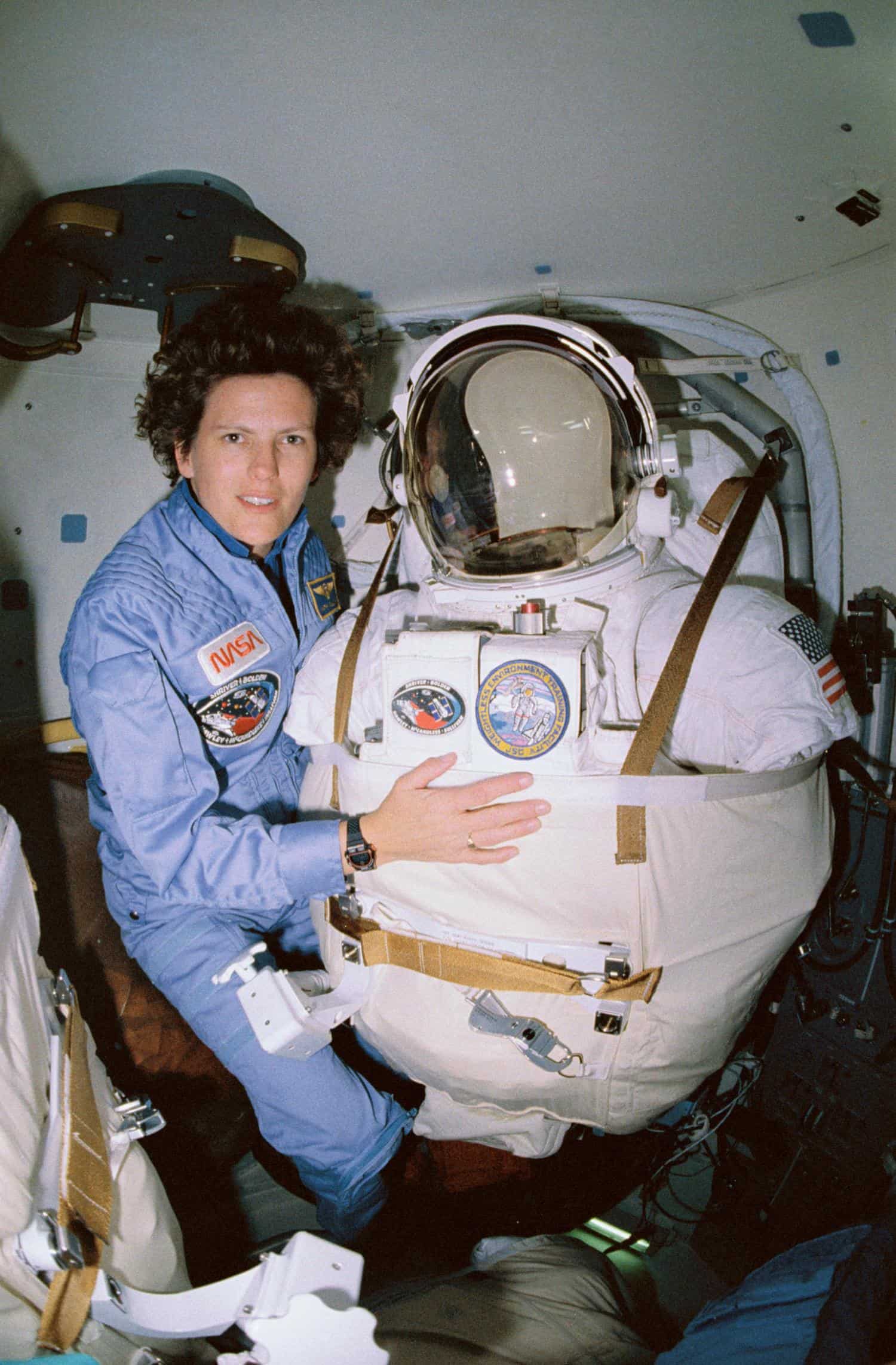
The photograph accompanying this article shows Sullivan in Discovery’s airlock on April 25 as she prepared for a possible excursion. A problem with deployment of a solar array gave the crew reason to prepare, but the issue was resolved without a spacewalk. The photograph records an important part of a deployment that can be easy to overlook. The crew had equipment and procedures ready for contingencies even when the planned operation ultimately went ahead without an astronaut leaving the spacecraft. NASA’s description of the photograph · NASA’s mission summary
Using a shuttle to study Earth’s atmosphere
Sullivan flew her third mission on Atlantis in March 1992. As payload commander on STS-45, she helped run the first Atmospheric Laboratory for Applications and Science mission. The shuttle carried twelve instruments on Spacelab pallets in the cargo bay. They studied subjects ranging from atmospheric chemistry to ultraviolet astronomy, while other instruments examined the physical conditions of the upper atmosphere and near-Earth space. NASA’s STS-45 summary
The missions called for different kinds of work from the same astronaut. On Challenger, Sullivan tested servicing equipment outside the shuttle. On Discovery, she helped the crew prepare for a potential intervention during the release of an observatory. On Atlantis, she took responsibility for a scientific payload whose instruments worked from the orbiter. By the end of STS-45, Sullivan had spent more than 532 hours in space. Together, those three flights show how the shuttle’s cargo bay, airlock and onboard laboratories allowed astronauts to carry out engineering and scientific work on the same fleet of spacecraft. NASA’s Sullivan profile and oral history collection
Sources
NASA’s STS-41G retrospective · NASA’s Kathryn Sullivan profile · NASA’s STS-31 gallery · NASA featured photograph · Public-domain image record
Featured photograph credit: NASA, GPN-2006-000014. Public-domain archive photograph.


No comment