
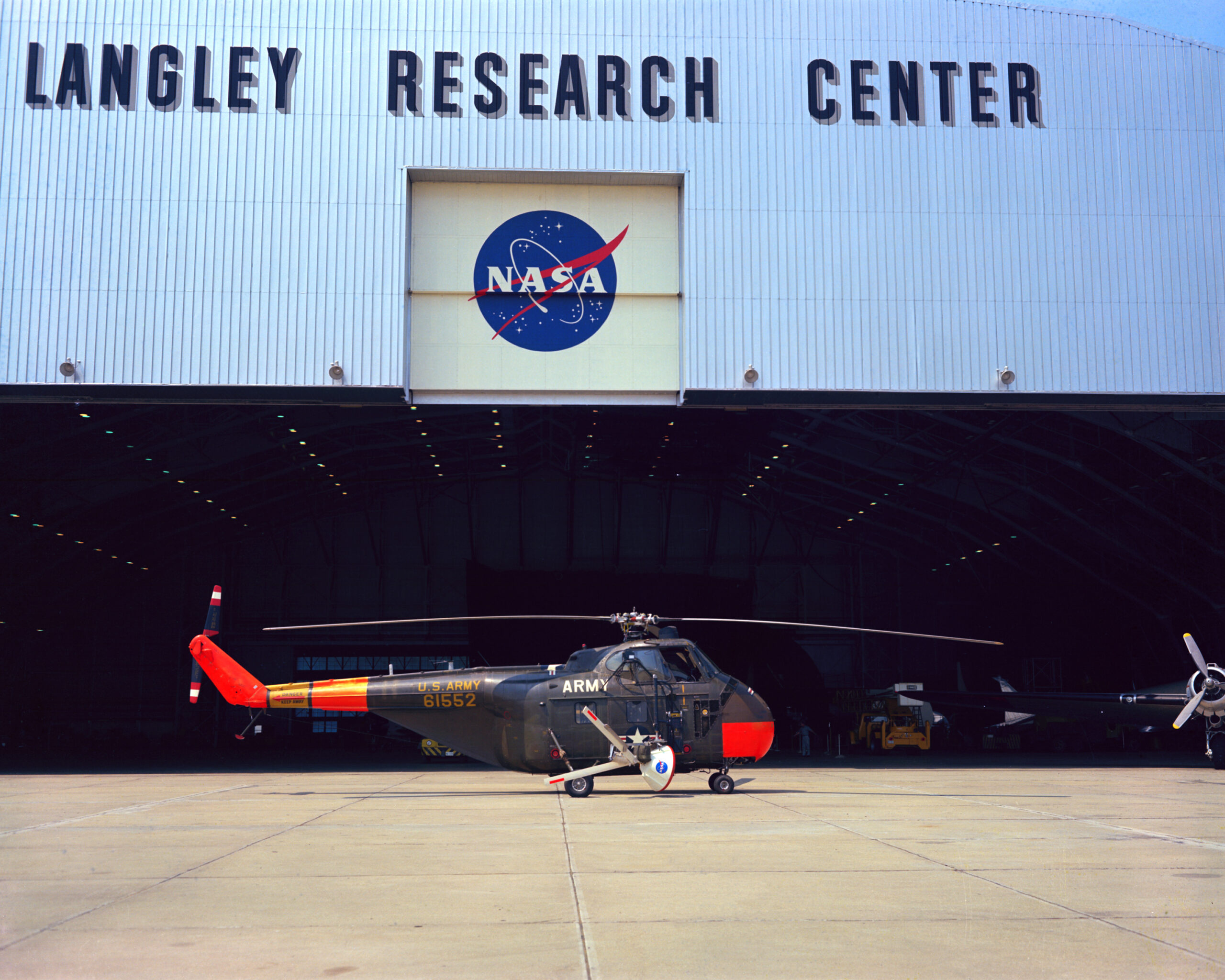
Featured photo: A NASA Sikorsky JH-19D helicopter in a Langley Research Center photograph taken March 31, 1965, with a model of the Apollo spacecraft on a drop mount near the cargo door. The H-19 type first flew on November 10, 1949. Photo: NASA (GPN-2000-001895)
On November 10, 1949, a new kind of helicopter left the ground in Connecticut. It was the first flight of Sikorsky’s S-55, which the U.S. Air Force designated YH-19. The Igor I. Sikorsky Historical Archives note that the company designed and built the machine with its own funds, without a government contract, and that the first flight came less than a year after the program began. What rose that day was not another two-seat observation helicopter. It was a transport.
A cabin where the engine used to be
Earlier Sikorsky helicopters, the R-4, R-5 and R-6, carried their engines under the main rotor. That left little room for people or cargo. On the S-55, designers moved the piston engine into the nose, ahead of and below the cockpit. The Sikorsky archives credit engineer Edward F. Katzenberger with the idea. The change opened a cabin directly beneath the rotor, so passengers and freight sat near the aircraft’s center of gravity instead of hanging off the tail.
That cabin could hold 10 passengers, or six stretchers and a medic. The helicopter could also lift about 2,000 pounds on an external hook. A hatch in the cabin floor let the crew watch a slung load and talk the pilot into position. Up front, a Pratt & Whitney R-1340 radial engine of 600 horsepower sat at an angle behind large clamshell doors, so mechanics could reach it from the ground. The archives say an engine change took only about two hours. Later military versions used a 700-horsepower Wright R-1300. The main rotor spanned 53 feet, and hydraulic servos took the heavy loads out of the controls.
Into service, and into Korea
The Air Force ordered five YH-19 helicopters for service tests. The first of them reached Korea in March 1951, and the Sikorsky archives record that the day after it arrived it helped evacuate paratroops. A second YH-19 followed that September. The trials went well enough that every U.S. military service bought the type. The Air Force flew it as the H-19, the Army as the H-19 Chickasaw, the Navy and Coast Guard as the HO4S, and the Marine Corps as the HRS.
In Korea the helicopter showed what a transport rotorcraft could do. Marine squadron HMR-161 arrived on September 2, 1951, with 15 HRS-1 helicopters. On September 13, during Operation Windmill I, the squadron moved 18,848 pounds of gear and 74 Marines onto a ridgeline in the Punchbowl area. A week later it lifted 224 reconnaissance Marines and 17,772 pounds of supplies to a remote hilltop. In late February 1953, during Operation Haylift II, the same squadron lifted 1.6 million pounds of cargo to resupply two regiments. The archives note that the Marines lost no helicopters to enemy fire during those operations, even when they were flying into hot landing zones.
Air Force H-19s flew search and rescue, including at night and behind enemy lines, and moved wounded troops from the field to Mobile Army Surgical Hospitals. The Sikorsky archives report that the 3rd Air Rescue Squadron, flying both older H-5 helicopters and the new H-19s, evacuated more than 7,000 wounded during the war and rescued 170 pilots from behind enemy lines and from the Yellow Sea. The U.S. Army arrived later with H-19s of its own. In March 1953, after floods cut off forward units of the 3rd Division, 10 Army H-19s made 30 round trips and delivered 33,925 pounds of food, ammunition and charcoal to a landing spot a few hundred yards from the front.
Across the Atlantic, and into civilian skies
The H-19 also proved it could travel. On July 15, 1952, two Air Force H-19As named Hop-A-Long and Whirl-O-Way left Westover Air Force Base in Massachusetts. Stripped of extra weight and fitted with three 100-gallon fuel tanks in the cabin, they flew a great-circle route through Maine, Labrador, Greenland, Iceland and Scotland, then on to the Netherlands and Germany. They arrived at Wiesbaden Air Base on August 4 after 4,220 miles. The longest over-water leg, from Keflavik, Iceland, to Prestwick, Scotland, covered 850 miles. It was the first time helicopters had crossed the Atlantic under their own power, a milestone also noted by the Canada Aviation and Space Museum.
Civilian work followed close behind. The Civil Aeronautics Administration certified the commercial S-55 on March 25, 1952. New York Airways began passenger service among the New York-area airports on July 9, 1953, becoming the first scheduled helicopter airline to carry passengers in the United States. Operators later used the type to haul people and material into country that roads could not reach, including construction of radar sites on the Distant Early Warning Line in the far north. According to the Sikorsky archives, the company itself built 1,281 of the helicopters, and firms in Britain, France and Japan built hundreds more under license. Britain’s Westland version was known as the Whirlwind. In the U.S. Naval Institute’s Naval History Magazine, the S-55 is described as the first American helicopter certified for commercial operation and the first produced in four-digit numbers for the U.S. armed forces.
Why it still matters
The S-55’s nose-mounted engine and under-rotor cabin became the pattern for large utility helicopters that followed. It turned the helicopter from a curiosity into a way to move troops, haul cargo, lift the injured out of rough country and work from ships at sea. The Navy used later HO4S models to develop helicopter anti-submarine tactics, and the Coast Guard flew the type on rescues, including basket recoveries from floodwaters.
NASA found a use for it too. Langley Research Center flew a JH-19D on research flights that included dropping scale models. A NASA photograph taken March 31, 1965, shows one of these helicopters with a model of the Apollo spacecraft hanging beside the cabin door. Sixteen years after that first flight in Connecticut, the same basic machine was helping prepare the spacecraft that would take Americans to the Moon. The transport helicopter born on November 10, 1949, had already changed how armies moved and how civilians were rescued. It was still earning its keep as a new chapter in flight began.



No comment