
Pilots live by windows. Miss the weather, miss the fuel, miss the light, and the flight does not happen. Solar physicists launching NASA sounding rockets face a sharper version of the same problem: solar flares can rise and fade in minutes, and a rocket only gets about five minutes above the atmosphere before it falls back to Earth.
On Nov. 4, NASA described a flare alert system built to close that gap. A paper published the same day in The Astrophysical Journal details how the system pinpoints a flare’s location and predicts how long it will last within minutes of detection by spacecraft. For the first time, NASA says, scientists have used sounding rockets to study a solar flare while it was still underway, because the alert told the team when to launch.
Why five minutes is not much time
Sounding rockets are a fast, relatively inexpensive way to study light from solar flares that Earth’s atmosphere absorbs before it reaches the ground. They climb above most of that atmosphere, collect data, and come home. The tradeoff is the clock. NASA notes that a rocket typically has only about five minutes to observe before falling back, and flares can disappear just as quickly.
Older alert systems could tell researchers that a flare had started. They could not reliably say whether it would still be bright when the rocket reached altitude. Launching into a flare was, as NASA put it, a gamble.
How the alert works
The new system analyzes X-ray and ultraviolet emission from active regions, the magnetically complex areas on the Sun that produce flares. It draws on observations from NASA’s Solar Dynamics Observatory, the National Oceanic and Atmospheric Administration’s Geostationary Operational Environmental Satellites (GOES), and ground-based observatories. Within minutes of a detection, the team gets a location and a forecast of how long the flare is likely to last.
That is enough information to make a go or no-go call while the event is still useful to observe. The approach sits between long-range forecasts that estimate flare probability hours ahead and late warnings that arrive after a flare has already peaked.
Two campaigns, three small flares
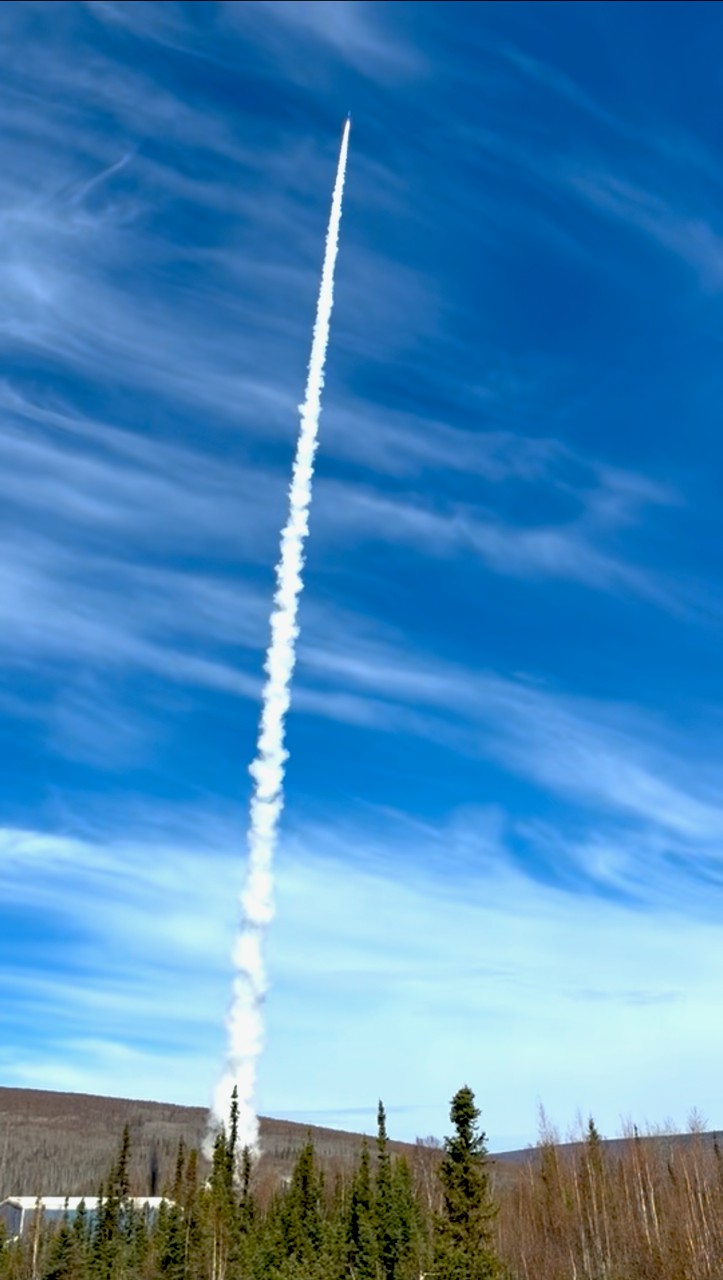
NASA says the system first helped coordinate two rocket launches from Poker Flat Research Range near Fairbanks, Alaska, in April 2024. The pair studied the same flare before it faded. An enhanced version of the alert guided another campaign in May 2026, when a NASA Black Brant IX carried the fifth Focusing Optics X-ray Solar Imager, or FOXSI-5, off the Poker Flat pad at 11:23 a.m. local time on May 14.
During that flight, FOXSI-5 successfully observed three small solar flares. The instrument is designed to image high-energy X-rays from flares with focusing optics, a technique that has advanced across five FOXSI flights. University of California, Berkeley’s Space Sciences Laboratory and partners have described how FOXSI-5 used multiple X-ray imagers, including a Timepix sensor developed with CERN, to capture spatial and energy information as the rocket climbed toward about 300 kilometers before parachuting back for recovery.
The May 2026 window was short. Berkeley’s Space Sciences Laboratory noted that the team launched with only two days left in a two-week window, and that the mid- and large-class flares they had hoped for did not appear. The smaller events still returned useful data, and the alert system is what made a timely launch possible.
What it means beyond the pad
The FOXSI team continues to improve the alert under a NASA Early Career Investigator Program grant. NASA says the same early warning could support future rocket campaigns, solar observatories, and space weather forecasting. Space weather matters to anyone who flies or operates satellites: flares and related solar activity can affect communications, navigation, and power systems on Earth and in orbit.
For Skylord readers, the story is not only about X-ray optics. It is about building a decision tool that respects a hard time limit. Sounding rockets do not wait. Flares do not wait. The teams that match them are practicing the same discipline pilots know: read the conditions fast, trust the instruments, and launch when the window is real.
Got an aviation or space story Skylord Magazine should chase, or someone we should interview? Send it our way.
Sources
- NASA Science: Solar Flare Alert System Helps NASA Rocket Team Decide When to Launch (Nov. 4, 2026)
- The Astrophysical Journal paper (DOI 10.3847/25c2cfeb.29c478f9)
- UC Berkeley Space Sciences Laboratory: FOXSI-5 mission feature
- SPIE: Initial report of Timepix3 detector performance on the FOXSI-5 sounding rocket payload
Featured image: A NASA Black Brant IX sounding rocket carries FOXSI-5 into the skies above Poker Flat Research Range near Fairbanks, Alaska, at 11:23 a.m. local time on May 14, 2026. Credit: NASA / Poker Flat Research Range



No comment