
Published November 21, 2026
On November 21, 2022, NASA’s uncrewed Orion spacecraft flew behind the Moon and fired its main engine during a planned break in radio contact with Earth. The maneuver changed the spacecraft’s trajectory and brought it to within about 81 miles of the lunar surface. It was the first close lunar flyby of Artemis I and a test of whether Orion and its European Service Module could execute a major maneuver far from Earth. NASA’s flight-day report records the sequence.
A burn behind the Moon
NASA’s initial flyby update reported that Orion fired its main engine at 7:44 a.m. Eastern for about two and a half minutes. The spacecraft was already behind the Moon from Earth’s point of view when it executed the burn. The Moon blocked the direct radio path, so NASA’s ground team had to wait until Orion emerged on the other side to resume contact. NASA reported regaining the signal at 7:59 a.m. Eastern through the Deep Space Network.
The engine firing and the return of communications were separate milestones. The burn changed the path Orion was flying. Reacquiring the signal let controllers receive data and check what had happened during the period when they could not hear from the spacecraft. That distinction matters in deep-space flight. A maneuver can be planned and carried out while a spacecraft is out of direct contact, with confirmation coming only once the geometry permits a radio link again.
A close pass on the way to a much wider orbit
The outbound powered flyby was one part of the route NASA designed for Artemis I. Passing close to the lunar surface placed Orion in a position to use the Moon’s gravity alongside the change in velocity from the engine burn. The resulting path carried the spacecraft away from the Moon on the next leg of the mission. A later engine firing was needed to enter the planned distant retrograde orbit. NASA described the flyby and the later insertion as separate maneuvers.
In that orbital description, “distant” refers to the large separation the spacecraft can reach from the Moon. “Retrograde” refers to the direction in which it moves around the Moon relative to the Moon’s movement around Earth. The close flyby and the later orbit were both planned into a single test flight. They asked different things of the spacecraft and its controllers, from a precisely timed engine firing near the Moon to sustained operations much farther away.
The view from a solar-array camera
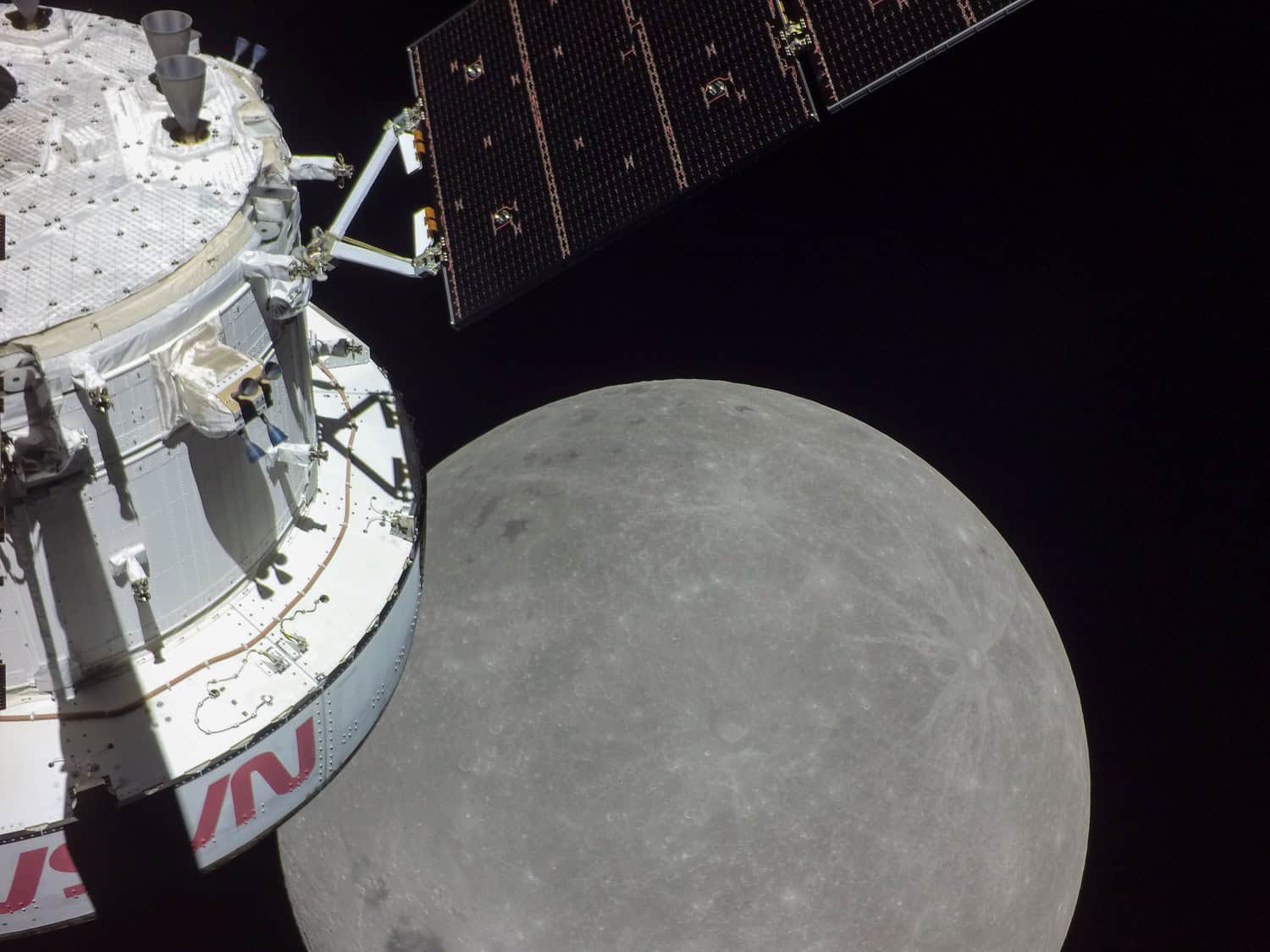
An onboard photograph from flight day six shows part of Orion in the foreground with the lunar far side beyond it. NASA identifies the dark region near the middle of the Moon in the image as Mare Orientale. The photograph came from a camera near the end of one of Orion’s solar arrays. Mounting the camera out on the array made it possible to include part of the spacecraft and the Moon in the same view.
The picture offers a visual record of the encounter, while the timing and trajectory come from the mission reports. The far side was central to both parts of the story. It was terrain visible to the onboard camera and also the part of the Moon that lay between Orion and Earth during the communications interruption.
Why the November 21 milestone mattered
Artemis I gave NASA a chance to operate Orion through a sequence of deep-space maneuvers before carrying a crew. The outbound flyby brought together propulsion, navigation, communications and spacecraft operations at a point where the direct ground link was temporarily unavailable. By the time controllers heard from Orion again, the vehicle had passed its closest point to the Moon on the outbound leg and was on its way toward the next maneuver. The combination of the powered pass and the return of the radio signal is what made November 21 a distinct milestone in the flight.
Sources
NASA Artemis I flight-day six report
NASA flyby and signal reacquisition update
Featured photograph, NASA art001e000269. Public domain. NASA media guidelines.





No comment