
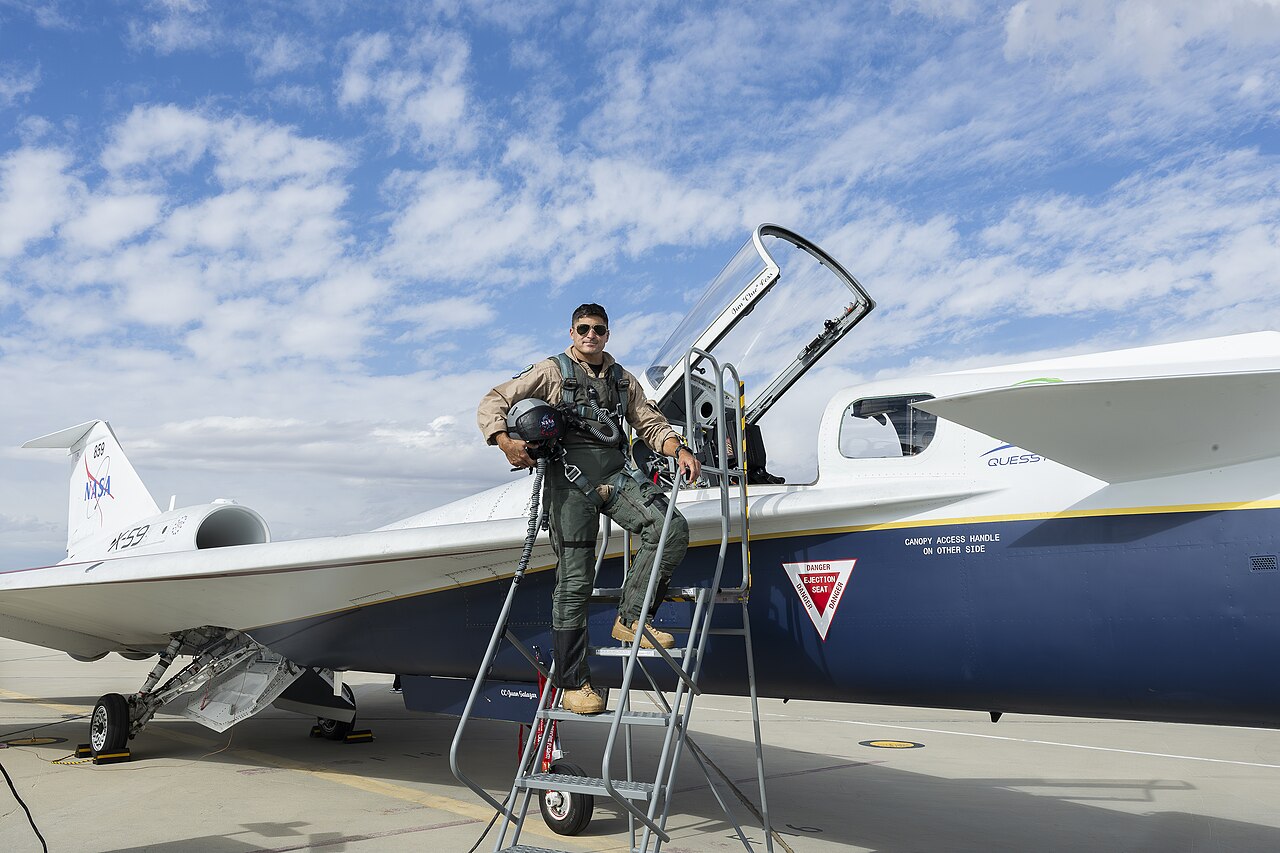
NASA’s X-59 has completed 41 flights since its first trip in October 2025, building a test record that now includes speeds up to Mach 1.53 and altitudes above 56,000 feet. The next major phase is expected to examine the sound the aircraft produces as it flies supersonically, a step toward testing whether a carefully shaped aircraft can make a softer sonic “thump” instead of the sharp boom people associate with supersonic flight.
The X-59 is NASA’s one-of-a-kind research aircraft for the Quesst mission. It is designed to gather flight and community-response data, not to carry passengers or enter airline service. NASA says the project will help regulators assess whether future standards could permit commercial supersonic flight over land.
From first flight to an expanding test envelope
The aircraft’s first flight took place on Oct. 28, 2025, from U.S. Air Force Plant 42 in Palmdale, California. NASA reported that the initial flight was deliberately low and slow, allowing the team to check systems and handling before expanding the aircraft’s operating range. The airplane later moved to NASA’s Armstrong Flight Research Center in Edwards, California, where the flight-test program continued.
NASA marked the first anniversary of that flight by reporting 40 additional flights. During the year, the X-59 reached more than 56,000 feet and a top speed of Mach 1.53. Those milestones show how the test program has moved from basic systems checks toward the speeds, altitudes, and conditions needed to evaluate the aircraft’s mission design.
The milestones do not mean that NASA has already demonstrated a quiet supersonic pass over a community. The agency describes the coming work as acoustic validation: measuring and analyzing the sound produced by the aircraft under planned test conditions. NASA says the team will continue flight-envelope work while preparing for that next phase.
What the aircraft is trying to change
A conventional aircraft flying faster than sound creates pressure waves that can combine into a loud sonic boom at the ground. The X-59’s long, narrow shape is intended to manage those pressure waves so that they reach people as a softer thump. NASA’s design target is a flight near 55,000 feet at about Mach 1.4. The agency has described the projected sound as comparable to a car door closing from roughly 20 feet away; that is a prediction to be tested, not a result already confirmed over neighborhoods.
The airplane’s shape is central to the experiment. Its sharply tapered nose and carefully arranged lifting surfaces are meant to spread the pressure changes generated in supersonic flight rather than allowing them to merge into the familiar boom. The unusual nose also prevents a conventional forward-facing cockpit view, so the pilot uses an external vision system that combines camera images on an instrument display with other flight information.
NASA’s test work has to establish more than a top speed. Engineers need to understand how the aircraft behaves across its flight envelope and how repeatable the pressure signature is under different conditions. The acoustic phase will add sound measurements and analysis to that work. NASA’s stated goal is to provide data that can help the public and aviation regulators evaluate what a quieter supersonic overflight would actually sound like.
A research aircraft, not a commercial prototype
The X-59 is not designed to prove that airlines can immediately begin flying supersonically over the United States. It is a research platform built to test one part of a larger question: whether aircraft design can reduce the noise of supersonic flight enough to change how regulators treat overland operations. Any future commercial aircraft, operating rules, or community standards would require additional engineering, evidence, and regulatory decisions.
That distinction matters because the Quesst mission studies both the aircraft and the response on the ground. NASA plans to use the aircraft’s measured sound and community feedback to inform regulators. A successful demonstration could contribute evidence to later policy discussions, but it would not itself change existing operating rules.
The next milestone is about sound
NASA’s one-year update placed acoustic validation among the next stages of the program. The agency has not described the X-59 as having completed that phase. Its current flight record instead shows the buildup that precedes it: systems checks, expansion to higher speeds and altitudes, and a growing body of data about how the research aircraft performs.
For aviation watchers, the practical question is now how the planned sound measurements compare with the design target. If the measured thump is quieter and consistent with NASA’s prediction, the data could help shape future studies of supersonic travel over land. If it differs, the results will still give engineers and policymakers evidence about the limits of the approach.
For now, 41 flights mark a year of steady testing rather than a commercial breakthrough. The X-59’s next contribution will come from turning its unusual shape into measurable acoustic data, then sharing what those measurements—and the public response—show.
Sources
- NASA: “NASA Celebrates a Year of Progress Since First X-59 Flight” (Oct. 28, 2026)
- NASA: “NASA’s X-59 Aircraft Flies Supersonic for First Time” (June 5, 2026)
- NASA Quesst mission overview
- NASA image and caption: X-59 test pilot Mike Lippert (Oct. 21, 2026)
- Aviation International News: X-59’s anniversary and its move to Florida (Oct. 30, 2026)
Featured image: NASA test pilot Mike Lippert poses ahead of a flight in the X-59 on Oct. 21, 2026. Photo: NASA/Carla Escamilla. NASA created the photograph; it is marked public domain in the United States. SkyLord Magazine is not affiliated with or endorsed by NASA.


No comment