
The White House and U.S. Department of Transportation are asking Congress for another $30.1 billion aimed at modernizing the Federal Aviation Administration’s air traffic control system and improving airports. The request, reported by Reuters on Nov. 13, would add to the $12.5 billion Congress approved in 2025 for air traffic upgrades and controller hiring. It is a funding request, not enacted money: Congress would have to approve it before the FAA could spend the proposed additional funds.
A proposed package for control systems, towers and airports
The administration’s latest request divides the funding among several parts of the aviation system. Reuters reported that $10.1 billion would support air traffic control modernization, including a common automation platform and controller workstations, with $2 billion for cloud computing. The request also includes $2 billion to replace or improve FAA control towers and $18 billion for airport projects, including $10 billion to modernize or replace aging terminals.
The amounts describe different but connected needs. The air traffic control allocation is intended for technology and communications that help controllers move flights through the National Airspace System. Tower funding would address facilities where controllers coordinate runway and airport-area traffic. The airport portion reaches beyond the FAA’s control systems to passenger and airport infrastructure. The package therefore combines operational technology with physical facilities, rather than treating air traffic modernization as a single software purchase.
The proposal follows months of public discussion about a second wave of modernization funding. In September, Transportation Secretary Sean Duffy and a group of aviation organizations backed a roughly $30 billion plan; the FAA’s announcement of the Modern Skies Act described investments in controller tools, communications, towers and airports. The Nov. 13 request formalizes a funding appeal to Congress, with a reported total of $30.1 billion and a specific breakdown that includes cloud computing and terminal projects.
What the first modernization phase is building
The FAA’s current effort, called the Brand New Air Traffic Control System, is being carried out in phases. In testimony on its fiscal 2027 budget, FAA Administrator Bryan Bedford described network infrastructure, traffic-flow data and automation as parts of a broader upgrade. The agency says its Enterprise Network Services program is intended to replace an aging network architecture that connects airports, weather systems, radar, voice communications and aircraft-related information. Other efforts are intended to give controllers a more integrated picture of traffic and help forecast congestion.
Bedford’s testimony reported progress as of Sept. 1: the FAA had replaced more than 64 percent of its copper-based telecommunications infrastructure, transitioned 21 towers from paper flight strips to electronic displays, converted more than 403 radio sites and installed six surface-movement radars at five airports. Those figures describe work already underway. They do not mean that every facility has received the new equipment or that the modernization is complete.
An independent Government Accountability Office review published in September gives another view of the effort. GAO said the first phase is intended to modernize communications, surveillance, weather and training systems, with a target completion date of December 2028. It reported that the FAA had replaced 2,560 of 5,170 older copper wires with fiber by May 2026. GAO also described a second phase focused on new automation systems for tracking aircraft and optimizing traffic, but said the FAA had not set a start or completion date for that phase.
The distinction matters because the newly requested package is broader than a simple continuation of the first phase. GAO reported that FAA officials estimated about $10.2 billion for phase two’s automation systems, excluding facilities. The administration’s reported $30.1 billion package also contains tower and airport investments, so the two figures are not direct equivalents. The public figures instead show why lawmakers will need to examine what work each funding line covers, how the amounts relate to ongoing programs and what infrastructure remains outside the air traffic system itself.
The oversight question is how costs and schedules will be managed
GAO’s report found that the FAA had not produced a comprehensive, well-documented lifecycle cost estimate for the modernization program or an integrated master schedule for the first phase. The watchdog said the agency’s high-level estimate did not include government-related costs, most operations and maintenance costs for phase one, or any phase-two costs. That assessment does not establish that the program cannot be completed; it identifies information Congress and the public may need to evaluate its cost and schedule as funding decisions are considered.
The report also described a gap between the FAA’s phase-one modernization estimate and the funds dedicated to system work in the 2025 law. As of June 2026, the agency estimated that phase-one system modernization would cost about $10.6 billion. GAO compared that estimate with roughly $9 billion appropriated for those system programs and found that several lines were estimated to need additional support. The analysis covered specific modernization programs and should not be confused with the full $30.1 billion request, which also includes airport and tower funding.
The FAA’s own account emphasizes delivery speed and initial progress. Bedford told lawmakers the agency had met or exceeded its accelerated schedule and said the 2027 budget would supplement the earlier investment. The GAO review adds a different test: whether the FAA can connect program estimates, schedules and operating costs in a way that allows lawmakers to track the full undertaking. Both questions will be relevant if Congress considers additional appropriations.
Recent disruptions have made the reliability of communications and air traffic infrastructure more visible to travelers. Reuters reported that September failures involving a circuit at a Philadelphia air traffic facility and a severed backup fiber cable in New Jersey contributed to thousands of delays and cancellations across the Northeast. The FAA’s modernization work includes replacing older communications infrastructure, but a funding request alone does not prevent an outage. Results depend on the equipment selected, installation plans, continued operation during cutovers, workforce capacity and maintenance after new systems enter service.
What happens next
The next step is congressional consideration. Until lawmakers approve funds, the Nov. 13 proposal remains a request from the administration. The decision involves more than whether to support modernization in principle: Congress will need to determine which projects receive funding, how the money fits with existing appropriations and what reporting should accompany it. The FAA’s modernization plan includes a broad set of systems and facilities, while the airport allocation would reach projects that affect passengers and airport operators beyond the controller’s workstation.
For pilots and airlines, the significance will be measured in operational changes rather than the headline amount. Replacing communications links, upgrading automation and moving from paper-based processes can improve resilience only when the new systems work together across facilities and remain usable during the transition. For airports, tower and terminal investments have separate planning and construction timelines. Those timelines mean the proposed spending, if approved, would translate into a series of projects rather than an immediate, nationwide switch to a new air traffic system.
The funding debate now puts two issues side by side: the pressure to replace aging aviation infrastructure and the need for transparent cost and schedule management. The FAA has reported measurable progress on fiber, radio sites and electronic tower displays. GAO has highlighted missing lifecycle-cost and integrated-schedule documentation. Congress’s review of the additional request will determine whether the next phase receives new resources, and under what oversight framework.
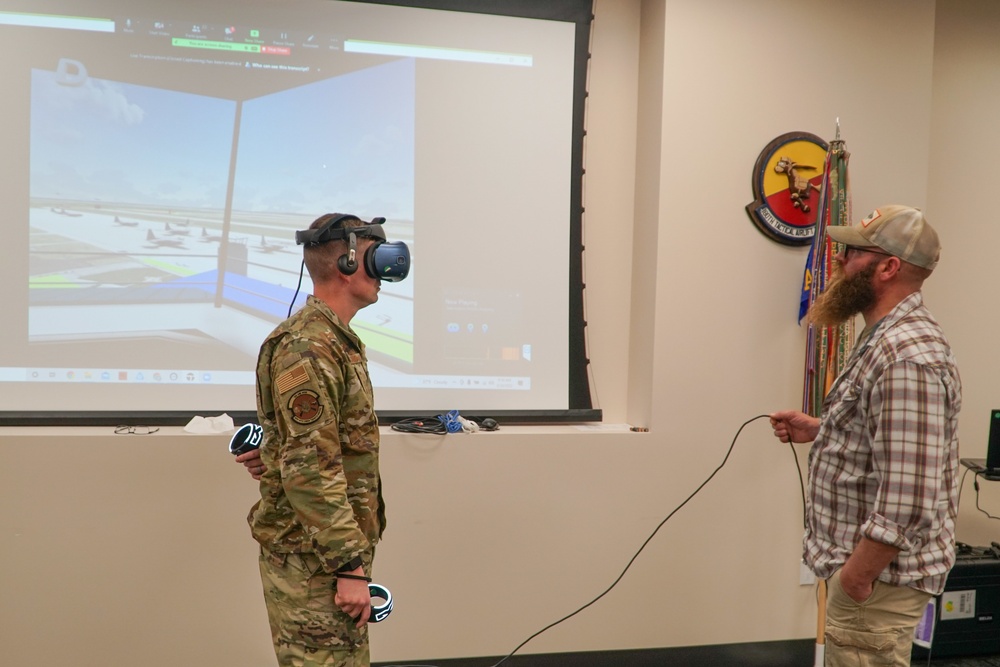
Featured image: Archival photograph of an air traffic controller reviewing a proposed airport tower design in St. Joseph, Missouri, on March 24, 2022; it does not depict projects in the current funding request. Credit: U.S. Air National Guard photo by Senior Master Sgt. Michael Crane. The DVIDS item identifies the image as public domain. See the original photo record and DVIDS copyright/use restrictions.
Sources
- Reuters: White House urges Congress to provide $30.1 billion for aviation reform (Nov. 13, 2026).
- Federal Aviation Administration: Administrator Bryan Bedford’s FY2027 budget testimony.
- U.S. Government Accountability Office: Air Traffic Control Systems—Ambitious New Modernization Effort Needs Cost and Schedule Planning (Sept. 2026).
- FAA: Transportation Secretary and Modern Skies Coalition back the Modern Skies Act (Sept. 29, 2026).
- AOPA: Duffy unveils plan for additional ATC modernization funding (Sept. 24, 2026).
- AOPA: Bill to fund next phase of ATC modernization introduced (Oct. 1, 2026).



No comment