
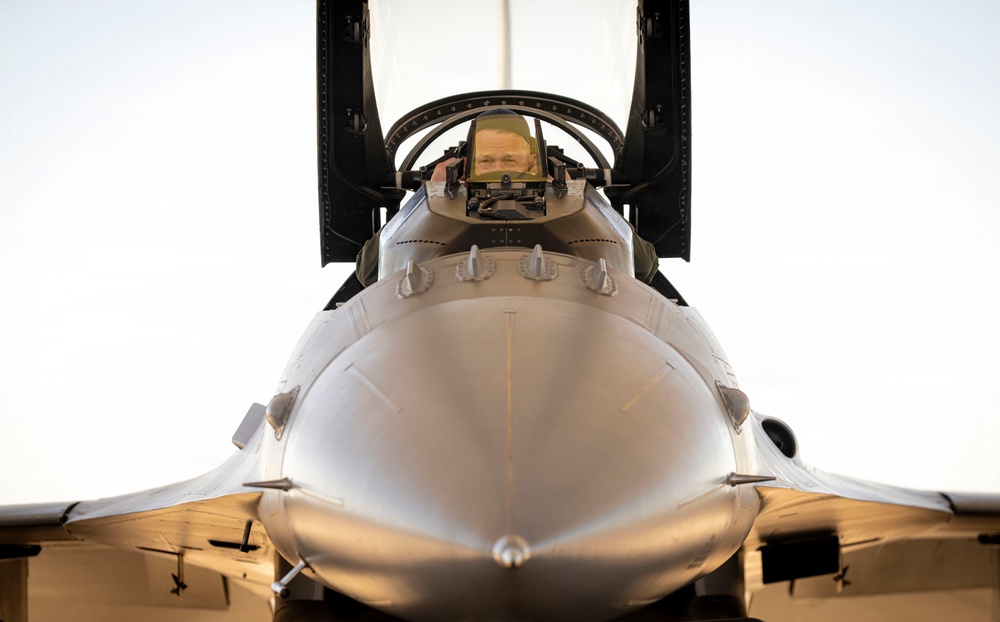
Chairman of the Joint Chiefs of Staff Gen. Dan Caine returned to the cockpit of an F-16 Fighting Falcon for a routine training flight in Tucson, Arizona, on Oct. 26, according to an official Department of War photo record. The flight was intended to test advances in targeting capability while helping Caine maintain proficiency in the aircraft, the caption says. The image record does not identify a particular targeting system, test unit, or operational scenario, so those details remain undisclosed.
The sortie offers a rare public look at a senior joint-force leader continuing hands-on flight training. Caine’s official biographies describe a career built largely around the F-16: he served as an instructor pilot, weapons officer, mission commander and flight commander across several fighter assignments. The Joint Chiefs biography characterizes him as having served primarily as an F-16 fighter pilot before taking on senior leadership roles.
What the official record says
The Office of the Chairman of the Joint Chiefs of Staff released a 12-image set through the Defense Visual Information Distribution Service, or DVIDS. The caption for photo 10053553 says Caine flew the F-16 in Tucson to test advancements in targeting capabilities while maintaining his proficiency. The photograph is dated Oct. 27 in DVIDS, while its caption identifies the flight as occurring Oct. 26. DVIDS lists Benjamin D. Applebaum as the photographer and the Office of the Chairman as the releasing organization.
The account is brief. It does not name the aircraft’s unit, the equipment involved, the flight duration, or what was learned. It also does not describe a weapons release or operational mission. The most reliable way to characterize the activity is therefore the one used by the source itself: a routine training flight connected to targeting-capability advancements and pilot proficiency.
That distinction matters. Modern targeting can involve sensors, software, data links, mission planning and coordination with other aircraft or forces. The official caption does not say which of those areas was involved in this sortie. Without further technical details from the Joint Staff or the Air Force, it would be speculative to attribute a specific pod, sensor, software package or combat test to the flight.
A fighter pilot’s career behind the flight
The Air Force’s biography of Gen. John D. “Dan” Caine lists multiple F-16 assignments. In the 138th Fighter Squadron in Syracuse, New York, he served as an instructor pilot and chief of scheduling and training. Later roles included F-16 instructor pilot, flight commander and chief of weapons and tactics with the 121st Fighter Squadron at Andrews Air Force Base, Maryland. The Joint Chiefs’ official biography likewise describes his operational experience as primarily centered on the F-16.
A Joint Chiefs transcript of a 2025 public appearance records Caine describing more than 2,800 flight hours, including 150 combat hours. Those figures provide career context, but the available sources do not say how frequently he flies now or whether the Tucson sortie was part of a recurring qualification schedule. The photo caption only establishes that the flight was intended to maintain proficiency and assess targeting advancements.
Maintaining proficiency is a practical matter for any pilot who remains assigned to fly. The F-16 requires pilots to manage aircraft systems, flight parameters and mission tasks while operating in a high-performance fighter aircraft. Caine’s flight is notable because it shows the country’s senior uniformed officer undertaking that kind of training; it should not be taken as evidence that he resumed an operational fighter assignment or that the F-16 is being used for a new mission.
Why the F-16 remains relevant to the test
The Air Force describes the F-16 Fighting Falcon as a compact multirole fighter that can perform air-to-air and air-to-surface missions. Its long service life has made it a platform for successive generations of aircraft upgrades, operational tactics and training. That breadth helps explain why a flight caption can refer generally to targeting capability without naming a single system: the aircraft’s mission role depends on an integrated set of aircraft and mission equipment, and the source did not identify which element was being assessed.
The flight took place amid a continuing emphasis across the services on connecting aircraft, sensors and command networks. But the public record for this sortie does not make a broader claim about joint-network testing or a new capability entering service. It confirms only that the flight was used to test unspecified targeting advancements while Caine maintained his own proficiency. Any more detailed technical interpretation would require a separate statement or release from the organizations involved.
The DVIDS gallery’s caption and imagery establish the event, while the Air Force and Joint Chiefs biographies establish Caine’s F-16 background. Together, those records place the flight in context without expanding what is known about its purpose. The clearest takeaway is that a senior leader with extensive fighter-pilot experience took part in a training sortie tied to ongoing targeting work, with the details of that work left publicly unspecified.
Sources
- DVIDS: “CJCS F-16 Flight,” photo 10053553 (event caption, photo credit and image rights)
- U.S. Air Force: Gen. John D. Caine biography
- Joint Chiefs of Staff: Gen. Dan Caine biography
- Joint Chiefs of Staff: 2025 fireside-chat transcript
- U.S. Air Force: F-16 Fighting Falcon fact sheet
- DVIDS visual-information copyright and use notice


No comment