
Europe’s Euclid space telescope has moved from commissioning and early demonstrations into a much larger phase of public science. On Nov. 12, the European Space Agency and the Euclid Consortium released DR1-Foundation, the mission’s first major data collection: roughly 13 months of observations covering about 1,900 square degrees of sky. The release contains images, spectra and catalogues describing more than 900 million galaxies and other measured sources, giving astronomers a broad survey base for studying how cosmic structure changed over time.
The release is a milestone in the mission’s survey, not a finished answer to the questions that motivated it. Euclid is designed to map the distribution of galaxies across a large fraction of the sky and use that pattern to test models of dark matter, dark energy and gravity. DR1-Foundation gives researchers a wide, reusable body of observations; later processing and analysis will turn that material into increasingly precise measurements. ESA’s release overview and Reuters’ independent report describe the scale and contents of the new dataset.
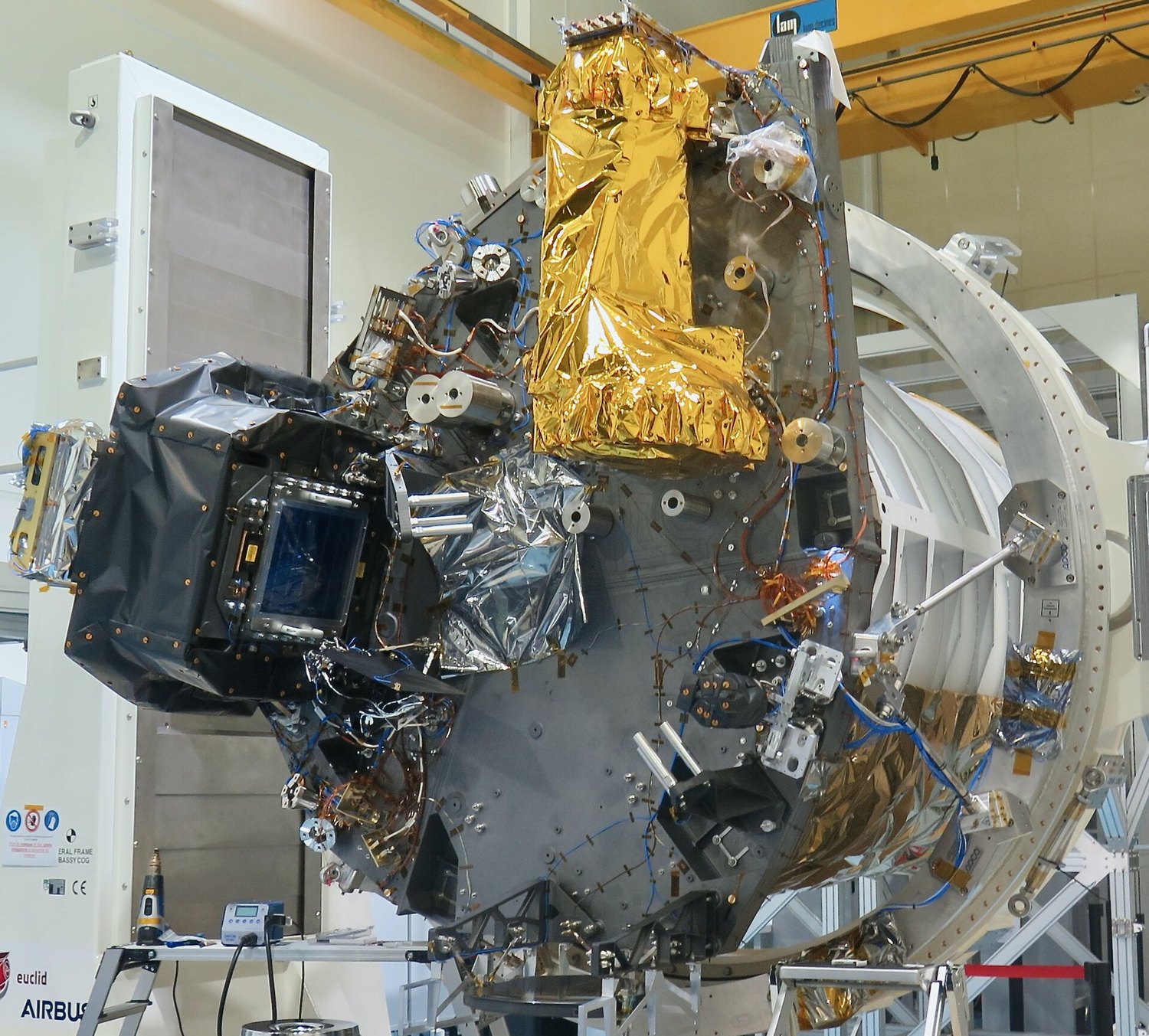
Archival image: Airbus photographed Euclid’s structural and thermal payload-module model in a clean room in 2020, with the VIS and NISP instruments installed. It is not a photograph of the telescope in orbit or of the 2026 data release. View the original image record. Credit: Airbus. Used for editorial reporting under the ESA Standard Licence listed on the asset record. This copy was resized proportionally to 1500 × 1353 pixels without cropping. See ESA’s current terms and conditions. No ESA endorsement is implied.
A first major release, built from a year of survey work
Euclid launched in July 2023 and began its science survey after commissioning. DR1-Foundation draws on observations collected from spring 2024 through spring 2025, according to ESA. That span is important because the release is not a collection of a few showcase images: it is a data package assembled from repeated observations across large, planned areas of sky. The mission’s Wide Survey covered about 1,900 square degrees during this period, approximately 14 percent of the area planned for Euclid’s six-year survey.
ESA describes the coverage as roughly 9,500 times the apparent area of the full Moon. The specific sky regions represented in the release include a northern mosaic covering 367 square degrees and a southern mosaic covering 148 square degrees, together with observations from the mission’s Deep Survey fields and calibration areas. The area in the mosaics is not the entire 1,900-square-degree survey footprint; the maps and catalogue products describe different parts of the data package. The Euclid Consortium’s release page summarizes the observations and the science goals behind them.
The data volume is also a reminder that a space telescope’s work does not end when a detector records photons. ESA reports approximately 1.7 million gigabytes across the Wide Survey products. The NASA/IPAC Infrared Science Archive describes the initial DR1 collection as approximately 1.8 petabytes and notes that it includes imaging, catalogues and spectra from the wide survey, deep fields and calibration observations. These are rounded figures from different archive descriptions, but both convey the scale of the work required to calibrate, catalogue, store and distribute a survey of this size.
What Euclid measures—and why the images are only one layer
Euclid combines visible-light imaging with near-infrared imaging and spectroscopy. Its visible instrument, VIS, records galaxy shapes in fine detail; the Near-Infrared Spectrometer and Photometer, NISP, measures infrared brightness and disperses light to help estimate distances. Those measurements answer different but connected questions. A galaxy’s apparent shape can be subtly distorted by the gravity of matter between it and Earth, while its spectrum and colours help place it at a distance and therefore at an earlier point in cosmic history. ESA describes the mission’s instruments and goals in its Euclid overview.
That combination is central to Euclid’s long-range map. The mission will chart galaxies and clusters across more than a third of the sky and out to about 10 billion light-years, helping researchers reconstruct how large-scale structure grew as the universe expanded. Dark matter does not shine in the telescope’s images, but its gravity affects how visible matter moves and how background galaxies appear. Dark energy is not a photographed object either; it is the name given to the still-unexplained influence associated with the universe’s accelerating expansion. Euclid’s contribution is to measure the geometry and evolution of the cosmic web with enough breadth and consistency to put competing explanations under pressure.
The DR1-Foundation catalogues include more than 900 million galaxies, around 15,000 candidates for strong gravitational lensing, over 60 million quasar candidates and spectra for more than 160 million sources. Strong lensing happens when a foreground galaxy or galaxy group bends light from an object behind it, producing arcs, rings or multiple images. Such systems are rare and useful: they allow astronomers to study the foreground mass, including its dark-matter distribution, while also revealing distant background galaxies. ESA and the consortium describe the new list as a candidate catalogue, which means the objects still need study and confirmation; the count should not be read as 15,000 fully resolved answers about dark matter.
The quasar catalogue has a different role. Quasars are bright central regions around actively feeding supermassive black holes. Because they can be seen across enormous distances, they help researchers probe the early universe and map material between galaxies. Euclid’s spectra add information beyond a coloured picture: the pattern of a source’s light can indicate its composition and help estimate its redshift, a measure linked to distance and cosmic expansion. Taken together, the catalogue and spectra provide many pathways for follow-up work, from identifying unusual objects to comparing galaxy populations across different epochs.
From earlier previews to a survey researchers can mine
Before DR1-Foundation, Euclid had released smaller early observations and a quick data release. ESA’s project scientist has contrasted those earlier releases—covering only a few days and around 60 square degrees—with this collection, which includes more than a year of data and a much broader footprint. The difference is methodological as well as numerical. A mission can demonstrate image quality with a few striking fields, but a cosmological survey must repeatedly observe large areas, control instrumental effects and keep measurements comparable from one region to the next.
The “Foundation” label also matters. According to the NASA/IPAC archive’s dataset description and the consortium’s DR1 information page, the November package supplies most of the first major release’s base products. A complete DR1 is expected in mid-2027 and is planned to add higher-level science products for galaxy clustering and weak-lensing studies. The present catalogue is an invitation to research, not the final mission analysis already written up in finished form.
That staged approach gives outside teams the opportunity to test their methods against a common data set. The Euclid Consortium brings together scientists and institutes across Europe and partner countries, and the released products are available through ESA’s science archive and the complementary NASA/IPAC Infrared Science Archive. Researchers can examine the same calibrated images, compare independent analyses and identify where a catalogue is robust or where a candidate needs additional observations. The consortium’s announcement notes that DR1-Foundation includes imaging, spectroscopy and higher-level science and calibration products.
A wide map will not settle dark matter and dark energy by itself
Euclid’s headline counts are impressive, but the scientific challenge is to distinguish real cosmic patterns from the limits of measurement. Galaxy shapes are affected by image quality, blending, detector behaviour and foreground objects. Distance estimates depend on the quality of photometric and spectroscopic information. Lensing candidates need checks to determine whether apparent arcs are genuine gravitational distortions rather than lookalikes. The mission’s calibration programme and uniform processing are intended to make these effects measurable, while the public release allows scientists to scrutinize the products and develop independent tests.
Nor does a large catalogue translate immediately into a single result about the universe. Different analyses can use the same observations to test galaxy clustering, lensing, galaxy evolution or the distribution of matter, and they may have different uncertainty budgets. The first data package is valuable in part because it creates a shared reference point. Teams can identify patterns, publish methods and compare conclusions as more survey area becomes available. Any claim that the November release has “solved” dark matter or dark energy would outrun what the release itself establishes.
Reuters reported the release as a major new collection for researchers studying the universe’s structure. ESA’s timeline points to a complete DR1 in 2027, followed by later major releases as Euclid gathers additional coverage. The full mission is intended to observe more than a third of the sky and galaxies out to about 10 billion light-years. Those future stages will add depth, area and derived measurements, allowing researchers to compare the first broad patterns in DR1-Foundation with a more complete view.
For now, the immediate change is practical: astronomers have a large, public, space-based survey to explore. Its images offer visual evidence of how much sky Euclid has covered, while the catalogues and spectra let research teams ask questions that cannot be answered from a single mosaic. The scientific return will emerge over time as the data are checked, combined with other observations and translated into papers. DR1-Foundation is the opening of that process at a scale Euclid had not previously made available.
Sources
- European Space Agency: “Dive into Euclid’s new cosmic treasure trove”
- European Space Agency: Euclid mission overview
- Euclid Consortium: DR1-Foundation release overview
- Reuters: Euclid mission data release spans more than 900 million galaxies
- NASA/IPAC Infrared Science Archive: Euclid DR1 dataset description
- Euclid Consortium: Press releases
- ESA image record: VIS and NISP instruments on Euclid’s payload module
- ESA terms and conditions





No comment