
Historical report — Sept. 23, 2014. The F-22 Raptor’s first combat mission came during the opening U.S.-led coalition strikes against the Islamic State group in Syria. U.S. Air Force and Defense Department accounts say Raptors joined a multi-aircraft campaign that struck targets in northern Syria, marking the fifth-generation fighter’s move from years of air-superiority preparation into a combat role that included precision attacks on the ground.
The mission’s significance was not simply that a new fighter type had entered combat. The F-22 was built around air dominance, but the September 2014 operation placed it inside a larger package of fighters, bombers, remotely piloted aircraft and cruise missiles. The Raptor’s first combat employment therefore offered an early example of how the aircraft would be used as one part of a coordinated campaign rather than as a stand-alone platform.
The first strikes in Syria
On Sept. 23, 2014, U.S. and partner forces began strikes against Islamic State of Iraq and the Levant, or ISIL, targets in Syria. A contemporaneous Air Force account said the campaign involved 14 strikes and aircraft from the United States and coalition partners, including F-15E, F-16, F/A-18 and F-22 fighters, B-1 bombers and remotely piloted aircraft. Targets listed by U.S. Central Command included training compounds, headquarters and command-and-control sites, storage facilities, vehicles and other infrastructure in several parts of Syria.
The Air Force later described the F-22’s role as its combat debut, with the aircraft’s first strike against ground targets occurring during the coalition campaign. A Defense Department briefing supplied a more detailed sequence: F-22s were in the second wave of attacks, launched from bases in the region at about 9 p.m. Eastern time. Officials said the second wave also included F-15s, F-16s, B-1 bombers and remotely piloted aircraft, while additional U.S. and coalition aircraft took part in later strikes.
That distinction between a combat mission and a first strike is useful. A combat debut can include escort, support or other operational tasks; the Air Force’s public account specifically identifies the first attack on enemy ground targets as the milestone. The Defense Department’s briefing said an F-22-delivered precision weapon hit part of a command-and-control building in Raqqah. The briefing described the strike as the first time the Raptor was used in a combat role and said the targeted portion of the building was destroyed.
A role beyond air-to-air combat
The Air Force’s F-22 fact sheet describes the Raptor as an air-dominance fighter designed to combine stealth, supercruise, maneuverability and integrated avionics. Its first combat deployment to Syria tested that broader system in a real operational setting. The public record does not detail every sensor, weapon or planning method used by the aircraft, so claims about the precise technical contribution should be limited to what officials disclosed at the time.
The Defense Department briefing emphasized that the Syria operation involved a large strike package and careful coordination through U.S. Central Command’s combined air operations center. It also reported that 96 percent of the munitions delivered in the operation were precision-guided. Those figures described the overall campaign, not the F-22 alone. They show the operational context in which the fighter’s first combat role took place: a coalition air operation involving multiple platforms, weapons and partner forces.
That context helps explain why the Raptor’s combat debut was closely watched. The aircraft had been associated primarily with defeating enemy aircraft and securing air superiority. Its participation in a strike campaign demonstrated that the platform could also contribute to air-to-ground operations when tasked as part of a broader force. The available official accounts, however, do not support treating one mission as proof of every later capability or tactic associated with the aircraft.
What the record establishes—and what it does not
Contemporaneous service and Defense Department reports agree on the central facts: the opening strikes occurred on Sept. 23, 2014; F-22s participated; and the operation was the aircraft’s first combat employment. The Air Force characterized the mission as the Raptor’s combat debut, while the Defense Department briefing identified F-22s in the second wave and described a precision attack against a command-and-control site.
The public accounts do not provide a complete mission log, a full list of every aircraft in each formation, or a technical evaluation of the F-22’s sensors and weapons during the sortie. They also do not attribute all campaign results to the Raptor. Those omissions are important in a historical reconstruction: the strongest account sticks to the documented role and avoids turning a limited public record into a more detailed operational narrative than the sources support.
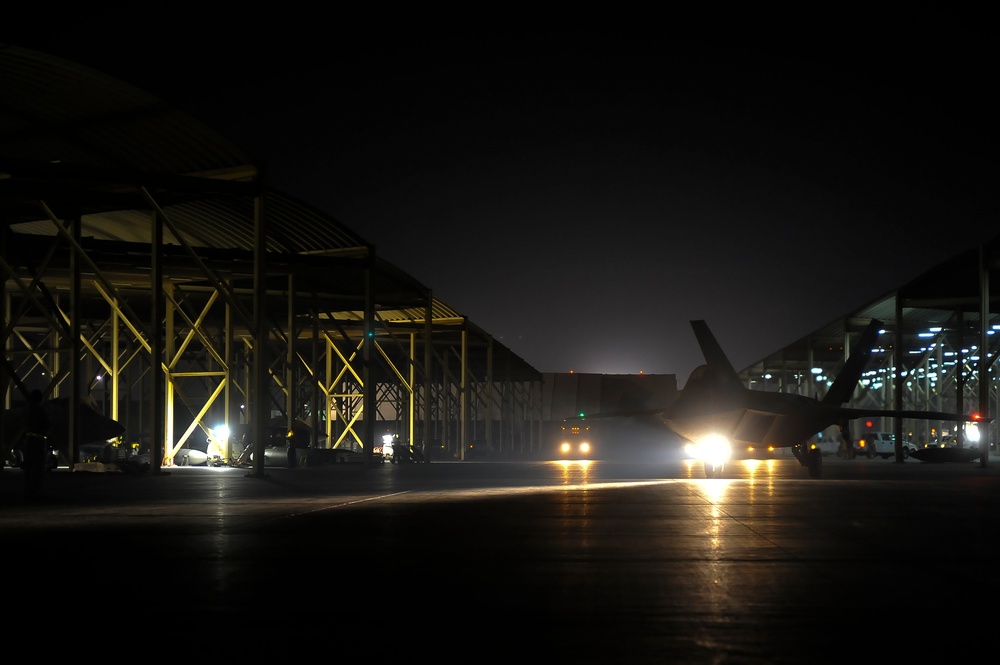
The featured photograph accompanying this article is archival. DVIDS identifies it as an F-22A taxiing in the U.S. Central Command area of responsibility before strike operations on Sept. 23, 2014. It depicts preparations ahead of the campaign, not the aircraft releasing a weapon or striking a target. The image record credits U.S. Air Force Tech. Sgt. Russ Scalf and marks the photograph public domain.
More than a decade later, the first Syria mission remains a clear marker in the Raptor’s service history: an aircraft developed for air dominance entered combat as part of a coalition strike force and was used against a ground target. The official record is concise, but it documents a change in the F-22’s operational story—from a platform defined by its air-to-air mission to one demonstrated in a wider set of combat tasks.
Sources
- U.S. Air Force: “F-22 Raptor brings unique capabilities to the coalition fight against ISIL”
- U.S. Department of Defense: “DoD Official: Successful Syrian Strikes Only the Beginning”
- U.S. Air Force Materiel Command: “Air Force fighters, bombers conduct strikes against ISIL targets in Syria”
- DVIDS: “Syria airstrike,” photo 1564880, by Tech. Sgt. Russ Scalf (archival image, public-domain status)
- DVIDS visual-information copyright and use notice
- U.S. Air Force: F-22 Raptor fact sheet

No comment