
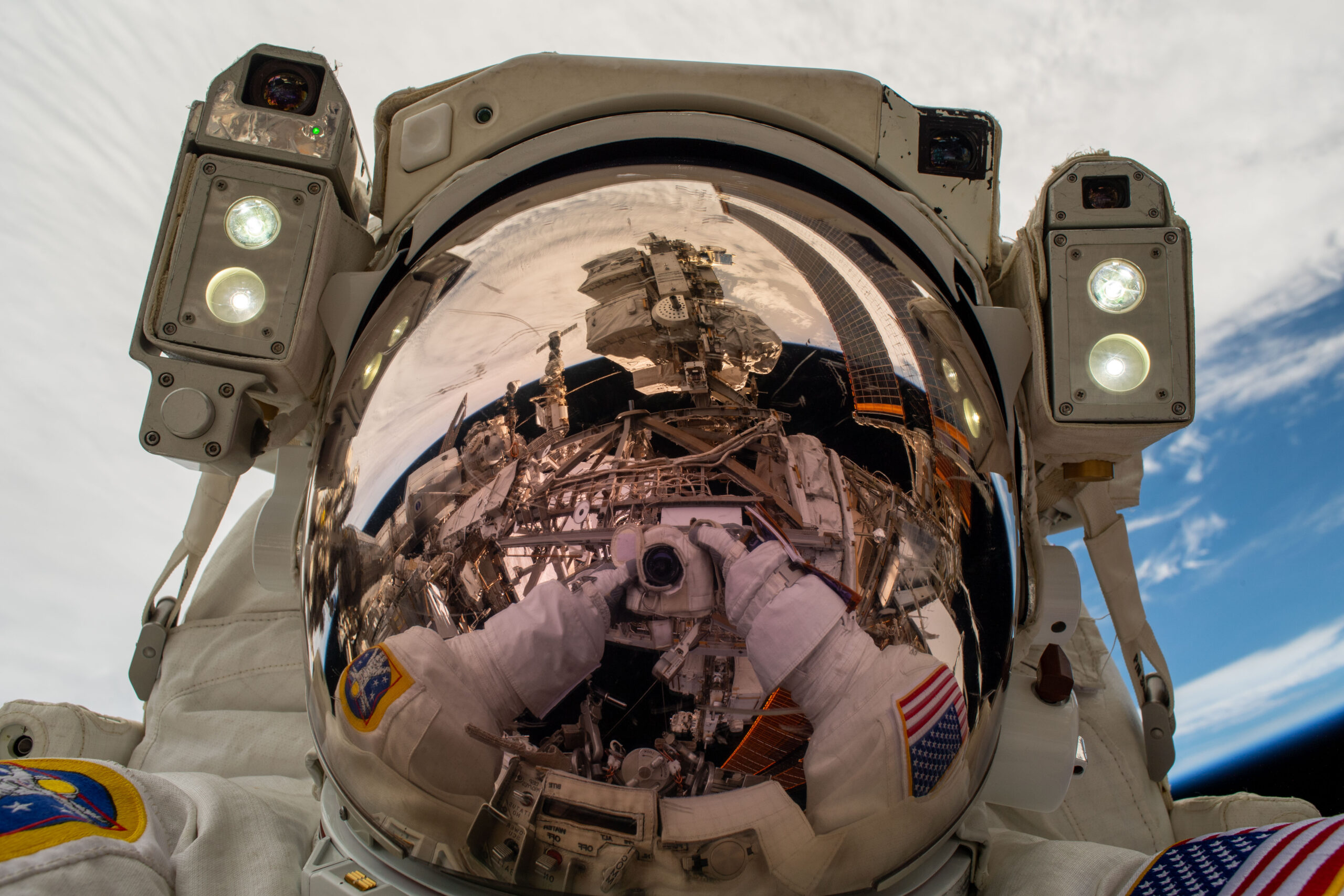
NASA astronaut Anil Menon arrived at the International Space Station in July 2026 carrying an unusual combination of experience: emergency medicine, aerospace medicine, military flight operations and commercial human-spaceflight work. The astronaut’s first orbital mission has now included a demanding series of spacewalks, culminating in the installation of the station’s eighth and final roll-out solar array.
Menon and Canadian Space Agency astronaut Joshua Kutryk completed that final installation on Nov. 5, 2026. NASA reported that the pair spent six hours and 59 minutes outside the station, deploying the final International Space Station Roll-Out Solar Array, or IROSA, on the 3B power channel. The work completed a multi-year effort to augment the station’s original solar arrays. The photo accompanying this profile is an archival NASA image of Menon during a 2026 spacewalk; it is not a photograph of the final array installation.
A career built around keeping people safe in flight
Menon’s path to the astronaut corps began in medicine and engineering. NASA’s biography describes him as an emergency-medicine physician who also trained in wilderness and aerospace medicine. He earned degrees in neurobiology, mechanical engineering, medicine and public health, then worked as a flight surgeon supporting military aviation and spaceflight operations.
Before joining NASA’s astronaut class, Menon became SpaceX’s first flight surgeon. NASA credits him with helping establish the company’s medical organization and supporting the Demo-2 mission, the first crewed flight of SpaceX’s Crew Dragon spacecraft. His responsibilities connected clinical medicine with engineering and mission operations: protecting crew health required planning for launch, time in orbit and return to Earth.
That background is a practical fit for long-duration missions. Medical planning for a crew cannot stop at routine care. Astronauts work in a confined vehicle, exercise to limit the effects of microgravity, conduct complex maintenance and research, and must be ready to respond when help is far from an emergency room. Menon’s experience in emergency response, flight medicine and crew-support systems gives him a perspective shaped by both the patient and the operation.
From mission support to the spacecraft
NASA selected Menon for its 2021 astronaut candidate class. He reported to the agency in January 2022 and completed astronaut training before being assigned to the Soyuz MS-29 mission. He launched from Baikonur on July 14, 2026, with Roscosmos cosmonauts Pyotr Dubrov and Anna Kikina for an approximately eight-month stay aboard the orbital laboratory.
NASA’s preflight podcast with Menon traced his interest in space to childhood visits to a science museum and a growing interest in exploration. The agency’s account also describes his work as a flight instructor and his more than 1,000 hours of pilot experience. Those details matter in a profession where astronauts must learn new vehicles, procedures and systems while working closely with an international crew.
Menon has also served as a first responder after major disasters and as a flight surgeon supporting Air Force operations. NASA says he logged more than 100 sorties in the F-15 and transported more than 100 patients as part of a critical-care air-transport team. Those roles demanded calm decision-making under time pressure—skills that translate to both spacecraft operations and spacewalk preparation.
Spacewalks as engineering work
The November 5 spacewalk was the final step in a power-system upgrade, but the astronauts’ work was only one part of a larger chain. Ground teams prepared procedures and tools, station crewmates supported operations from inside, and mission controllers monitored the excursion. Outside the station, the pair had to move hardware, coordinate positions and complete installation tasks while wearing pressurized suits.
The final IROSA adds to the station’s electrical capacity alongside its original solar arrays. NASA has described the roll-out arrays as part of a broader effort to maintain power as the orbital laboratory ages and its systems continue to support research. The upgrade is significant for the station’s ongoing operations, but it does not remove the need for maintenance, careful power management or future decisions about the laboratory’s long-term role.
For Menon, the work marked a transition from preparing other people for spaceflight to performing the mission himself. His first flight has combined research, cargo operations and repeated work outside the station. The arc from emergency physician and flight surgeon to astronaut is not simply a change of workplace: it puts his medical and aviation background into the environment he spent years helping others prepare for.
What comes next
Menon is scheduled to remain aboard the station for roughly eight months as part of Expedition 75. The crew continues research and maintenance while preparing visiting cargo vehicles and returning experiments to Earth. NASA’s Nov. 12 station update, for example, described crew members packing a SpaceX Dragon spacecraft with research samples and supplies for its eventual departure.
The station’s final IROSA installation closes one chapter of a long power-upgrade campaign. Menon’s mission continues with the daily work of an orbital laboratory: science, maintenance, crew care and preparation for the next operation. His career shows how those responsibilities can draw on medicine, engineering and flight experience at once.
Image: NASA/Anil Menon. Public-domain NASA image from a 2026 spacewalk; archival image, not a photograph of the Nov. 5 installation.


No comment