
A Royal Navy test pilot has flown the first release of a Meteor missile test asset from inside an F-35B Lightning II’s weapons bay, marking a new step in the weapon’s integration with the British and Italian versions of the fighter. The Oct. 7 flight at Naval Air Station Patuxent River, Maryland, demonstrated safe separation in flight; the test asset’s rocket motor did not ignite and its control surfaces did not activate. The milestone was announced Nov. 5 by the F-35 Joint Program Office and MBDA.
The test was a jettison trial, not a live firing or an operational use of Meteor. Its purpose was to collect information about how the missile-sized test article left the aircraft’s internal bay in a complex aerodynamic environment. That separation data helps engineers check and refine digital models before moving to more demanding release profiles and, later, live missile firings.
A first release from the internal weapons bay
The F-35 Joint Program Office’s announcement says a combined F-35 Integrated Test Force team prepared and loaded the weapon test asset before the flight. The team included Royal Navy, Royal Air Force and industry personnel. MBDA’s release adds that the sortie was flown by a Royal Navy F-35 test pilot assigned to the UK Air and Space Warfare Centre and embedded with the joint test force.
Both program accounts describe the event as the first Meteor release from an F-35B internal weapons bay. The missile separated from the aircraft but did not power itself or deploy control surfaces. That distinction is central to understanding the milestone: a jettison trial is designed to examine separation and aircraft safety, while a live firing would test the missile’s powered flight and engagement performance.
The trial generated data to refine predictive aerodynamic and digital models used to assess release characteristics. It did not establish that Meteor is cleared for operational use on the F-35B. MBDA said a series of additional release profiles is planned over the coming months, followed by live firings to assess both separation and missile fly-out performance under different conditions.
Why the test matters to the F-35 program
Meteor is a beyond-visual-range air-to-air missile developed by MBDA. The F-35 Joint Program Office says the integration effort supports future air-to-air options for British and Italian F-35 fleets. MBDA describes the missile as using sustained propulsion rather than relying only on an initial boost-and-glide profile. The October event addressed a necessary early question in that integration work: whether the weapon can safely leave the aircraft’s internal bay.
Independent coverage by Navy Lookout places the release test within a longer effort to bring British weapons onto the F-35B. It notes that an earlier captive-carry phase involved carrying Meteor inside the bay without releasing it, while this October trial moved to separation. The outlet also reports that operational availability remains dependent on additional integration and test work; the Nov. 5 announcements likewise describe future release profiles and live firings still to come.
The British and Italian programs share the goal of expanding their F-35 air-to-air options, but the announcement does not say that the missile is ready for combat use or that the same integration schedule applies to every aircraft variant. The reported flight specifically involved an F-35B and an internal-bay release. Further tests will be needed to validate release across the aircraft’s intended operating conditions.
A measured step in a longer test campaign
For weapons integration, an apparently simple separation event can require careful measurement. A store must clear the aircraft without contacting its structure or destabilizing the aircraft, and the observed behavior is compared with engineering predictions. The JPO and MBDA did not publish detailed telemetry or the test’s numerical results, so the public record supports only the broad conclusion they reported: the test asset separated safely and provided data for refining predictive models.
The Oct. 7 flight is therefore a development milestone, not a declaration of operational capability. The next stage, according to MBDA, will broaden the release profiles; live firings are planned afterward. Those phases will answer different questions from the first jettison trial, including how the missile behaves after release under powered flight. Neither source provided dates for the later events.
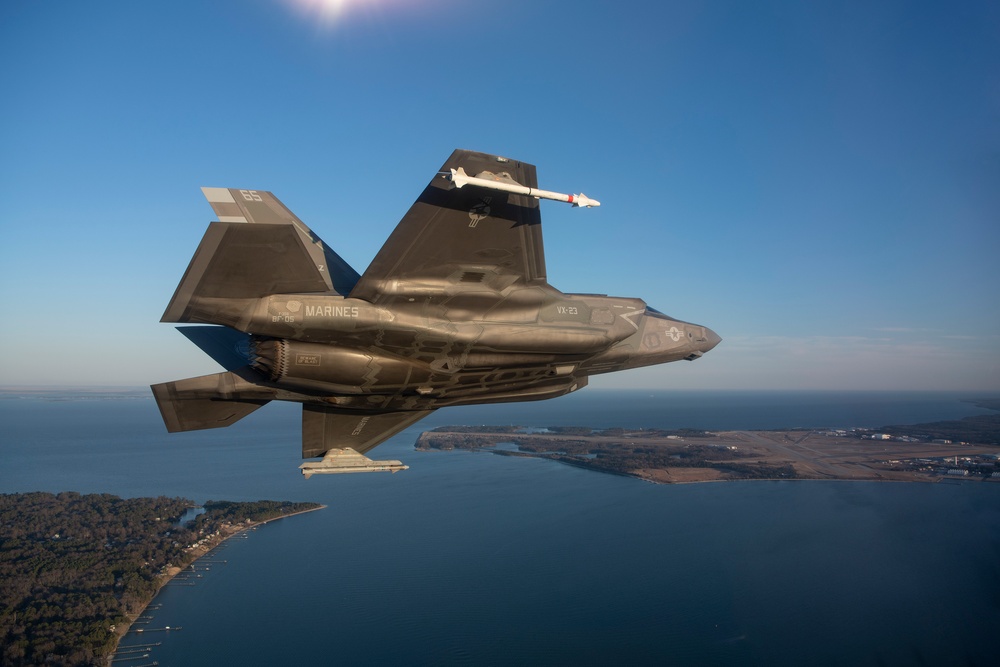
The featured photograph is archival and does not show the Meteor release. DVIDS identifies it as an F-35B of the Patuxent River Integrated Test Force approaching to land after a weapons-integration test flight on Feb. 11, 2022. It is included as an archival image of the aircraft and test organization, not as a depiction of the October 2026 event.
Sources
- F-35 Joint Program Office via DVIDS: first Meteor jettison flight trial
- MBDA: “METEOR completes first jettison trials from F-35”
- Navy Lookout: Royal Navy pilot conducts first F-35B Meteor release test
- DVIDS archival photo 7054451 by Kyra Helwick (PUBLIC DOMAIN)
- DVIDS visual-information copyright and use notice

No comment