
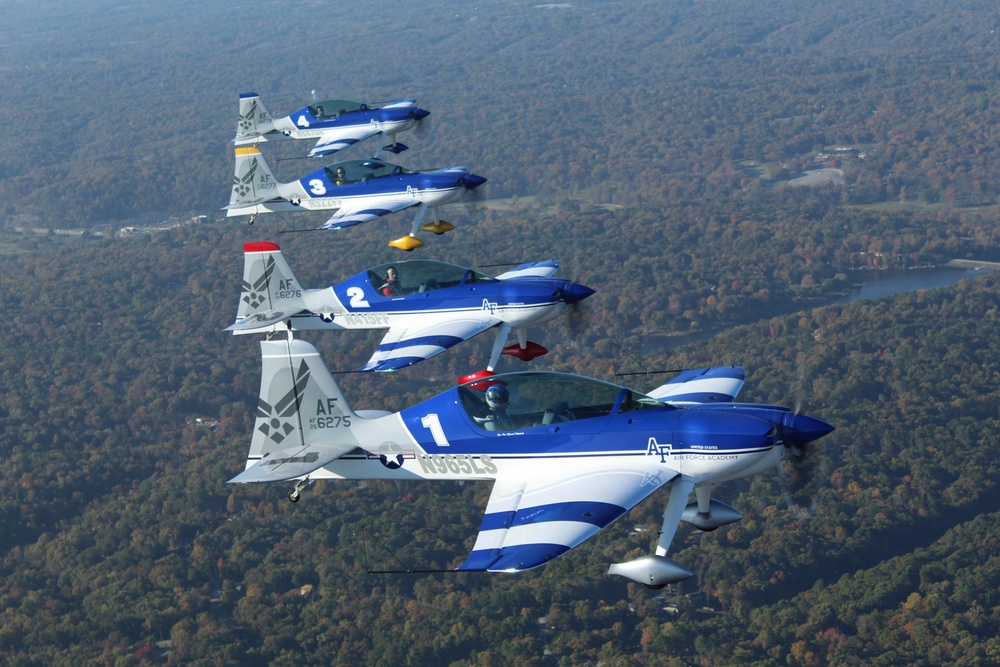
The U.S. Air Force Academy introduced four T-19A Kestrel aerobatic aircraft to cadets on Nov. 12, flying them over the Cadet Wing before landing at Davis Airfield. The formation marked the public debut of the Academy’s first aircraft dedicated to powered aerobatic training. The aircraft are meant to expand cadet airmanship opportunities and support a new aerobatic curriculum, with cadets expected to take on a larger role as the program develops.
The unveiling turns a planned capability into an operating program, but the Academy has not yet published a syllabus, training schedule, or estimate of how many cadets will fly the Kestrels. The initial work rests with six active-duty pilots selected from Academy staff and the 306th Flying Training Group. They will create the curriculum and lead early demonstrations while the school determines how students will enter the program.
Four aircraft and a new training role
The Academy said the four T-19As are donated, single-engine, two-seat aerobatic airplanes. At the Nov. 12 ceremony, Air Force Chief of Staff Gen. Ken Wilsbach, Superintendent Lt. Gen. Paul Moga, Provost Brig. Gen. James Valpiani, and initial cadre member Lt. Col. Evan Backes piloted the aircraft. They flew over the Cadet Wing’s noon meal formation, landed at Davis Airfield, and joined the event on the ground. The Academy described the flight as the aircraft’s official public debut.
The T-19A is based on the GB1 GameBird, an aerobatic design built by Game Composites, also referenced as Game Aerospace in the manufacturer’s current materials. The aircraft’s two seats allow an instructor and student to fly together, and its aerobatic design exposes pilots to attitudes and maneuvers beyond ordinary straight-and-level flight. The manufacturer describes the civilian GB1 as a two-seat airplane with dual controls and aerobatic capability. Those specifications describe the underlying design; they do not provide the Academy’s military operating limits or training rules for the T-19A.
That distinction matters. The Academy has framed the Kestrel as an airmanship aircraft, not as a replacement for the service’s primary or advanced trainer fleets. The public announcement does not say that cadets will use it to earn pilot wings, meet a required flight-hour quota, or qualify for a particular aircraft. Its immediate task is narrower: give selected cadets access to powered aerobatic flying and build a structured program around it.
A curriculum still being built
The Academy says six active-duty military pilots from its staff and the 306th Flying Training Group will develop and execute the initial aerobatic curriculum. The group is also expected to lead demonstration activities. The Academy has said it wants to increase cadet participation through structured training, mentorship, and leadership opportunities, eventually forming a nationally competitive aerobatic and demonstration team.
The sequence suggests a gradual build-up rather than an immediate student-run team. In the first phase, experienced military pilots establish procedures, evaluate the aircraft in Academy operations, and develop the training framework. Cadets are intended to join more deeply as the program matures. The Academy has not released the selection standards, progression steps, number of annual participants, or timeline for public performances, so those remain program goals rather than scheduled outcomes.
Aerobatic flight can teach pilots to recognize changing aircraft attitudes, manage energy, coordinate control inputs, and maintain orientation while the horizon moves across the canopy. Those are general aviation skills, but the Academy has not published a lesson-by-lesson account of how the T-19A syllabus will use them. Its public explanation emphasizes airmanship, confidence, discipline, and leadership. The practical value will depend on how the school connects the experience to its broader cadet development and aviation programs.
The name Kestrel also came through cadet participation. A selected group helped choose the name, and the four aircraft carry accents based on the Academy’s class colors. At the ceremony, four cadets representing different classes received symbolic keys to the aircraft. These gestures show the Academy is presenting the program as part of cadet life and leadership development, as well as an aviation activity.
Donations, operating costs, and accountability
The aircraft were donated, but operating a military flying program still requires public resources. Breaking Defense reported that an Air Force spokesperson valued the gift at $3 million and said the service invested about $400,000 for initial spares, support equipment, and flight gear. The spokesperson also said the Air Force expects to budget roughly $1 million annually to sustain the aircraft. Those figures were attributed to the service through the outlet; the Academy’s own debut announcement did not include a cost breakdown.
The cost picture is relevant because the Kestrel program is presented as a cadet opportunity and a future demonstration capability, not an operational combat unit. The annual sustainment estimate covers the resources needed to keep the aircraft available, while the six-pilot cadre supplies the first instructional and operating capacity. The Academy has not yet said how often the aircraft will fly, what maintenance model it will use, or how program costs will be tracked against participation and training results.
Local coverage by The Gazette independently described the four-aircraft arrival and connected the plan to the Academy’s ambition for a powered-flight aerobatics team. The Academy’s official report provides the program’s stated goals; the independent reports add detail about the aircraft’s delivery, funding, and the service’s early intentions. Neither has published a final syllabus or performance measures for the program.
What the debut does—and does not—establish
The flyover confirms the Kestrels have reached the Academy and completed the public introduction. DVIDS records show the aircraft had recently completed military certification flights, and the Academy says the senior leaders flew them during the debut. That is an important threshold for a new training activity, but it is not proof that the cadet curriculum is fully established or that students are already completing a regular flight course.
The next measures to watch are operational rather than ceremonial: when the Academy begins structured cadet instruction, how many cadets participate, how the six-pilot cadre develops and revises its syllabus, and whether the planned demonstration team appears at events. The service’s public statements describe a long-term objective of wider cadet involvement. They do not yet provide a public timetable for reaching it.
For the Air Force Academy, the T-19A Kestrel adds a visible, hands-on flying option to its airmanship program. The aircraft’s aerobatic role gives the school a new way to teach and practice flight skills, while the donation-funded start leaves continuing sustainment costs with the service. Whether the program becomes a sustained cadet pipeline or a smaller demonstration effort will become clearer as the curriculum moves from its initial instructor cadre to student participation.
Sources
- U.S. Air Force Academy: Air Force leaders pilot T-19A Kestrel in historic Academy debut, Nov. 12, 2026
- DVIDS photo 10090509: T-19A Kestrels in formation, Nov. 11, 2026; image-specific rights statement and credit
- DVIDS copyright and use information
- Breaking Defense: Air Force unveils T-19A, a new aerobatic plane to train future pilots, Nov. 12, 2026
- The Gazette: New aerobatic planes swoop into the Air Force Academy, Nov. 12, 2026
- Game Aerospace: GB1 GameBird design and features
- AOPA aircraft guide: GB1 GameBird overview and specifications
Featured photograph: Four U.S. Air Force Academy T-19A Kestrels in formation en route to Peterson Space Force Base, Colorado, Nov. 11, 2026, one day before their public debut. U.S. Air Force photo by Maj. Ben Kram, DVIDS photo 10090509. The DVIDS record marks this specific image public domain. The appearance of Department of War visual information does not imply or constitute DoW endorsement. Original image record · DVIDS use terms.

No comment