
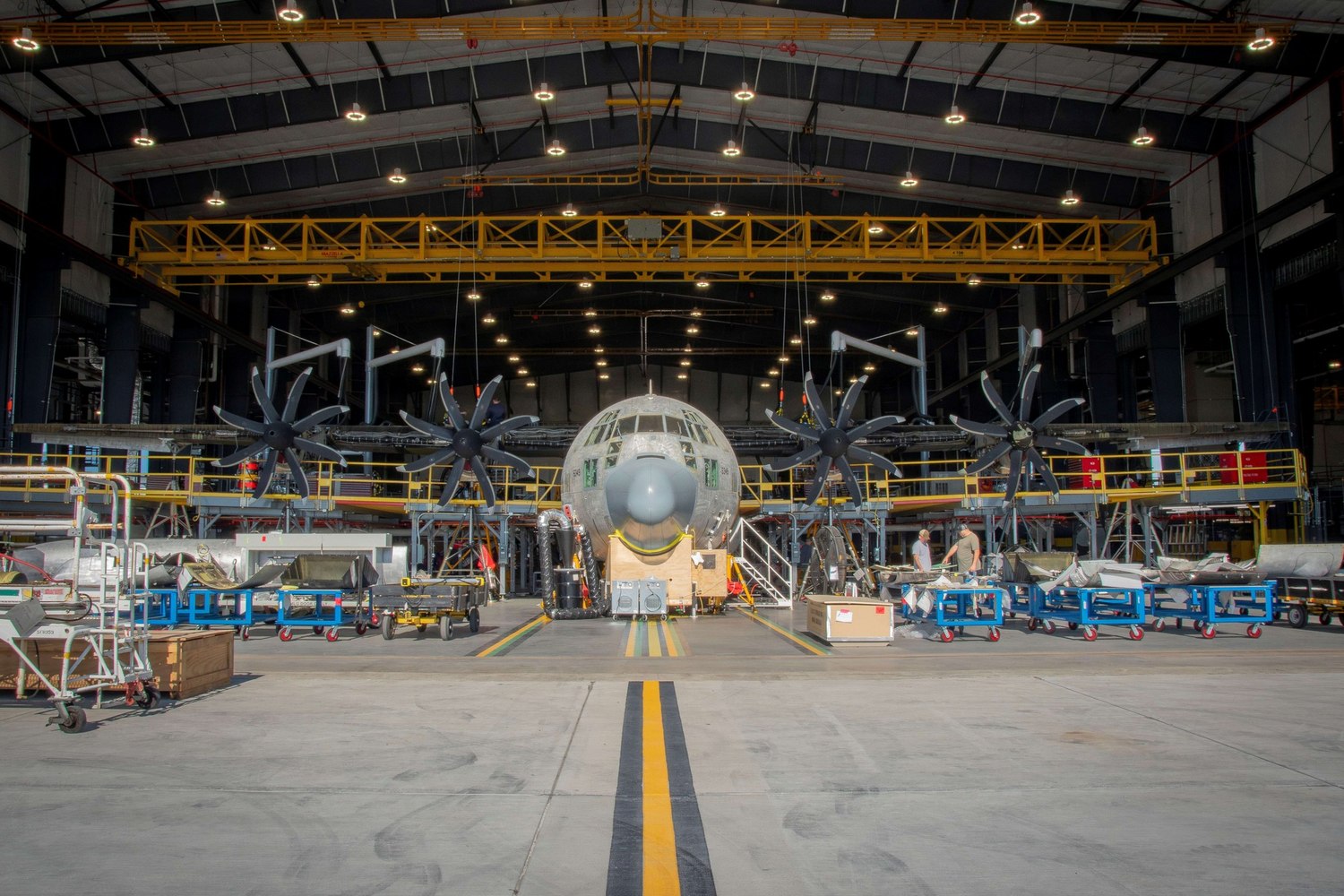
Fleet Readiness Center East has begun its first full-scale C-130T maintenance cycle at its new aircraft depot in Kinston, North Carolina, marking the transition from building a specialized maintenance operation to using it on a Navy transport aircraft. The Navy says the aircraft’s induction starts planned maintenance work at the North Carolina Global TransPark complex, which is also being prepared for Marine Corps C-130 variants and Air Force HH-60W helicopters.
The milestone was reported by Naval Air Systems Command on Nov. 12. The C-130T had previously been selected for maintenance, repair and overhaul work at Fleet Readiness Center East, but this first aircraft begins the depot’s initial full-scale planned maintenance interval there. The arrival is a concrete step in a multi-year effort to shift part of the service’s C-130 sustainment workload to the purpose-built facility.
From depot designation to the first aircraft
In its current account, NAVAIR says the C-130T’s induction begins the first full-scale maintenance, repair and overhaul cycle on the aircraft since Fleet Readiness Center East (FRCE) was named the Navy’s designated C-130 repair point. The depot had spent years preparing the workload: NAVAIR’s 2023 announcement described the planned addition of Navy and Marine Corps C/KC-130J and C/KC-130T work and said the new workload could begin as early as the end of fiscal year 2026.
The first induction is not a claim that the full maintenance line is already at its eventual capacity. NAVAIR describes the new aircraft as moving the site closer to full operational capacity. The release says it took three days from touchdown to the start of maintenance, after months of planning and roughly three years of preparation since the depot’s C-130 designation. Those details describe the start of work on one aircraft; the Navy has not published a fleet-wide turnaround measure or a schedule for completing this airframe.
The aircraft was cleaned and stripped at Tinker Air Force Base before it arrived at FRCE. NAVAIR says that step will not be required for future C-130s once the Kinston complex’s own paint-and-strip capability is ready, which it expects by early 2027. Until then, the depot is opening the maintenance line in stages rather than waiting for every planned support function to be complete.
What the C-130T work involves
The C-130T is a legacy Hercules transport used by Navy and Marine Corps Reserve units for tactical passenger and cargo airlift. Its tanker derivative, the KC-130T, also supports aerial refueling and other assault-support missions. That distinction matters because the depot is supporting more than a single airframe configuration: FRCE’s planned work covers C/KC-130T aircraft as well as newer C/KC-130J variants, with the precise maintenance requirements depending on the aircraft.
Before the new line opened, FRCE personnel already supported C-130s through targeted minor depot inspections and field teams that travel to aircraft operating locations. NAVAIR says those inspections handle structural repairs and corrosion that go beyond the work available to operational squadrons and intermediate-level maintainers. At Kinston, the depot is adding the space and equipment for larger planned maintenance intervals, while continuing those smaller and expeditionary support activities.
That combination could give the Navy more options for where and how to perform C-130 maintenance, but the public announcement does not provide the number of aircraft expected to pass through Kinston annually, the average duration of an overhaul, or how the new workload will affect fleet availability. The facility is a maintenance capability; the induction alone does not establish that aircraft will return to service faster or that readiness rates have changed.
A complex built for multiple aircraft types
The Global TransPark complex was opened in September as a joint state-and-Navy project. The North Carolina Department of Transportation describes it as a roughly 75-acre facility with more than 700,000 square feet of space and direct taxiway access to an 11,500-foot runway. The site is intended to handle Navy and Marine Corps C/KC-130 aircraft and Air Force HH-60W search-and-rescue helicopters.
Local reporting by Neuse News also covered the September opening and the planned aircraft mix. That earlier coverage confirms the broader project context, while the new C-130T induction itself is reported by NAVAIR and Fleet Readiness Center East.
NAVAIR estimates the C-130 line will generate more than 350,000 direct artisan labor hours by 2030. That is a forecast, not a reported total of work already completed. The complex is part of a larger FRCE depot operation, and NAVAIR describes the Kinston site as an expansion of the organization’s C-130 sustainment work rather than a replacement for every existing maintenance activity.
The next test is sustained throughput
For a new depot line, the first aircraft is an operational test of planning, tooling, workforce coordination and the flow of parts and technical information. NAVAIR says FRCE studied other C-130 depots as it prepared to move from shorter field inspections to multi-month, full-scale maintenance. The service has not released detailed performance data from this first cycle, so the practical test will be whether the facility can carry out its planned work consistently as additional aircraft arrive.
For now, the verified development is specific: FRCE has started scheduled C-130T maintenance at the Kinston complex, after receiving the aircraft and beginning work within three days of touchdown. The next publicly stated milestone is the expected early-2027 opening of on-site paint-and-strip capability. The Navy has not announced a completion date for the first C-130T, future induction dates, or an annual maintenance target.
Sources
- Naval Air Systems Command: first C-130T induction at Global TransPark, Nov. 12, 2026
- North Carolina Department of Transportation: Global TransPark aircraft maintenance complex, Sept. 17, 2026
- Neuse News: Kinston aircraft maintenance complex opening, Sept. 18, 2026
- Naval Air Systems Command: FRCE C-130 workload designation, April 5, 2023
- DVIDS photo 10090520: photo record, caption, date, location and public-domain designation
- DVIDS public-use, privacy and non-endorsement terms
Featured photograph: C-130T Hercules in a hangar, photographed Oct. 15, 2026. DVIDS lists Cherry Point, North Carolina, as the location; this archival photo does not establish that the aircraft is at the Kinston Global TransPark facility. U.S. Navy photo by Rebecca McGann, DVIDS photo 10090520. The DVIDS record marks the image public domain. The appearance of U.S. Department of War visual information does not imply or constitute DoW endorsement. Original image record · DVIDS use terms.

No comment