
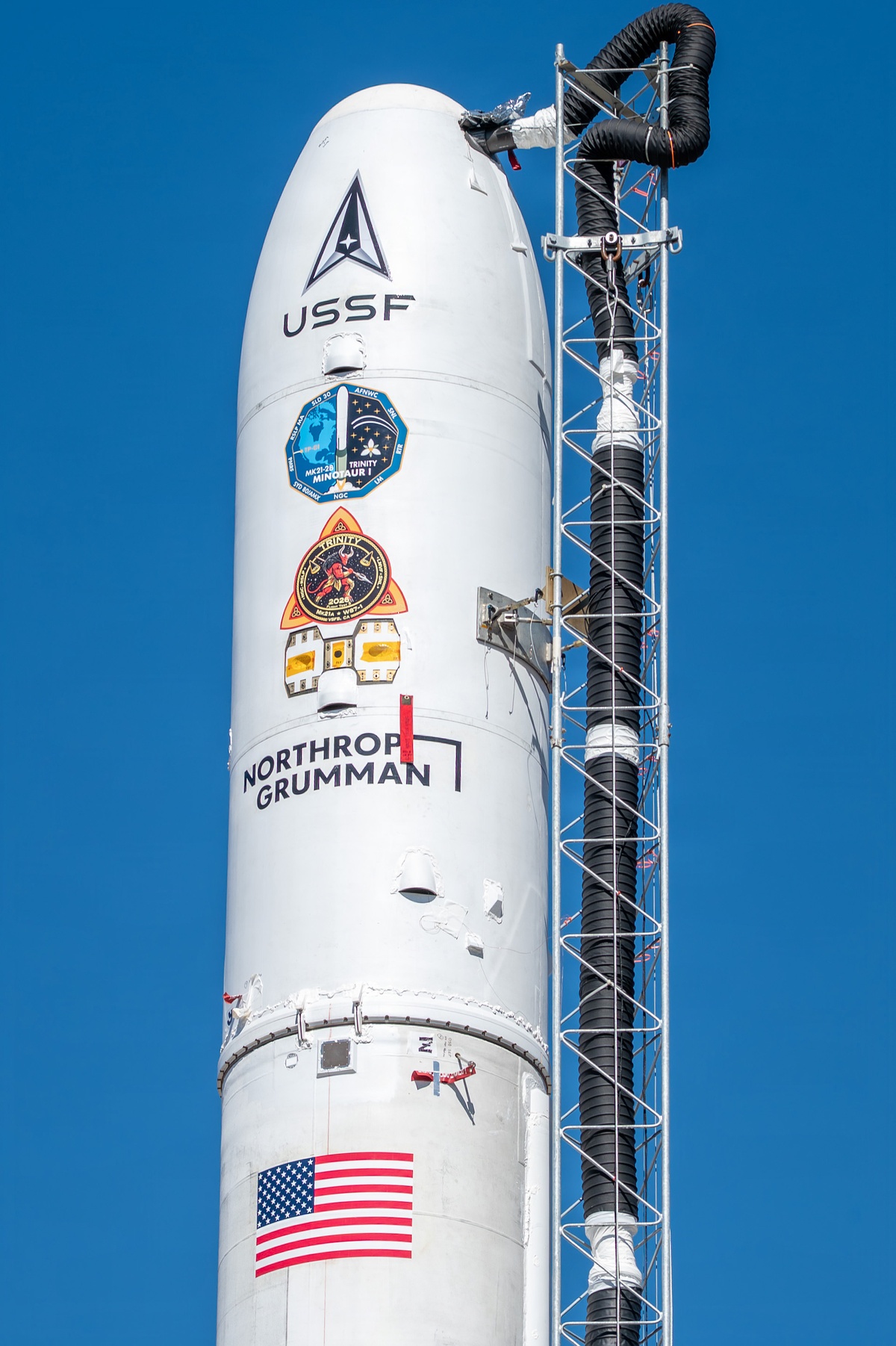
The U.S. Air Force’s October test of an unarmed Mk21A reentry vehicle added another flight-data point to development of the payload section planned for the Sentinel intercontinental ballistic missile. Lockheed Martin announced completion of the test on Nov. 4, while an Air Force Nuclear Weapons Center report says the vehicle launched from Vandenberg Space Force Base on Oct. 9 aboard a Minotaur I rocket. The release describes a developmental test, not an operational missile launch or a test carrying a nuclear warhead.
The distinction matters because Sentinel is a large, restructured acquisition program with unresolved cost and schedule risks. The reentry-vehicle flight is a piece of that effort: useful for engineering and test work, but not evidence that the full missile, its launch facilities, or its command systems are ready for deployment. The public accounts also provide few technical details about the test’s measured results.
An unarmed test vehicle launched from Vandenberg
The Air Force Nuclear Weapons Center’s account identifies the Oct. 9 flight as an in-flight environmental test supporting Mk21A development. It says the reentry vehicle was unarmed and launched on a Minotaur I supplied by Northrop Grumman, with the U.S. Space Force’s Rocket Systems Launch Program overseeing the launch. The Air Force report does not publish a detailed trajectory, telemetry package, or measurements from the flight.
Lockheed Martin, which is developing the Mk21A under contract, said the flight demonstrated maturity in the vehicle architecture and validated next-generation reentry technologies. The company said data from the test will inform design refinements and future tests as the program works toward a system-level critical design review. Those are the contractor’s characterization and stated next steps; the release does not provide underlying performance data for independent technical assessment.
Coverage by Air & Space Forces Magazine and Stars and Stripes places the launch in the wider Sentinel test program. Both describe an unarmed Mk21A flight from Vandenberg on Oct. 9. Air & Space Forces reported that it was the first publicly announced Mk21A test since June 2024; Stars and Stripes also noted the Air Force’s plan for a later test of a fully assembled Sentinel with an unarmed warhead.
What the Mk21A is designed to do
A reentry vehicle is the portion of a ballistic missile that carries its payload through the return from space toward the target area. Its design has to protect and deliver that payload through a demanding flight environment. The Mk21A is being developed for the future LGM-35A Sentinel system and is intended to carry the W87-1 warhead. The October vehicle was unarmed, and the public accounts do not describe the internal test instrumentation or the exact conditions it experienced.
The Air Force describes the Mk21A as a modernization of the existing Mk21 reentry vehicle. It is planned for the land-based leg of the U.S. nuclear triad, where Sentinel is intended to replace the Minuteman III. A reentry vehicle test can inform the design of that payload section, but it does not test every element needed for an operational ICBM. The Minotaur I launch vehicle used for the test is a test-launch platform, not the Sentinel missile.
Northrop Grumman’s Minotaur I was assembled from government-furnished rocket motors with modern avionics, according to the Air Force’s launch-program descriptions. The service uses the vehicle family for test payloads and technology demonstrations. That makes the launch a way to put a developmental article through a real flight environment without equating the booster with the operational system it is helping to test.
A component milestone inside a much larger program
Sentinel’s broader schedule remains a central constraint. The Government Accountability Office’s February 2026 assessment says the program is being restructured after a statutory cost-growth breach, with the first flight of the Sentinel missile then planned for March 2028. GAO also describes continuing uncertainty as the Air Force revises requirements, cost estimates, and program baselines. That assessment concerns the full missile and its infrastructure, rather than just the Mk21A.
That distinction is important when interpreting the November announcement. A flight test may reduce uncertainty about a component, provide data for design updates, and help prepare for later qualification work. It cannot by itself settle the costs and risks associated with Sentinel’s launch silos, launch control centers, software, manufacturing, or transition from the aging Minuteman III force. GAO’s report identifies those program-wide issues separately from the payload vehicle’s development.
There are also separate review and test milestones. Air & Space Forces Magazine corrected its initial report to clarify that the March 2027 critical design review is for the Mk21A, not for the entire Sentinel ICBM. Lockheed’s release likewise refers to a system-level CDR for the reentry vehicle. The announced review should therefore not be read as a full Sentinel design approval or as a declaration that the missile is ready for flight.
The Mk21A effort has its own contract history. Air & Space Forces reported that the Air Force awarded Lockheed a $996 million development contract in 2023 and added a $453 million modification in 2025. Lockheed describes the prime contract as worth more than $1 billion. These figures refer to the vehicle effort, not the cost of the complete Sentinel program, which GAO estimates at a far larger scale and says remains uncertain.
What the public record shows—and what it does not
The public record supports several concrete points: the Oct. 9 launch took place from Vandenberg; the vehicle was unarmed; Minotaur I provided the test launch; and the Air Force and Lockheed say the flight will contribute to continued development. The Lockheed statement calls the test a validation step, while the Air Force report frames it as an environmental flight test. Neither publishes detailed measurements that would allow readers to independently judge thermal loads, component performance, or how the results compare with program requirements.
That is not unusual for a defense test, but it limits what can responsibly be concluded from a short announcement. “Test completed” describes an event; it does not automatically establish that every objective was achieved, that a design is final, or that the broader program is on schedule. The useful next evidence will be the official description of follow-on test objectives, the Mk21A design review, and future reporting on the Sentinel program’s restructured baseline.
The next phase described by Lockheed is further design refinement and testing on the path to the Mk21A review. The Air Force’s eventual objective is a reentry vehicle integrated with Sentinel, but the full missile has a separate development and flight-test path. Tracking those milestones separately will make it easier to distinguish progress on the vehicle from progress on the entire weapon system.
Photo: Archival prelaunch photograph of the Minotaur I and unarmed Mk21A vehicle staged at Vandenberg on Oct. 5, four days before the test. U.S. Space Force photo by Airman 1st Class Ian Hawkes, DVIDS photo 10040980. Public domain (U.S. government work); see the DVIDS copyright and use notice. The appearance of U.S. Department of War visual information does not imply or constitute Department of War endorsement. The photograph shows the vehicle staged before launch; it is not an image of the flight itself.
Sources
- Lockheed Martin: “Completes Flight Test of Future Intercontinental Ballistic Missile System Reentry Vehicle” (Nov. 4, 2026)
- Air Force Nuclear Weapons Center via DVIDS: “Air Force tests unarmed ICBM reentry vehicle with Minotaur launch” (posted Nov. 12, 2026; reports the Oct. 9 test)
- Air & Space Forces Magazine: “Air Force Tests New Sentinel Reentry Vehicle” (Oct. 13, 2026; updated Oct. 16)
- Stars and Stripes: “Air Force successfully tests reentry vehicle for new Sentinel ICBM” (Oct. 16, 2026)
- U.S. Government Accountability Office: Sentinel and ICBM modernization risks (Feb. 18, 2026)
- DVIDS image record: Mk21A test vehicle staged at Vandenberg (Oct. 5, 2026)
- DVIDS copyright and use notice


No comment