
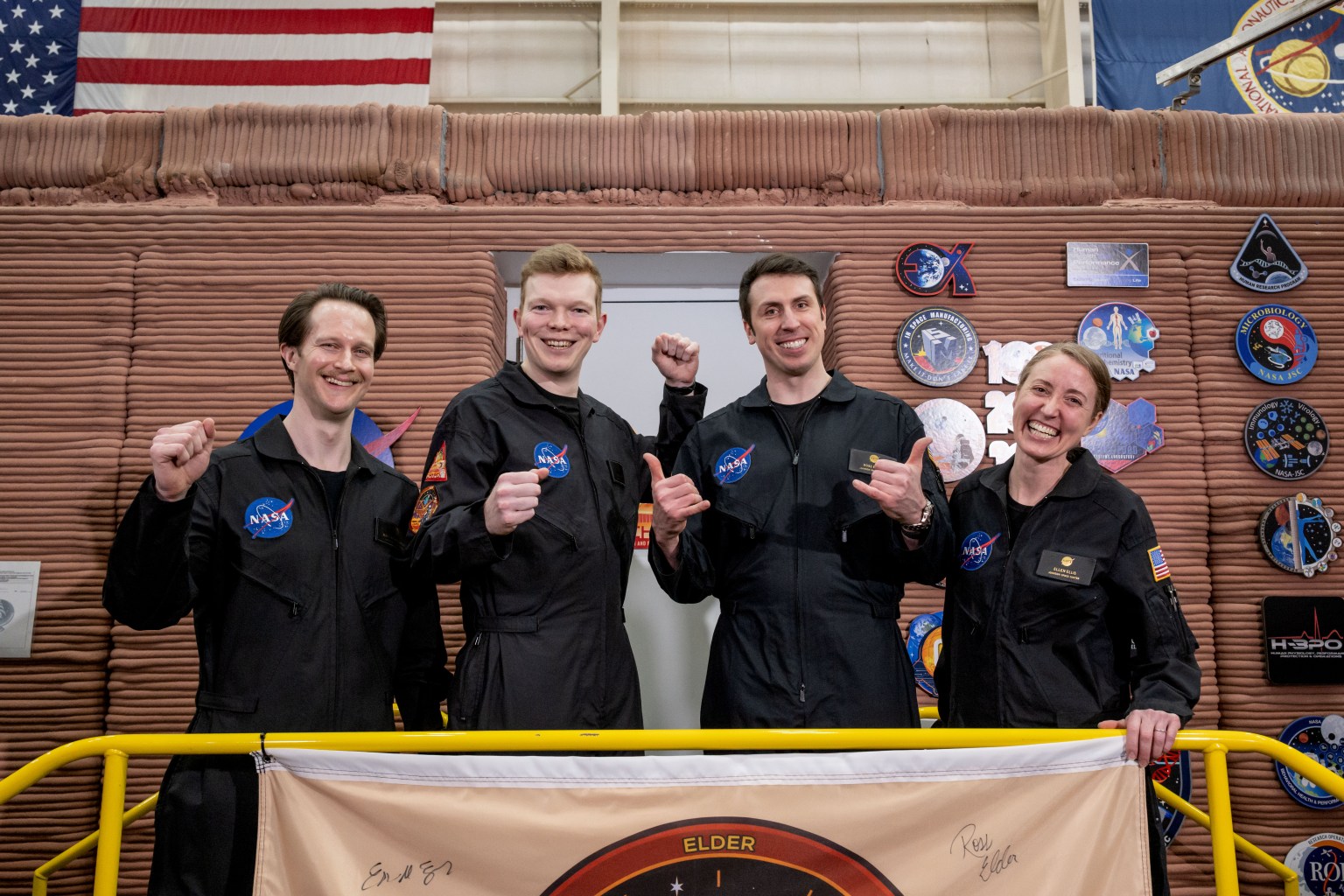
Four volunteers stepped out of NASA’s Mars Dune Alpha habitat on Oct. 31 after 378 days in isolation. Their exit marked the end of CHAPEA Mission 2, a yearlong ground simulation designed to study how people live and work under constraints that future planetary crews may face.
Ross Elder, Ellen Ellis, James Spicer, and Matthew Montgomery entered the roughly 1,700-square-foot habitat at Johnson Space Center in Houston on Oct. 19, 2025. During the mission they conducted simulated Mars walks, operated robotic systems, maintained the habitat, exercised, and cultivated crops while researchers collected health and performance data.
Daily operations under constraints
The simulation placed the crew in a carefully controlled environment. They worked with limited resources and communication delays of up to 22 minutes each way, reflecting the time it can take signals to travel between Earth and Mars. NASA says the crew’s data will help researchers assess how human health and performance respond to those conditions.
The work was practical as well as psychological. Crew members prepared for outdoor excursions through an airlock, completed long traverses in simulated suits, monitored food and water, and maintained systems inside the habitat. They also remotely operated a drone and rover to survey terrain and identify or collect rock samples.
That combination of routine and unexpected work is central to the study. A distant crew cannot depend on immediate help from Earth. Mission planners need to understand how much time tasks require, which supplies become critical, how teams make decisions, and what support keeps people healthy over long periods.
Four backgrounds, one small team
The crew brought different technical and operational experience. Elder, a U.S. Air Force experimental test pilot, led the mission and compared some of the Marswalk and robotic tasks to operating as part of a flight crew. Ellis, a U.S. Space Force officer and medical officer, organized biological sample collection and health research. Spicer applied experience in satellite communications and spacecraft development to habitat maintenance. Montgomery, a science officer with experience in engineering and indoor agriculture, worked on rock samples, 3D printing, and a seed-germination experiment.
NASA’s account of the mission emphasizes the value of the group’s combined skills. A future exploration crew will have to solve problems with the equipment and people available, while relying on a ground team that can provide guidance from far away. The simulation gives NASA a way to study those interactions before astronauts travel beyond low Earth orbit.
The study is an analog, not a trip to Mars. The habitat is on Earth and does not reproduce the planet’s gravity, radiation, or every environmental hazard. Its value lies in testing human routines, resource limits, team dynamics, and operational procedures in a controlled setting.
Data for Moon and Mars planning
After the crew’s exit, NASA planned two weeks of evaluations and debriefings to interpret the collected measurements alongside the participants’ experiences. Researchers will compare the results with the first CHAPEA mission, which ended in July 2024.
The findings can inform how NASA schedules work, supports crew health, plans food and water systems, and allocates communication time for future missions. NASA says the data will also support planning for the agency’s Moon Base effort, where astronauts will need to live and work for extended periods near the lunar South Pole.
For the four volunteers, the first step outdoors after more than a year inside was a public milestone. For NASA, the exit closed one experiment and opened the next phase: studying what the crew experienced, translating those lessons into mission plans, and refining the systems that will support people farther from Earth.
Source: NASA, “CHAPEA Mission 2 Crew Reflects After 378 Days on Simulated Mars,” Nov. 9, 2026. Read the full NASA article.





No comment