
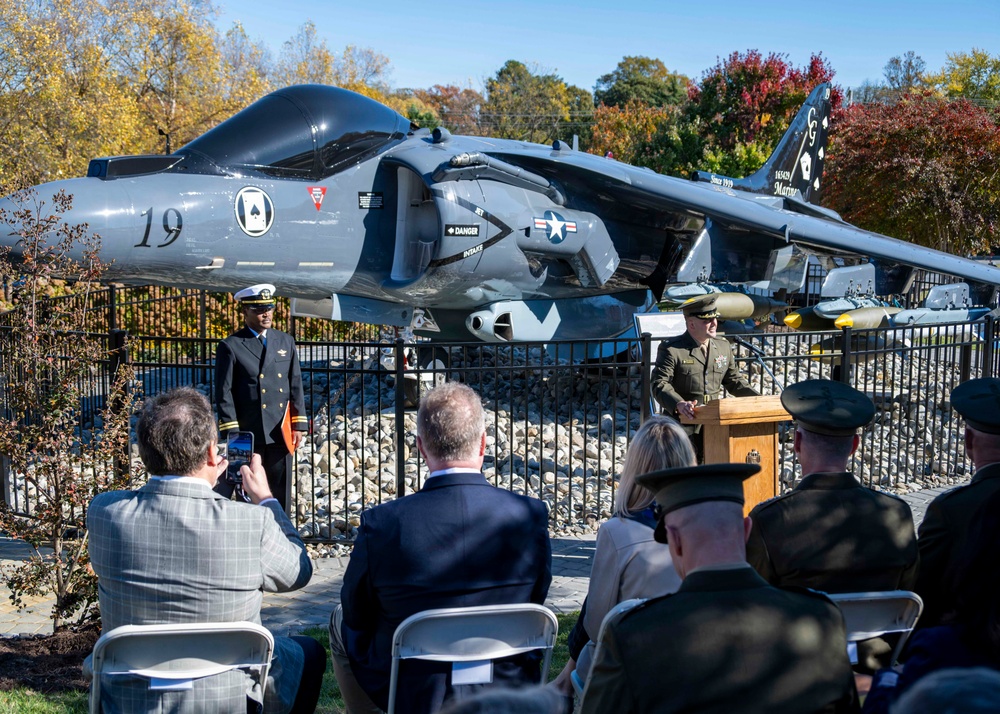
A retired AV-8B Harrier II now stands outside Navy-Marine Corps Memorial Stadium in Annapolis, Maryland, where the U.S. Naval Academy and Marine Corps dedicated the aircraft to generations of Marine aviators. The display places a recognizable piece of Marine aviation history near the site where the service’s flying story began.
The decommissioned aircraft, formerly assigned to Marine Attack Squadron 231, was permanently installed at the stadium in a ceremony reported by the Naval Academy on Nov. 12. Senior Marine Corps leaders, Academy officials, and aviation veterans attended. The ceremony included a flyover by F-35B Lightning II aircraft from Marine Fighter Attack Squadron 231 at Marine Corps Air Station Cherry Point, North Carolina.
A Harrier with a place in the story
The AV-8B is best known for its ability to take off from short runways and land vertically, a capability that shaped how Marine aviation could support forces operating from ships and austere locations. The aircraft’s service connected generations of pilots, maintainers, and ordnance crews who kept it ready and employed it in operational settings.
At the dedication, Assistant Commandant of the Marine Corps Gen. Bradford Gering described the display as a tribute to the people behind the aircraft: the designers and developers, the pilots who flew it, the maintainers who sustained it, the ordnance crews who armed it, and the leaders who committed it to missions.
The Harrier’s story is also tied to the Naval Academy’s location. In 1912, First Lt. Alfred A. Cunningham reported for aviation duty at Greenbury Point, across the Severn River from Annapolis. He became Naval Aviator No. 5 and the first Marine to earn his wings. The new display stands roughly four miles from that historic site.
From early experiments to a modern flyover
The dedication connected that early chapter to the current force. In addition to the F-35B formation at the ceremony, Marine Corps aircraft took part in flyovers during the Navy–Temple football game. The lineup included UH-1Y Venom helicopters, MV-22B Ospreys, and CH-53E Super Stallions.
Those aircraft represent different jobs within Marine aviation: fighter attack, utility transport, tiltrotor lift, and heavy-lift helicopter operations. Seen together, they offered a snapshot of the force that followed the Harrier and of the range of aircraft used to move, protect, and support Marines.
For midshipmen, the Harrier is more than a retired airframe. It is a reminder that aviation capability depends on people and institutions as much as on design. The aircraft’s presence at the stadium makes that history part of everyday life at the Academy, while the flyover brought active Marine aviation directly to the community gathered there.
The display also gives the Academy a physical link to Cunningham and the earliest days of Marine flight. More than a century after he reported to Greenbury Point, the Harrier marks a visible line from those first aviation experiments to the aircraft and crews serving today.
Source: U.S. Naval Academy, “Academy Dedicates Harrier Jet at Stadium to Honor Marine Aviators,” Nov. 12, 2026; released through DVIDS. Read the full release.


No comment