
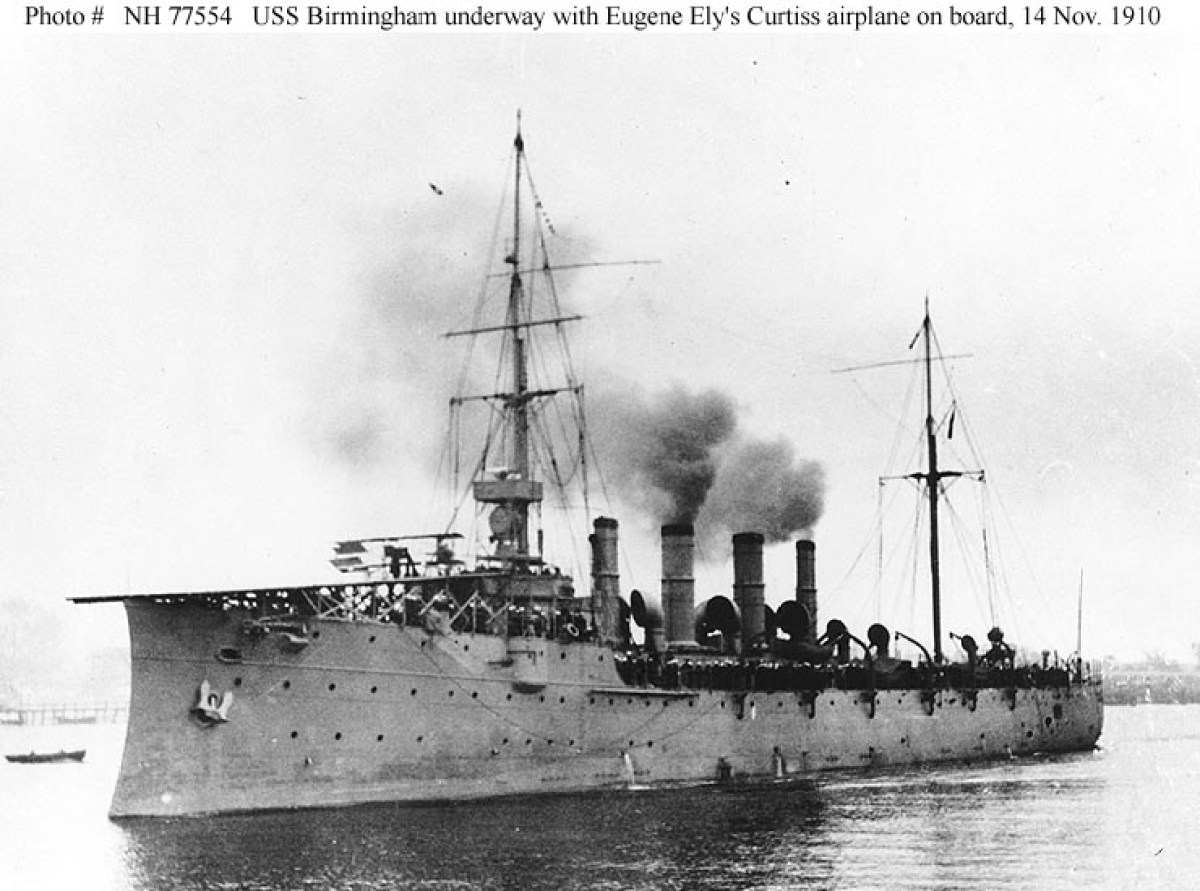
On November 14, 1910, civilian pilot Eugene B. Ely took a Curtiss pusher biplane off a temporary wooden platform built over the bow of the cruiser USS Birmingham. The flight lasted only a few minutes and ended on a nearby beach, but it demonstrated that an airplane could be launched from a warship—an idea that would reshape naval aviation.
The experiment took place in Hampton Roads, Virginia. A platform was fitted to Birmingham’s forecastle so Ely’s aircraft could gather speed before reaching the ship’s bow. The U.S. Naval History and Heritage Command describes the takeoff as the first airplane launch from a warship. A National Archives account preserves photographs and details of the experiment, including the biplane positioned aboard the cruiser before it left the Norfolk Navy Yard.
A pilot, a platform, and an uncertain launch
Ely was a professional exhibition pilot working with aircraft pioneer Glenn Curtiss. The Navy was interested in whether airplanes could help ships scout over the horizon, but launching an aircraft from a moving or stationary ship was unproven. At the time, aircraft were fragile, slow and dependent on open ground for takeoff and landing. A ship offered a narrow, unstable surface surrounded by water.
The wooden platform gave Ely a short runway above the bow. Contemporary photographs show the Curtiss pusher biplane secured on deck as sailors and shipyard workers prepared the experiment. The aircraft used a rear-mounted propeller and an open framework typical of early flying machines. It had none of the enclosed cockpits, powered controls or paved runways that later became standard in aviation.
On the afternoon of November 14, Birmingham proceeded into Hampton Roads. Ely accelerated along the platform and cleared the ship. The aircraft briefly touched the water, damaging the propeller tips, but Ely recovered and continued to shore. The National Archives and Navy histories describe the event as a successful takeoff from a ship, even though the flight did not end with a landing back aboard.
Why the first takeoff mattered
The demonstration did not immediately create an aircraft carrier. It answered one specific question: a fixed-wing airplane could leave a warship. Ely’s next major test addressed the other half of the problem. On January 18, 1911, he landed on a platform aboard USS Pennsylvania in San Francisco Bay. That platform used arresting gear—ropes connected to sandbags—to slow the aircraft after touchdown.
Taken together, the two experiments helped naval officers imagine ships as both launch and recovery platforms. The Navy began formal flight training soon afterward, and the converted collier USS Langley entered service as the first U.S. aircraft carrier in 1922. Later carrier aviation would depend on machinery and procedures far more advanced than Ely’s wooden ramp, but the essential problem was already visible: how to move an airplane safely between ship and sky.
Ely’s contribution was a demonstration, not a complete operating system. Weather, limited visibility, short range and the need to land ashore remained practical barriers. Still, the test gave naval planners a real flight to study instead of a theoretical proposal. The risk was shared by the pilot, the ship’s crew and the engineers who built the platform.
A milestone remembered in photographs
The surviving photographs are valuable because they show the experiment as an engineering project. They record the ship, the temporary runway and the aircraft before the launch. The archival image used here depicts the Curtiss biplane aboard Birmingham before Ely’s flight; it is not a photograph of the airplane in the air.
More than a century later, carrier aviation is a complex system of aircraft, deck crews, launch equipment, recovery cables and flight-control procedures. Its early history began with simpler trials that tested what ships and airplanes might do together. Ely’s November 1910 takeoff was one of those decisive first steps.
Image: National Archives photograph via the U.S. National Archives’ Text Message blog. Archival image from November 14, 1910.

No comment