
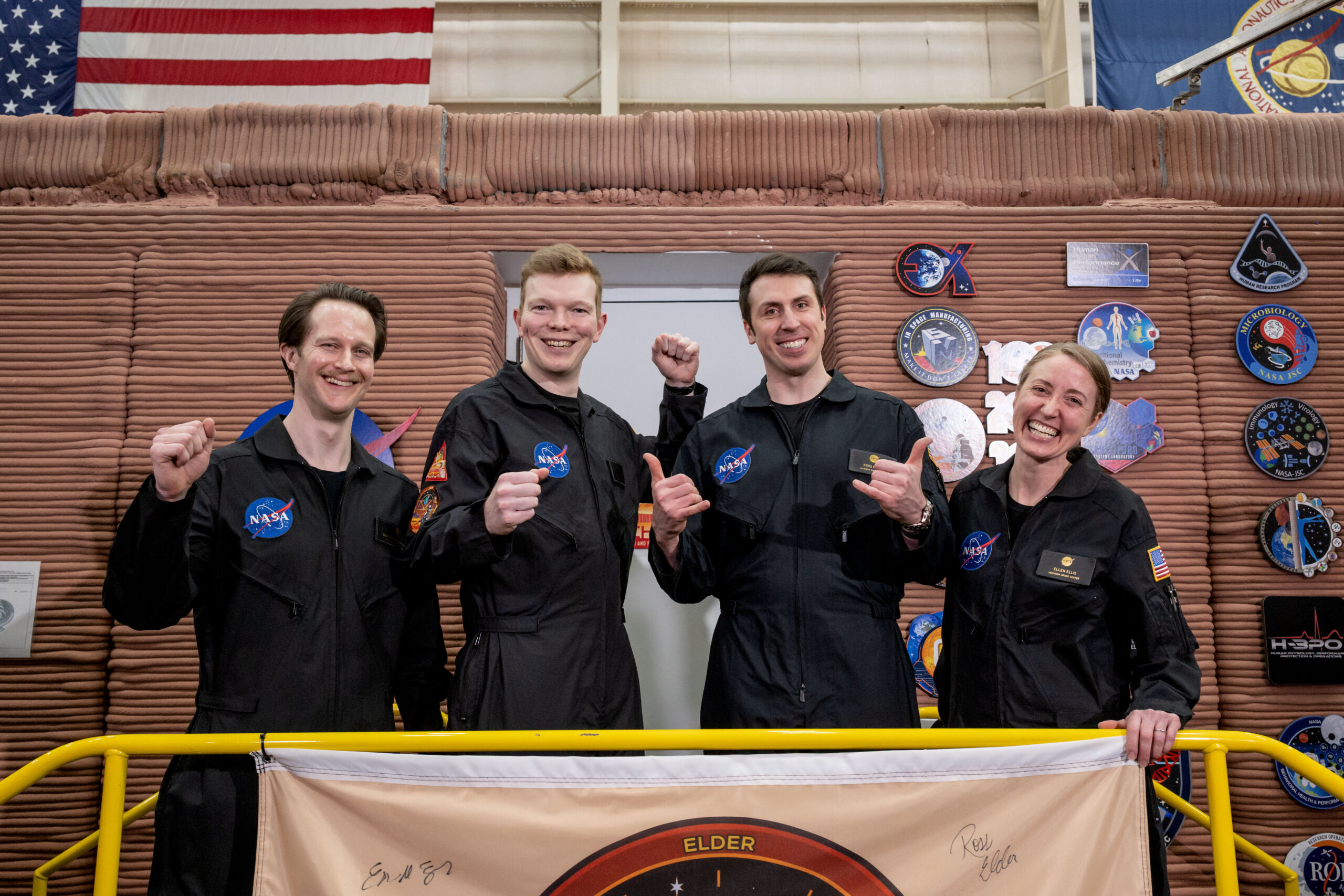
Photo: The CHAPEA Mission 2 crew celebrates at egress, Oct. 31, 2026, NASA Johnson Space Center. Credit: NASA/James Blair
Pilots know the feeling of climbing out of a cockpit after a long sortie: stiff legs, a squint at the daylight, and a crew you trust more than you did that morning. Now imagine that sortie lasting 378 days.
That is roughly what four NASA research volunteers just finished. On Oct. 31, 2026, Ross Elder, Ellen Ellis, James Spicer and Matthew Montgomery stepped out of Mars Dune Alpha, a roughly 1,700-square-foot, 3D-printed habitat at NASA’s Johnson Space Center in Houston, completing the agency’s second yearlong Mars surface simulation. NASA shared the crew’s reflections on the mission on Nov. 9.
At Skylord, we are drawn to this story for a simple reason: the commander is a test pilot, and the lessons the crew brought out of that habitat sound a lot like the lessons every good flight crew already lives by.
A year without windows
The mission is called CHAPEA, short for Crew Health and Performance Exploration Analog. Mission 2 began on Oct. 19, 2025, and for the next 378 days the crew lived without windows, without the sounds of the outside world and without real-time calls to family and friends. Messages to and from “Earth” were delayed by up to 22 minutes each way, the kind of lag a real Mars crew would face.
Inside, the crew ran simulated Marswalks, robotic operations, habitat maintenance, exercise and crop cultivation. They worked with limited resources while researchers across NASA collected data on their health and performance.
To put the length of the stay in perspective, NASA astronaut Jack Hathaway pointed out that while the crew was inside, he flew a 237-day mission aboard the International Space Station and came home. During the same stretch, the Artemis II astronauts flew around the Moon and set the record for the farthest humans have traveled from Earth.
“The reality of what you guys did here required immense physiological and psychological strength, teamwork, and human grit,” Hathaway told the crew.
A test pilot in command
Commander Ross Elder brought a U.S. Air Force experimental test pilot’s approach to leading the crew. According to NASA, he found simulated Marswalks and robotic exploration “uncannily similar” to operating as part of a flight. From inside the habitat, the crew remotely flew a drone and drove a rover to survey terrain and identify or collect rock samples.
The Marswalk schedule was demanding. Preparing suits, working through airlock procedures and making long traverses all took time and stamina, and Elder came away emphasizing nutrition, exercise and rest as essential to keeping up that pace. Any pilot who has flown a long day of back-to-back sorties will recognize the point.
“The real magic has been the privilege and pleasure of seeing everyone come together,” Elder said.
The rest of the crew
Medical officer Ellen Ellis is a U.S. Space Force officer with experience at the National Reconnaissance Office. She helped organize biological sample collections and prepare supplies for the crew’s health research. She said she rarely felt isolated because she had three teammates to rely on every day, and she credited the specialists on the ground for their support. “A future Mars crew requires a highly integrated ground team,” she said.
Flight engineer James Spicer, who has a background in satellite communications and spacecraft development, kept the habitat’s systems running. He compared the year to life aboard a submarine or a boat, with the crew tracking consumables from dish soap to respirator filters and carefully managing food and water.
Science officer Matthew Montgomery brought experience in hardware engineering, robotics, technology startups and independent film. He helped identify rock samples, set up the habitat’s 3D printing capability, and ran a seed-germination experiment using a control and simulated Martian soil. “It’s really the people that make exploration possible,” he said.
Why it matters
Spacecraft get tested on the ground long before they fly. CHAPEA does the same for the people. The study builds on the first CHAPEA mission, which ended July 6, 2024, and two weeks of post-mission evaluations and debriefs will help researchers interpret the new data alongside the crew’s own experiences.
CHAPEA principal investigator Grace Douglas said the research will help NASA weigh human health and performance risks against resources such as crew time, communication capacity, and food and water system designs. Project scientist Sara Whiting noted the data arrives as NASA plans how astronauts will live and work at the Moon Base near the lunar South Pole.
“This is really the now moment for this kind of data,” Whiting said.
For those of us who love aviation, there is something familiar in all of it. Long before anyone flies to Mars, the work looks a lot like flight test: careful procedures, honest reporting when something doesn’t look right, and a crew that keeps each other going. Montgomery described learning to speak up whenever something gave him pause, a habit that helped catch concerns with equipment, safety and data quality. That is good airmanship on any planet.
Share your story with Skylord Magazine
Do you have an aviation or space story we should be covering, or have you been part of a mission, a flight test or a crew like this one? Skylord Magazine would love to hear your tips and talk with you for a future article.
Sources
- NASA, “CHAPEA Mission 2 Crew Reflects After 378 Days on Simulated Mars,” Sumer Loggins, Nov. 9, 2026: https://www.nasa.gov/centers-and-facilities/johnson/chapea-mission-2-crew-reflects-after-378-days-on-simulated-mars/
- NASA, Crew Health and Performance Exploration Analog (CHAPEA): https://www.nasa.gov/humans-in-space/chapea/




No comment