

By Skylord Magazine
The next chapter of lunar exploration is as much a transportation story as a destination story. NASA’s Nov. 7 announcement at the MAX POWER aerospace expo and air show at Kennedy Space Center in Florida brought together cargo deliveries, a nuclear-powered rover, orbital transfer vehicles and the power and communications equipment needed to support operations on the Moon.
For Space Coast readers, the announcement connects a local aerospace gathering with a much longer journey. The release outlines how equipment could move from Earth to lunar orbit and finally to the surface, while robotic missions gather information before astronauts arrive. These are awards and development plans, not completed deliveries or an operational lunar settlement.
A larger network for lunar cargo
NASA selected eight companies for the next phase of its Commercial Lunar Payload Services initiative. Blue Origin, Firefly Aerospace, Intuitive Machines, ispace-U.S., Lockheed Martin Space, Northrop Grumman Space Systems, SpaceX and Voyager Technologies are eligible to compete for future surface delivery missions under CLPS 2.
The distinction matters: eligibility under a multiple-award framework is not the same as receiving every future mission. The companies will compete to provide services that include managing, building and operating landers carrying science, technology and infrastructure payloads. NASA describes CLPS 2 as a 10-year framework with a combined maximum value of $10 billion. That ceiling should not be confused with money already spent on deliveries.
PROMISE would bring Mars-rover experience to the Moon
One of the most distinctive pieces of the update is PROMISE, short for Polar Rover for Observation, Mapping, and In-Situ Exploration. NASA is moving forward with development of the six-wheeled, nuclear-powered rover to examine the surface and subsurface near the lunar South Pole.
The Jet Propulsion Laboratory will manage the mission and build the rover using a combination of spare flight components and engineering test models from the Curiosity and Perseverance Mars rover programs. NASA says it has assessed the hardware’s compatibility with the lunar environment. Reusing proven components and operating approaches is intended to shorten integration and testing, rather than starting every element from scratch.
The planned instrument package includes a drill able to investigate material approximately one meter below the surface, spectrometers, temperature and radiation sensors, and visible-light cameras. The rover also would demonstrate a radiation-tolerant computing system and advanced autonomy technology. Nuclear power is intended to support operation during long lunar nights and inside permanently shadowed regions, where ice may be present.
NASA is targeting a late-2028 launch and planning an 18-month mission. Those remain targets, not a guarantee of launch or arrival. Blue Origin received a base contract to deliver PROMISE using its Mark 1 lander, with an additional option tied to performance.
Getting cargo beyond Earth orbit
A lunar lander handles the final descent, but equipment must first reach the right place in space. NASA’s update includes six task orders under its Venture-Class Acquisition of Dedicated and Rideshare launch services contract, awarded to Arrow Science and Technology, Blue Origin and Impulse Space for integrating and transporting Moon Base cargo.
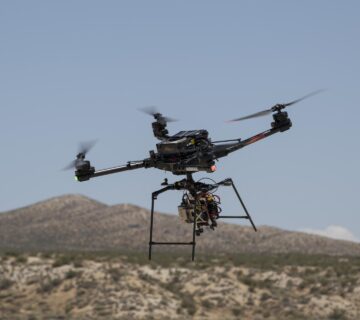
The planned missions cover navigation and communications demonstrations, orbital transfer operations, and robotic scouting. One category includes CAPSTONE 02 for deep-space navigation and proximity operations. Another would send highly mobile MoonFall drones to survey terrain beyond the reach of conventional rovers. These demonstrations are intended to reduce uncertainty before later exploration activities, not to replace the need for landing and surface testing.
A base also needs everyday utilities
Less dramatic than a landing, but just as important to the overall plan, is miniCAST: a Mini-Communications and Solar Tower combining power and communications capabilities. The announcement identifies work on energy storage, power generation and wireless power transfer, with assembly and testing at NASA’s Marshall Space Flight Center.
The initial effort concerns components rather than a large integrated installation. That is an important boundary when interpreting the announcement: selecting suppliers and testing hardware are steps toward infrastructure, not evidence that the infrastructure is already standing on the Moon.
Skylord’s takeaway is the connection between these pieces. Cargo access, surface mobility, navigation, power and communications have to work as a system. The Kennedy announcement offers a clearer view of that intended system, while leaving the real test where aviation and space projects ultimately earn their credibility: in hardware testing and flight.
Photo: NASA/Bill Anders. Archival Earthrise photograph taken aboard Apollo 8 on Dec. 24, 1968; it does not depict the proposed Moon Base.
Sources
- NASA: NASA Awards Moon Base Transportation, Technology, Science Projects, Nov. 7, 2026 — source for the awards, program details and mission targets above.
- NASA: Earthrise by NASA Astronaut Bill Anders — photograph identification and credit.
- NASA Images and Media Usage Guidelines — editorial image-use terms.


No comment